The best accounts receivable software for debt collection agencies in 2026 is Paidnice, for an agency on Xero or QuickBooks Online that needs different late fee and reminder rules for contingency clients and retainer clients.
Chaser, Kolleno, Upflow and Quadient AR complete the five, compared on whether the tool applies a late fee itself and whether that rule can vary by client. Published entry prices start at £49 (US$69) a month.
| Tool | Best for |
|---|---|
| Paidnice | An agency on Xero or QuickBooks Online that wants different fee and reminder rules for contingency clients and retainer clients |
| Chaser | An agency with a named credit controller that wants a Creditsafe check before a new mandate and posted letters, Compact for revenue under £4m |
| Kolleno | A high-volume agency where allocating bulk client remittances is the bottleneck |
| Upflow | An agency that wants to measure and report its own collections by metric, such as DSO |
| Quadient AR | An enterprise agency billing several trading entities out of NetSuite, Sage Intacct or SAP |
An agency that recovers money for a living still has to collect its own commissions, success fees and retainers.
An agency waits in two stages that no benchmark measures. First for the debtor to pay the client, then for the client to reconcile and remit before the commission can even be invoiced.
The Xero Small Business Insights baseline covers only the second stage: 29.7 days to be paid across US small businesses and 8.6 days past due. Add the first stage and the real figure is longer than anything on this chart.
The one debtor a collection agency will not chase
An agency owns letters, diallers and phone scripts, and points every one of them at somebody else's debtors for a living. It can point none of them at the client whose ledger it works, because that client is the revenue.
That single constraint shapes everything below it. The commission invoice, the success fee and the monthly retainer are the only receivables in the business that cannot be chased the way the business chases receivables.
A collector who would put a debtor on a five-step ladder without hesitating will let a client fee note run to 70 days rather than raise it at a review meeting, because the relationship being protected is worth more than the invoice being chased.
What fixes it is a rule that runs without anybody deciding. A reminder that goes out on day 7 because the policy says day 7 carries no personal decision and no implied accusation, and a charge that appears because the client agreement says it appears is a term of business rather than an escalation.
How this list was put together
This list helps a debt collection agency chase its own commission and fee invoices, the ones raised in Xero, QuickBooks Online or an ERP.
| What we checked | Where the evidence came from |
|---|---|
| Late fee grain, and whether the rule can vary by client | Vendor help pages on fees and interest |
| Reminder grain | Vendor workflow documentation |
| Cash application for bulk client remittances | Vendor product pages, with "Not documented" where a vendor publishes nothing |
| Statements and payment plans | Vendor feature pages |
| Published from-price and revenue fit | Vendor pricing pages |
| Rating and review count | The Xero App Store or G2 |
Collection agency AR software compared: the table
 |
 |
 |
 |
 |
|
|---|---|---|---|---|---|
| Best for | Xero or QuickBooks Online agency with contingency and retainer clients | Agency wanting a Creditsafe check before a new mandate | High-volume agency reconciling bulk client remittances | Agency measuring its own DSO by account manager | National agency billing many entities out of an ERP |
| Revenue fit | Any size up to $50m a year, or 50,000 invoices a year | Compact under £4m, Core from £4m, Complete to £100m | Under £1m on BusinessPay, with tiers stepping at £1m, £100m and £1bn | Gross invoice value tiers, up to $10m through above $100m | Not published |
| From (monthly) | $69 | £199 | $650 per user | Not published | Not published |
| Ledger integrations | Xero, QuickBooks Online and newer ledgers such as Rillet and Campfire (closed testing) on every plan; Sage Accounting and other ERPs on Custom | Xero, QuickBooks, Sage, NetSuite, Dynamics 365 Business Central | NetSuite, SAP, Sage Intacct, Business Central, Workday, Xero, QuickBooks Online | Xero, QuickBooks Online, NetSuite, Sage Intacct, Stripe Billing, Chargebee, Zuora | NetSuite, Sage Intacct, Sage 300 and X3, Dynamics, SAP, Acumatica, Xero, QuickBooks |
| Late fee grain | Yes (per customer group) | Yes (one set of late-fee rules, not tied to schedules) | None found | No (via your ERP only) | None found |
| Reminder grain | Per customer group | Per schedule, several schedules at once | Per workflow, with conditional branches and run-hour limits | Per workflow, sending once a day on business days | Per rule, from one shared AR mailbox |
| Statements | Yes (any schedule) | Yes (monthly, fixed day) | Yes (in the portal) | Portal PDF statement, no scheduled send | Yes (in the portal) |
| Payment plans | Yes (on Pro) | Yes | Yes | No | Limited (recurring amounts only) |
| Cash application | Not documented | Not documented | Yes, from Enterprise (remittance parsing and bank files) | Cash Application Agent on Accelerate and above | Yes (dedicated module) |
| AI | Advanced Reads customer replies, drafts answers and follow-up actions (like PO updates) for your approval; MCP server for Claude, ChatGPT and other agents | Advanced Insights, Copilot drafts and an autonomous Agent; AI agent support from Business Plus, fully automated agent runs and AP portal features billed separately by token use | Advanced Collections and cash application agents, from suggest-only to autonomous (Collections Agent from Scale, Cash Application Agent from Accelerate) | Basic Payment prediction, prioritisation, a cash assistant and an agent that reads inbound AR emails and prepares suggested actions for review | |
| Rated (source, count) | 5.0 (84, Xero App Store) | 4.98 (374, Xero App Store) | 4.9 (117, G2) | 4.8 (235, G2) | 4.4 (156, G2) |
Cash application is the row where "Not documented" bites on this page: two of the five publish nothing that confirms it either way, and it is the capability an agency reconciling client remittances most needs an answer on.
The five tools in five checked facts
- All five connect to both Xero and QuickBooks Online.
- AI that handles collections work or customer replies: Paidnice, Upflow and Kolleno.
"Not published": the vendor puts no price in public. "None found": nothing was found in either direction. The prices are the vendors' own from-prices.
1. Paidnice, best for Xero or QuickBooks Online
Best for: Collection agencies on Xero or QuickBooks Online.
Any size up to $50m a year, or 50,000 invoices a year
What is Paidnice best for?
For a collection agency that wants reminder tone, late fee and statement schedule set per client group, so a contingency client and a slow retainer client are chased on different rules.
- Fits
- Collection agencies on Xero or QuickBooks Online of any size up to $50m a year, or 50,000 invoices a year, with or without a dedicated finance hire
- Regions
- United States, United Kingdom, Australia, New Zealand, Canada, South Africa
- Entry cost
- £49 (US$69) a month on Essentials, covering 150 invoices, 600 emails and up to 2 team members; Pro from £74 (US$99) a month with unlimited users and no per-seat fee. Check current pricing with the vendor.
- Rated
- 5.0 from 84 Xero App Store reviews; 4.9 from 14 on Capterra
- Awards
- Xero Global Small Business App of the Year 2025 and NZ Small Business App of the Year 2026
- Runs on
- Xero, QuickBooks Online, Stripe, Pinch Payments, CloudDepot, HubSpot, Pipedrive, Zapier. NetSuite, Sage Intacct, MYOB and Dynamics 365 Business Central on the Custom plan only
- Late fees and interest
- Yes. Two charge types available on the same customer group, an invoice late fee and a statement interest charge, both raised on the client's ledger as Draft or Approved. Compounding is on by default
Paidnice adds charging and cadence to Xero or QuickBooks Online, with reminder sequences, statement schedules, installment plans (on Pro), a payer portal and the fee policy all attached to a customer group. For an agency the sending domain is worth a second look.
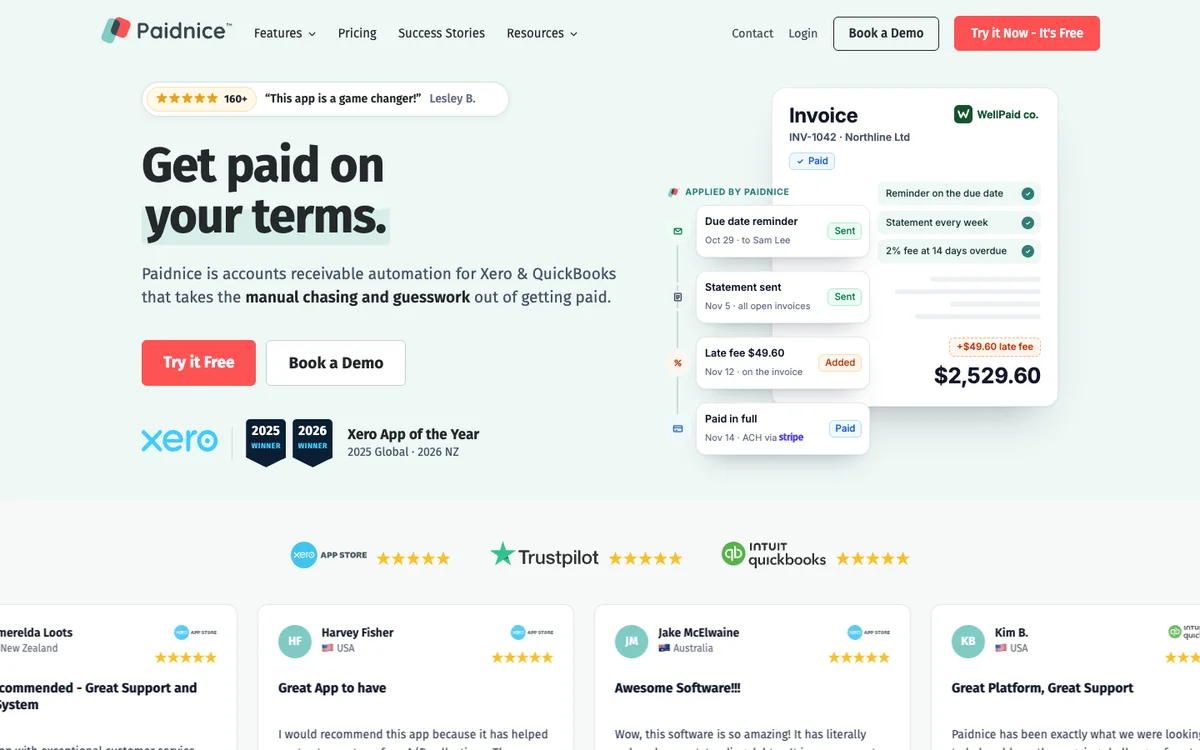
Reminders leave from the agency's own authenticated domain on Pro, so the chase for a commission invoice arrives from the accounts address rather than from anything resembling the collections work the agency does in its clients' names.
A contingency client whose fee only exists once a recovery lands, a retainer client billed on the first of the month, and a client arguing about a fee note are three unrelated chasing problems that happen to share a ledger, and policies sitting under customer groups let all three run their own rule simultaneously.
A disputed fee note is filtered out by invoice reference, so the client stays in its group while the argued line stops being chased.
The charge is computed net of credits on the account, which matters constantly here because the client's share of a recovery is often already netted off, and statement interest is recalculated as the statement leaves rather than at the last policy run.
Limitations with Paidnice. Xero and QuickBooks Online are on every plan. Newer ledgers such as Rillet, Campfire, Digits, DualEntry, Puzzle, Accounting Seed and Odoo are available on every plan through Paidnice's closed testing program. Sage Accounting and other ERPs connect on the Custom plan. An agency raising fee notes out of its case management platform has to land those invoices in one of these ledgers before any of this applies.
NetSuite, Sage Intacct, MYOB and Dynamics 365 Business Central are a Custom-plan build rather than a standard connector, and a few payment features differ between Xero and QuickBooks Online. Essentials covers two team members.
There is no cash application here, which is the material gap for this buyer: a client remitting six recoveries in one transfer still has to be allocated manually in the ledger before the chasing knows what is outstanding.
And on the rating criterion the 5.0 from 84 above is beaten by Chaser's 4.98 from 374, because that is the larger verified base.
Prefer to watch? Here is the video version of this review.
2. Chaser, best for a named credit controller
Best for: Agencies with a named credit controller.
Compact under £4m of revenue
What is Chaser best for?
For an agency finance lead who wants email, SMS, letters and recorded calls in one schedule, plus a Creditsafe check on a new client before fee terms are agreed.
- Fits
- Agencies with a named credit controller; Compact is for revenue under £4m, Core from £4m, and Complete runs to £100m
- Regions
- UK-registered, trading since 2014, sells worldwide
- Entry cost
- £199/mo on Compact for revenue under £4m with 4 users; Core £599/mo under £10m; Complete £899/mo to £100m.
- Rated
- 4.98 from 374 Xero App Store reviews; 4.3 from 71 on G2; 4.9 from 45 on Capterra
- Awards
- Finalist, UK Small Business App Partner of the Year, Xero Awards 2023
- Runs on
- Xero, QuickBooks, Sage 50, Sage 200, Sage Intacct, Sage Business Cloud Accounting, NetSuite, Dynamics 365 Business Central, AccountsIQ, SAP, HubSpot, Gmail, Outlook
- Late fees and interest
- Yes. Four calculation types, recalculated daily, but one set of late-fee rules, across the account or for selected debtors, not tied to schedules. No fee is raised on payment-plan invoices, and Chaser's help says a late fee cannot be added or updated after a part payment when written to Xero
- Customers
- Named on its website: Pact Coffee, Huttie and TaxAssist. Huttie's case study reports £15,000 of old debt recovered.
Chaser has traded since 2014 and sends from the team's own Gmail or Outlook mailbox, with SMS, letters, a payer portal and partner collections behind it.
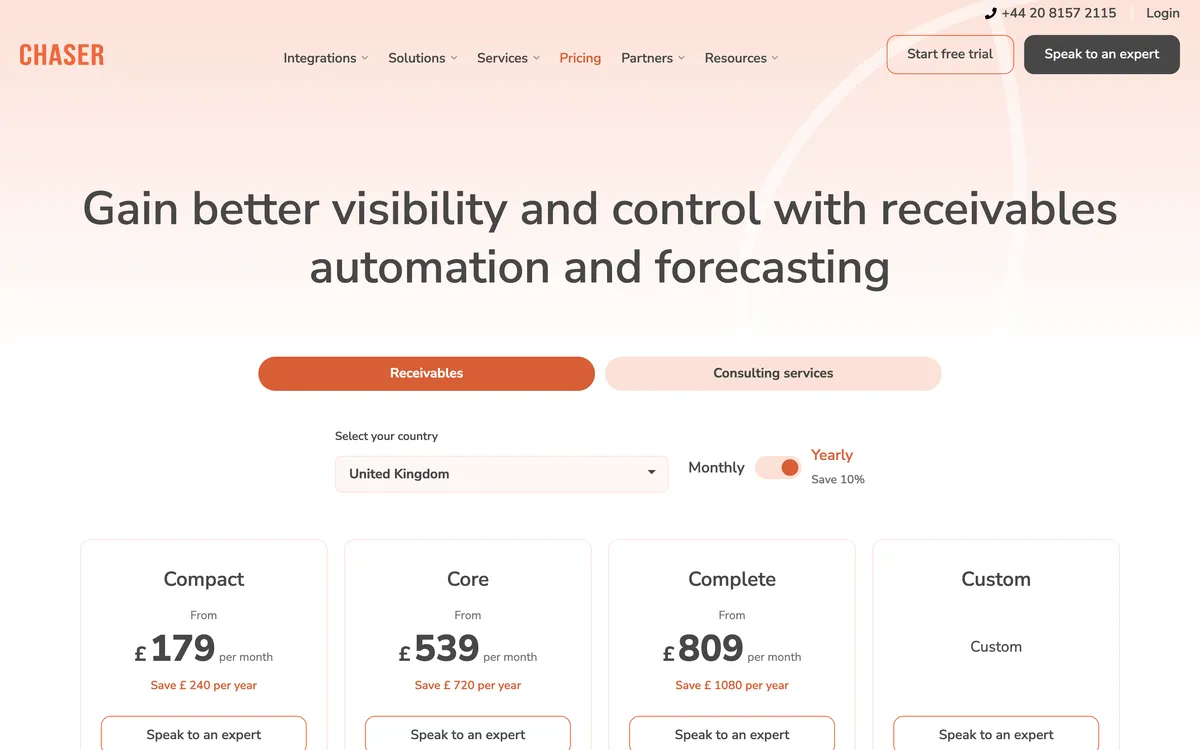
The Creditsafe report inside it carries a score, a recommended limit, the payment score, credit event history, Companies House filing and director data, and monitoring.
The moment that report is worth anything to an agency is before a contingency mandate is signed, because contingency work is unsecured lending of the agency's own labor: months of recovery effort against a promise to pay a percentage. Running the check after the first fee note ages is running it too late.
Limitations with Chaser. It applies one set of late-fee rules, across the account or for selected debtors, at one rate. That falls short of the per-group rates a mixed contingency and retainer book needs. Chaser raises no fee on a payment-plan invoice, and its help says a late fee cannot be added or updated after a part payment when written to Xero, which affects a fee book the moment a client settles a commission in stages.
Statements go out once a month, on a day Chaser fixes rather than you. Compact stops at four seats. Chaser credit checks are sold by credit on any plan and need Chaser billing, not Xero App Store billing; monitoring is not offered in Australia.
The entry price is tiered on company revenue rather than invoice volume, so the bill moves when the agency wins a large panel appointment rather than when it raises more fee notes.
3. Kolleno, best for client remittance matching
Best for: High-volume agencies reconciling client remittances.
What is Kolleno best for?
For an agency whose bottleneck is matching bulk remittances and part payments back to open fee notes, rather than sending the reminder that produced them.
- Fits
- Order-to-cash teams: BusinessPay for turnover under £1m, Business Plus £1m to £100m, Enterprise £100m to £1bn
- Regions
- London head office, founded 2020, selling internationally
- Entry cost
- $650 per user a month on BusinessPay, $545 on annual billing, minimum one user, for turnover under £1m; Business Plus $1,245 per user.
- Rated
- 4.9 from 117 G2 reviews; 5.0 from 18 Xero App Store reviews; 5.0 from 8 on Capterra
- Awards
- G2 Best Software Awards 2024
- Runs on
- NetSuite, SAP S/4HANA and Business One, Sage Intacct, Business Central, Workday, Oracle JD Edwards, Epicor, Infor, Odoo, Zuora, Xero, QuickBooks Online. Xero and QuickBooks connect on BusinessPay and Business Plus; NetSuite and SAP start on Enterprise
- Late fees and interest
- None found. No feature page or help article documents a late fee or interest calculation
- Does best
- Cash application, with email remittance parsing, BAI2, NACHA and ISO 20022 bank files, match scoring and NetSuite multi-currency journal entries
- Customers
- Named on its website: Wise, Deel and Laundryheap. Laundryheap's case study reports 94% of payments collected on time.
Kolleno is on this page for its cash application. It is an order-to-cash platform built around it, with the deepest such capability in this comparison: remittance emails parsed into suggested matches, SFTP bank connections, one-to-many matching, partials, credit-note offsets, foreign exchange and bank-fee handling.

There is an oddity worth naming. Kolleno lists AI agent support from Business Plus (insights, a copilot drafting messages for review, and an agent that works a collections policy unattended), which means a collection agency is being sold an automated collector. Fully automated agent runs and AP portal features are billed separately by token use. a collection agency is being sold an automated collector.
Judge it against what your own collectors cost per account handled rather than against a software benchmark, because that is the comparison the purchase makes. Installments split weekly, monthly or bi-monthly with automations linked to the plan, and uneven totals are divided manually.
Limitations with Kolleno. $650 per user a month on BusinessPay, a tier for turnover under £1m that leaves out workflow automation, is outside what most agency principals will approve, and the next tier nearly doubles it. Nothing in its materials documents a fee or interest calculation, so charging a client for a late commission stays a manual decision every month. Auto-reconciliation starts on the Enterprise tier, not BusinessPay, and the terms default to 24 months, renewing for 12, with 90 days' notice and non-refundable fees.
Kolleno includes 100 to 600 calls a plan. Its pricing page does not say which actions a workflow can hold. Navigation and reporting depth are what reviewers keep coming back to.
4. Upflow, best for own collections by metric
Best for: Agencies that manage their own collections by metric, five gross invoice value tiers from up to $10m to above $100m.
What is Upflow best for?
For an agency operations lead who wants countback DSO and collection effectiveness measured across the agency's own client book before anything is automated.
- Fits
- B2B finance teams that manage by metric, quoted in five tiers by gross invoice value, from up to $10m on Starter to above $100m on Enterprise
- Regions
- New York head office, Paris origin, customers in 30-plus countries
- Entry cost
- Not published. Upflow prints no figures and quotes five tiers by gross invoice value; Upflow offers a free Discover dashboard tier and a 14-day free trial on its Xero App Store listing; its pricing page lists no trial. Upflow's last published prices were $440 a month for Grow and $880 for Scale, current prices hidden and must be requested
- Rated
- 4.8 from 235 G2 reviews; 4.5 from 15 on Capterra · Xero App Store listing
- Awards
- Not published
- Runs on
- Xero, QuickBooks Online, NetSuite, Sage Intacct, Stripe Billing, Chargebee, Zuora
- Late fees and interest
- No, via your ERP only. Upflow's own documentation points the job back to the ERP and there is no native computation
- Customers
- Named on its website: Lattice, Vercel and Front. Lattice's case study reports 99% collection with one person in AR.
Upflow is measurement rather than machinery, and the metrics are the clearest here: countback DSO against best possible DSO, collection effectiveness, at-risk balances above 90 days, and billing-cohort cash forecasting, on dashboards filtered by workflow, country or account manager and mailed out on a schedule.
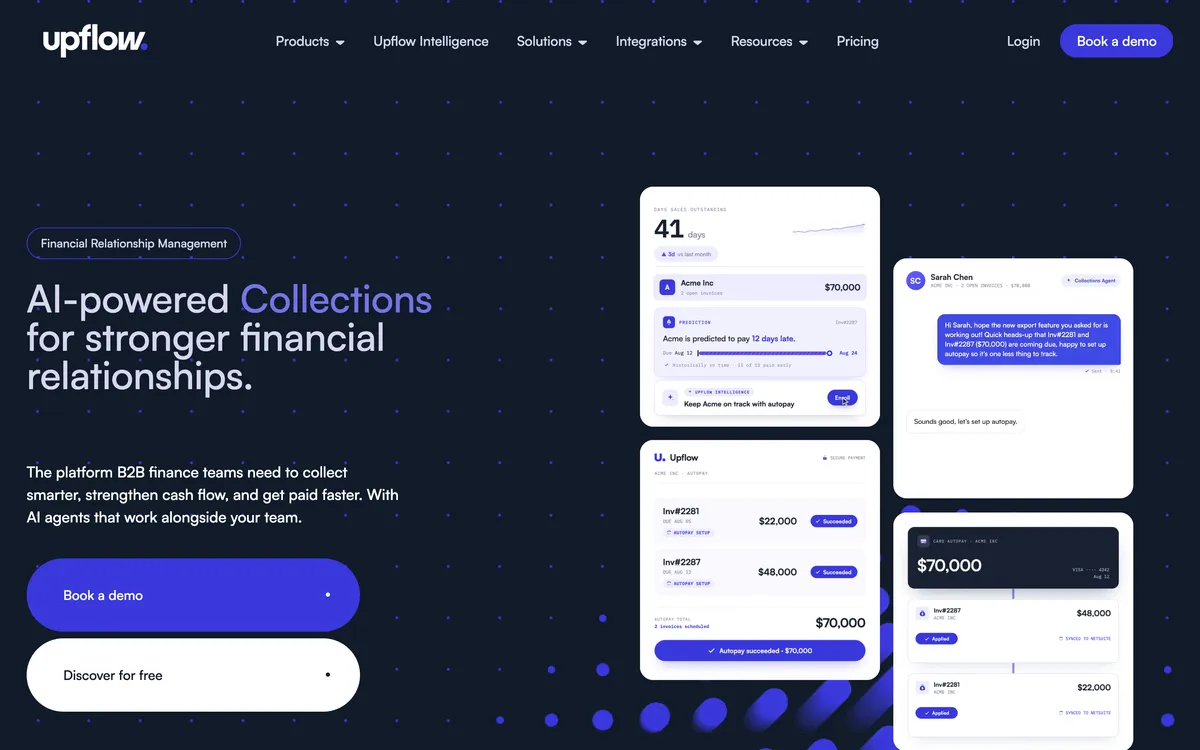
That is the argument for this tool over the others: the account manager filter turns a slow client book into a named conversation with the person who owns those relationships. The free Discover tier reports and chases nobody.
Limitations with Upflow. There is no native fee computation. Upflow points the job back to the ERP, and a mid-sized agency on Xero or QuickBooks Online has no ERP to point it at, so the answer is nothing happens.
There are no installment schedules either, only a promise to pay recorded against the account plus whatever part payments a client chooses to make. Automatic actions fire once a day on business days, so a fee note falling due on Friday afternoon is not touched until Monday.
Sending through your own SMTP turns off open and click tracking, which removes most of the analytics you bought it for. The QuickBooks link polls every five minutes and drops payments into Undeposited Funds for someone to reconcile. Upflow's last published prices were $440 a month for Grow and $880 for Scale. Current prices are hidden and must be requested from Upflow.
5. Quadient AR, best for multi-client billing
Best for: Enterprise agencies billing many client entities.
Quote-only pricing
What is Quadient AR best for?
For a large agency billing many client entities out of NetSuite, Sage Intacct or SAP, that wants payment-date prediction and cash application inside one AR suite.
- Fits
- Enterprise B2B finance teams with multi-ERP or multi-subsidiary billing. No revenue band published and the product is quoted rather than priced
- Regions
- Founded 2015 in New York as YayPay, acquired by Quadient in July 2020 and sold internationally inside Quadient's suite
- Entry cost
- Not published. Quadient's pricing page carries no figures. Capterra lists a starting price of $500 per feature per month, and third-party estimates from PricingNow and itqlick, last seen, put implementation at $5,000 to $15,000 on top.
- Rated
- 4.4 from 156 G2 reviews; 4.5 from 33 on Capterra
- Awards
- IDC MarketScape Leader, December 2024; SPARK Matrix Leader, June 2026
- Runs on
- NetSuite, Sage Intacct, Sage 300 and X3, Dynamics, SAP, Acumatica, Xero, QuickBooks, Zuora and Salesforce, prebuilt or tailored, with multi-entity and multi-subsidiary support
- Late fees and interest
- None found. No native late fee or interest module appears in its help documentation
Quadient AR is the enterprise entry, bought as one pillar of a suite that also covers payables and customer communications.

The agency that buys it is usually a national firm billing several trading entities out of a mid-market ERP, and what it is buying is scale: rules firing on customer events such as credit-limit breaches and score changes, a credit application and scorecard module, disputes, and cash application that writes back automatically to NetSuite and Sage Intacct.
The prediction engine is the part worth a demonstration. It scores when each open invoice is likely to settle, quoted at 83% to 94% accuracy and sharpest inside seven days.
Limitations with Quadient AR. Sending goes through one shared receivables mailbox, with no per-specialist mailboxes and no distribution lists, which is wrong for an agency where each collector owns a named client list and the client expects to hear from that person.
A single invoice cannot be split into monthly payments in the portal, so an installment arrangement on a large commission means a support ticket. No fee or interest module is documented. Pricing is quote-only with implementation charged separately, and G2 reviewers name payment reliability and support responsiveness as recurring problems.
Contingency, retainer and disbursement: three ways an agency gets paid late
An agency fee book looks like one ledger and behaves like three. Each of the three goes late for a different reason, and a chasing rule written for one of them is wrong for the other two.
Contingency. The fee only exists after a recovery, and it cannot be invoiced until the debtor has paid the client and the client has told you so.
A contingency fee note that looks 45 days overdue may have been raised late through no fault of anybody, because the ageing clock started on a date the agency did not control. Chasing hard here chases a reconciliation, not a refusal.
Retainer. A fixed monthly invoice on ordinary terms, which is the one part of the book that behaves like a normal business-to-business receivable. It goes late for normal reasons: a payment run that missed it, a purchase order that expired, a change of finance staff. This is the group a firm ladder and a fee actually suit.
Disbursements. Court fees, tracing costs, process serving and search fees, recharged at cost and disputed line by line. They are small, numerous and argued about more often than anything else in the book, and they are the reason a client account is part paid rather than unpaid at any given moment.
Put those three on one set of rules and every choice is wrong. Set the rule for the retainer group and it fires on a contingency fee note that was raised late by design. Set it for the contingency group and the retainer client never feels anything.
Set it for the disbursements and you are charging interest on an argument.
Which of the five tools can charge a client a late fee without ending the mandate?
Two of the five compute the charge without help from the ledger: Paidnice as a policy per customer group, Chaser as the same kinds of calculation behind one set of rules. Upflow sends the job back to an ERP the agency probably does not have, and no fee or interest function is documented for Kolleno or Quadient AR.
Start with the client agreement, because in the United States a fee on a commission or retainer invoice is a contract term rather than a statutory right, and the rate has to be in the signed agreement before anybody raises it. Most agency agreements already contain one.
Almost none of them are ever used, and the reason is the sentence above: raising it manually means a named person deciding, client by client, that this month is the month to press a client. Nobody wants to be that person about a panel appointment worth six figures.
The way through is to make the charge a term rather than an action. A fee that appears because the agreement says it appears reads as a term of business, and it gives a finance lead something to concede: waived deliberately, in writing, in exchange for the account being cleared this week.
Contingency group, retainer group, one rule or two
Chaser has one set of late-fee rules, with no documented way to run different rules per group. It raises no fee on a payment-plan invoice, and its help says a late fee cannot be added or updated after a part payment when written to Xero, which matters on an agency ledger with part-paid disbursements.
Paidnice puts the policy under the customer group, so contingency, retainer and disputed-accounts each run their own rule concurrently.
One set of late-fee rules (Chaser)
- Four calculation types, recalculated daily
- Contingency and retainer clients on the same rate
- No fee on payment-plan invoices; none added or updated after a part payment written to Xero
- Chased from the team's own mailbox
A policy per customer group (Paidnice)
- An annual rate prorated per day, or a percentage of the balance
- A contingency group and a retainer group running different rules at once
- An invoice fee and a statement charge together
- Raised on the ledger as Draft or Approved
What a late fee is worth on one overdue commission invoice
A $8,500 commission, 60 days past terms, at 12% a year: $167.67 now, $83.84 for every further 30 days, $251.51 by the time it is 90 days out.
Now multiply it by every commission invoice the agency lets run because raising the charge was awkward. The rate has to be in the signed client agreement first.
Remittance, reconciliation and the commission that cannot be invoiced yet
The most expensive delay in an agency is the gap between the debtor paying and the agency being in a position to raise the invoice at all.
Follow one contingency recovery through. The debtor pays, into the agency client account or straight to the client depending on the mandate. If it lands with the agency, the funds are held, reconciled and remitted to the client net or gross depending on the agreement.
If it lands with the client, the agency does not necessarily know it happened until a remittance report or a portal reconciliation says so. Only then can commission be calculated, and it is calculated on a recovery statement the client has to agree, which is the step where an amount can be queried after the work is finished.
The invoice is raised after that. The ageing clock starts after that. So an agency looking at a 60-day commission balance is often looking at money recovered four months ago.
Two consequences follow, and both are uncomfortable. The first is that a large share of an agency's aged debt is a reconciliation dispute that looks like arrears: two parties holding different views of what was recovered, on which placements, net of which disbursements.
Running that up a chasing ladder is an own goal, because pressure does not resolve an arithmetic disagreement and the person receiving the pressure is the person who has to authorize the correction.
The second is that the number an agency most wants, its own days sales outstanding, is partly a measurement of its clients back office rather than of its own collections.
That makes cash application the tool question: matching a bulk remittance across many open items, parsing the advice that came with it, handling partials and credit-note offsets, and posting the result to the ledger.
Kolleno does that, which is why it appears on this page despite documenting no fee mechanic, and Quadient AR does it as a dedicated module writing back to NetSuite and Sage Intacct. Upflow offers a Cash Application Agent on Accelerate and above.
What is accounts receivable software for debt collection agencies, and what is it not?
Two systems, two ledgers, and an agency is the only buyer in this category that runs both. One holds the debt you were instructed to recover. The other holds the invoice you raised for recovering it, and only the second one is what this page is about.
The case management platform holds placements, recovery activity, trust accounting and the audit trail a regulator will ask for. What it does not hold is the commission invoice raised once a recovery lands, because that invoice is created in Xero, QuickBooks Online or the ERP and never enters the placement file.
Every tool on this page reads the second system and none of them reads the first, which is a boundary worth confirming in a demonstration rather than discovering in month two.
- A rule per client group: tone, timing, channel and charge defined for contingency clients separately from retainer clients, because the two are governed by different agreements.
- A charge that raises itself: so no named person has to decide, month by month, whether to press a client the agency is also trying to retain.
- A live read of the ledger: so the moment a client remittance is allocated, the chase stops, and nobody sends a reminder about a fee note that cleared on Monday.
- A statement as well as a reminder: one document showing all six open fee notes and the disbursements attached to them, which is what a client actually reconciles against.
- Your own sending domain (on Pro with Paidnice): the fee note chase arrives from the agency accounts address, visibly separate from the recovery correspondence the agency sends in its clients' names.
By agency size: sole practitioner, panel firm, national
- Sole practitioner or small firm. A short client list, the principal doing the billing, and no finance hire. Paidnice at £49 (US$69) a month is the lowest published entry price on this page, and reconciliation is still a manual job that takes twenty minutes a week.
- Growing, with a mixed client book. Contingency and retainer clients now need different treatment, which is the moment grain starts to matter. Paidnice for per-group rules, or Chaser's Compact tier at £199 a month if the Creditsafe check before a new mandate is worth more than the grain, remembering that Compact stops at four seats.
- Panel firm with named account managers. Each collector owns a client list, so who sends what starts to matter as much as what is sent. Paidnice for per-group policies on flat pricing that does not move with headcount; Chaser at £599 a month on Core for monitoring and the deeper ledger list.
- National, multi-entity. Kolleno when allocating client remittances is the genuine bottleneck rather than the chasing (consider Paidnice for the chasing around it), Upflow when nobody in the business can state the agency's own DSO in a pitch, and Quadient AR when several trading entities bill out of NetSuite, Sage Intacct or SAP.
Running this next to a case management system
None of these five reads the case management platform. They read the accounting ledger the fee notes are raised in, and the join between the two is usually an export and a nightly import somebody built once.
- Xero. All five connect, and Paidnice and Chaser are the two with a Xero App Store review base above 80, which is the review surface where the raters actually run the ledger you do.
- QuickBooks Online. All five again, with one caveat: Upflow's link is one-way, polled every five minutes, and drops payments into Undeposited Funds, which adds a reconciliation step to a business that already has too many.
- Sage 50 and Sage 200. Chaser, and Quadient AR on the larger Sage products rather than Sage 50. Paidnice does not serve Sage 50 or Sage 200, which removes the per-group option for an agency whose books sit there.
- NetSuite, Sage Intacct and SAP. Kolleno, Quadient AR, Upflow (NetSuite and Sage Intacct only) and Chaser, which is the tier where cash application becomes available and the prices stop being published. Paidnice reaches NetSuite, Sage Intacct, MYOB and Dynamics 365 Business Central on its Custom plan only, as a build.
What an agency pays to collect its own book
Set this against the commission the agency writes off each year as too awkward to chase, which is the honest comparison. Published entry prices: Paidnice £49 (US$69) a month, Chaser £199, Kolleno $650 per user. Upflow and Quadient AR print nothing at any tier.
Kolleno charges per user, so a three-person collections and finance group starts at $1,950 a month before integration. Chaser charges on company revenue, so winning one large panel appointment moves the software bill even though the number of fee notes barely changes.
Invoice volume is the metric that fits, because an agency hires collectors far faster than it raises fee notes. Paidnice prices that way, flat, with no per-seat charge: two team members on the entry plan and unlimited users on Pro and above, so a team of nine collectors costs what a team of two costs.
Two of the five leave a buyer with nothing to work with. Upflow took its prices off its site and quotes five tiers by gross invoice value, and its last published prices were $440 a month for Grow and $880 for Scale.
Which accounts receivable software for debt collection agencies fits your use case?
| Use case | Start with | Why | Watch out |
|---|---|---|---|
| Agency on Xero or QuickBooks Online with contingency and retainer clients on different rules | Paidnice | A policy per customer group, with one disputed fee note filtered out by its reference | No cash application, so remittances are allocated manually |
| Reminders and statements only, no late fees | Paidnice | Reminder sequences and statements per client group from £49 (US$69) a month; the fee policy is optional | Essentials covers two team members |
| Creditsafe check before a contingency mandate | Chaser | A credit report, SMS, posted letters and recorded calls in one schedule | One set of late-fee rules; no fee on payment-plan invoices, none added after a part payment (Xero) |
| Matching bulk remittances to open fee notes | Kolleno | Remittance parsing, bank files and one-to-many matching with partials | $650 per user a month, and no fee calculation documented |
| Measuring the agency's own DSO by account manager | Upflow | Countback DSO and collection effectiveness on scheduled dashboards | No native fees on Xero or QuickBooks Online, and no published price |
| National firm billing several entities out of NetSuite, Sage Intacct or SAP | Quadient AR | Payment-date prediction and cash application that writes back to the ERP | Quote only, with implementation at $5,000 to $15,000 (PricingNow and itqlick estimates, last seen) |
Questions agency principals ask
What is the best accounts receivable software for a debt collection agency?
Paidnice, from £49 (US$69) a month, for an agency on Xero or QuickBooks Online whose contingency and retainer clients need different rules on the same ledger.
Where a Creditsafe check before a new mandate matters more than per-group rules, Chaser fits, at £199 a month, and where allocating client remittances is the bottleneck, Kolleno fits. Consider Paidnice for the chasing around it.
Why does a collection agency need AR software of its own?
Because the case management platform holds the debt the agency was instructed to recover, and nothing else. The commission, the success fee and the retainer are invoices the agency raises in its own accounting ledger, and no part of the recovery system knows they exist or chases them. That is the whole gap this category fills.
Which of these tools apply a late fee automatically?
Two of them. Paidnice attaches a policy to a customer group, posts the charge to the client's ledger as Draft or Approved, and compounds by default.
Chaser runs four calculation types behind one set of late-fee rules, across the account or for selected debtors, raises no fee on payment-plan invoices, and its help says a late fee cannot be added or updated after a part payment when written to Xero, while Upflow returns the job to an ERP and neither Kolleno nor Quadient AR documents a fee function.
How much does AR software for a collection agency cost?
Paidnice is £49 (US$69) a month on Essentials, with unlimited users from Pro, and Chaser Compact is £199 a month for revenue under £4m, with Core from £599 above that. Kolleno is $650 per user on BusinessPay, for turnover under £1m, and Quadient AR publishes no price.
Upflow's last published prices were $440 a month for Grow and $880 for Scale. Current prices are hidden and must be requested from Upflow.
How do these tools handle contingency commission invoices?
They chase whatever the ledger already holds, and nothing before that. A contingency commission becomes a receivable at the moment it is invoiced in Xero or QuickBooks Online, and from then on it carries the schedule and the rule attached to that client group.
What no tool here does is tell you the recovery happened, so a commission raised three weeks late gets chased three weeks late and looks like a payment problem when it was a reconciliation delay.
Can these tools handle remittances to clients?
Only in the sense that they read the ledger after somebody has posted the remittance. Netting a client's share against commission is an accounting entry, not a chasing action.
Kolleno and Quadient AR have a cash application module that spreads a bulk payment across open items and writes the result back, and Upflow has a Cash Application Agent on Accelerate; on Paidnice and Chaser the allocation is a person, and the chasing reads what that person produced.
Do I still need AR software if my accounting package sends reminders?
The built-in reminder is one template on one schedule for the whole client list, which is the one thing an agency cannot use, because contingency and retainer clients are the whole point. It applies no charge, produces no statement on your cycle and reports nothing back.
To compare the same tools for any business type, read the best credit control software guide, which sets out six tools by size, ledger and price.
Related reading for collection agencies
Buyer's guide
Best accounts receivable software (by business type)
The pillar guide: pick by size and accounting system, with a recommendation matrix.
Agencies
Best AR software for agencies
Relationship-safe chasing for creative and marketing shops.
Recruitment
Best AR software for recruitment firms
High-volume contractor invoicing and payroll cash flow.
Alternatives
Best Chaser alternatives
Six Chaser alternatives on enforcement, price and reviews.
Sources
14 sources, checked by Julie Turnbridge on November 3, 2026
- Xero Small Business Insights xero.com/resources/small-business-insights/latest-united-...
- Xero App Store apps.xero.com/uk/app/paidnice
- Capterra capterra.com/p/254868/Paidnice
- Xero App Store apps.xero.com/uk/app/chaser
- G2 g2.com/products/chaser/reviews
- Capterra capterra.com/p/157101/CHASER
- G2 g2.com/products/kolleno/reviews
- Xero App Store apps.xero.com/uk/app/kolleno
- Capterra capterra.com/p/227932/Kolleno
- G2 g2.com/products/upflow-upflow/reviews
- Capterra capterra.com/p/193097/Upflow
- Xero App Store listing apps.xero.com/us/app/upflow
- G2 g2.com/products/quadient-accounts-receivable-by-yaypay/re...
- Capterra capterra.com/p/213360/YayPay