The best Statey alternatives in 2026 are Paidnice, for a Xero or QuickBooks Online business that wants reminders and a late fee behind the statement, then Chaser, Kolleno and Upflow. Statey itself is the South African Xero statement app, not the software library of the same name, and automates statements from $10 a month per Xero organisation.
| Tool | Best for |
|---|---|
| Paidnice | A Xero or QuickBooks Online business that wants reminders and a late fee or interest policy per customer group to follow the statement |
| Chaser | A finance team that wants statements inside a multi-channel chasing workflow and can accept a fixed monthly send day |
| Kolleno | An order-to-cash team that wants statements as a portal download next to bank-file cash application |
| Statey | A Xero organisation that wants only the statement automated, with four age analysis methods and a Do Not Send list, from $10 a month |
| Upflow | An analytics-led finance team that wants countback DSO and collection effectiveness reporting; no statement generation is documented |
Xero Small Business Insights. A statement arrives in the middle of that wait: 29.3 days in the United Kingdom, 23.2 in New Zealand, with the average British invoice settling 8.3 days after its due date. Each figure has improved a little on the year before, from 29.6, 24.1 and 9.2.
What a Xero statement add-on is (and what it is not)
A Xero statement add-on sends your customer statements for you. It reads the open balances in your Xero organisation and emails each customer a statement on a schedule, so nobody generates and sends them manually each month.
On the tools in this guide, that covers:
- Statement schedules, weekly, fortnightly or monthly
- Ageing columns and configurable statement sections
- Recipient control through smart groups, customer groups or a Do Not Send list
- Delivery statistics showing who receives statements, on Statey
- Statements consolidated across parent and child contacts, on Paidnice
- An interest line recalculated at send, on Paidnice
It is not Xero’s own statement. Xero produces activity and outstanding statements at no extra cost, but only manually, with no schedule and no interest line.
It is not credit control software. A statements-only tool such as Statey stops once the statement is sent. Credit control software keeps going with reminders, late fees and interest, payment plans and a payment portal.
It is not your ledger either. Xero stays the record of every invoice and payment, and the add-on syncs from it, every six hours in Statey’s case.
Reminders and statements alone are a full use case. Late fees and interest are optional layers you add when a balance stops moving.
How this list was put together
This list helps a Xero business that uses Statey for statements find a tool that also chases and charges.
| What we checked | Where the evidence came from |
|---|---|
| Scheduled statements | Vendor help pages on statement schedules |
| Statement configuration and recipient control | Vendor help pages and feature pages |
| What the tool does beyond the statement | Vendor feature pages |
| Late fees and interest | Vendor help pages on fees and interest |
| Published from-price | The vendor's pricing page, in the currency the vendor publishes |
| Rating and review count | The Xero App Store or G2 |
Xero’s own statements: activity, outstanding, and the manual send
Xero already makes two kinds of statement and emails either one to a customer, at no extra cost. What it will not do is send them on a schedule, which is the whole reason this category exists.
The activity statement lists every transaction against a contact over a period you choose: invoices raised, payments received, credit notes applied, whether or not anything is still owing. The outstanding statement lists only what is unpaid on a given date, item by item, with nothing already settled shown at all.
Both are generated manually, from the contact record or from the Business menu, for whichever customers you select. There is no schedule, no ageing configuration, no smart recipient list, and no way to exclude an account permanently.
The branding follows your invoice theme rather than being set separately, and neither statement carries an interest line, because Xero does not compute one.
For a short list of accounts once a month that is a perfectly good arrangement, and it is free with your subscription. See Xero Central for the process. The moment it becomes a monthly chore across a long contact list, or across several organisations, an add-on pays for itself in time saved before you count anything it collects.
Which statement to send a late payer, and why it matters
Send the outstanding statement. The activity statement shows a period of trading, including everything already paid, and handing a late payer a document full of settled invoices gives them something to read instead of something to pay.
The two answer different questions. An activity statement answers what happened between these dates, which invites a reconciliation: their accounts clerk starts matching your list against theirs, finds a credit note applied on a different day, and the balance turns into a query.
An outstanding statement answers what do you owe me right now, which invites one of two replies, payment or a specific dispute about a specific invoice.
Two rules follow. Send the outstanding statement to anybody carrying an overdue balance, and keep the activity statement for the customer who asked for a copy of the year.
And send it to whoever schedules the payments, which is often not the person who placed the order, because a statement read by the wrong contact is a statement that has not been sent.
- Paidnice sends on any schedule you set, consolidates parent and child contacts into one statement, targets by customer group, and adds an interest line the Xero statement cannot carry, recalculated at the moment of sending.
- Chaser sends monthly, on a fixed day, and neither the recipients nor the senders are customisable, which is the one control a statements buyer is most likely to want.
- Kolleno puts the statement in a customer portal as a download rather than a scheduled send.
- Statey builds each statement from five configurable sections with four age analysis methods, across invoice date or due date and calendar months or exact days, and targets it with smart groups, smart recipient lists and a Do Not Send list.
- Upflow documents no statement generation at all. Its portal shows an invoice and account view, which is a different object.
Five Xero statement add-ons compared
 |
 |
 |
 |
 |
|
|---|---|---|---|---|---|
| Best for | Statements followed by reminders and a late fee policy | Statements inside a multi-channel chasing workflow, fixed monthly day | Statements as a portal download beside cash application | The statement automated and nothing else, from $10 | Collections analytics, with no statement generation documented |
| Revenue fit | Any size up to $50m a year, or 50,000 invoices a year | Compact under £4m, Core from £4m, Complete to £100m | Under £1m on BusinessPay, tiers to £1bn and above | Any Xero organisation | Gross invoice value tiers, up to $10m through above $100m |
| From (monthly) | £49 (A$99, NZ$109 excl GST, US$69) | £199 (Compact) | $650 per user | $10 per Xero organisation | Hidden now; last published $440 a month (Grow) |
| Scheduled statements | Yes (any schedule) | Yes (monthly, fixed day) | Not documented (portal download) | Yes (weekly, fortnightly or monthly) | Not documented |
| Statement configuration | Yes (consolidated parent and child contacts, interest recalculated at send) | No (recipients and senders are not customisable) | Not documented | Yes (four age analysis methods, own sending domain on Pro) | Not documented |
| Beyond the statement | Yes (reminders, late fees, escalation) | Yes (chasing, credit checks, collections referral) | Yes (AI collections, cash application on Enterprise only) | None (statements only) | Yes (workflows, collections analytics) |
| Recipient control | Yes (per customer group) | No (statement recipients and senders are fixed) | Yes (workflow branches) | Yes (smart groups, smart recipient lists, Do Not Send list) | Yes (risk and behaviour segments) |
| Late fees and interest | Yes (a policy per customer group) | Yes (one set of late-fee rules, across the account or for selected debtors) | None found | None | No (via your ERP only) |
| Payment plans | Yes (on Pro) | Yes | Yes | None | No (customer-initiated part payments) |
| Ledger integrations | Xero, QuickBooks Online on every plan; newer ledgers such as Rillet, Campfire and Odoo through closed testing; Sage Accounting and other ERPs on Custom | Xero, QuickBooks, Sage, NetSuite, Dynamics 365 Business Central | NetSuite, SAP, Sage Intacct, Business Central, Xero, QuickBooks Online | Xero | Xero, QuickBooks Online, NetSuite, Sage Intacct, Stripe Billing, Chargebee, Zuora |
| AI | Advanced Reads customer replies, drafts answers and follow-up actions (like PO updates) for your approval; MCP server for Claude, ChatGPT and other agents | Advanced Insights, Copilot drafts and an autonomous Agent; AI agent support from Business Plus, fully automated agent runs and AP portal features billed separately by token use | None No AI feature | Advanced Collections and cash application agents, from suggest-only to autonomous (Collections Agent from Scale, Cash Application Agent from Accelerate) | |
| Rated (source, count) | 5.0 (84, Xero App Store) | 4.98 (374, Xero App Store) | 4.9 (117, G2) | 4.8 (19, Xero App Store) | 4.8 (235, G2) |
"Not documented" means the vendor does not document the capability. "Not published" means the vendor does not print a price. "None found" means no evidence either way. Every price is shown in the currency the vendor publishes it in, never an exchange-rate conversion.
The five tools in five checked facts
- Four of the five print a monthly price: Statey from US$10, Paidnice from £49 (US$69), Chaser from £199 and Kolleno from US$650. Upflow quotes.
- Each published price grows with something different: a flat fee per Xero organisation (Statey), invoice volume (Paidnice), revenue band (Chaser) and users (Kolleno).
- Two of the five apply a late fee themselves: Paidnice (per customer group) and Chaser (one set of late-fee rules).
- All five connect to Xero. Four of the five also connect to QuickBooks Online. Statey does not.
- AI that handles collections work or customer replies: Paidnice, Kolleno and Upflow. No AI in receivables: Statey.
We checked each tool's own pricing, integration and help pages. "None found" in the data means the vendor's pages do not show the feature.
CreditorWatch Collect (formerly Debtor Daddy) was also checked for this page. It chases by email and SMS for Xero users in Australia and New Zealand, but its own Xero material documents no scheduled customer statements, so it is not compared here as a statement add-on.
1. Paidnice, best for statements to reminders
Best for: Xero and QuickBooks Online businesses that want the statement to lead somewhere, any size up to $50m a year, or 50,000 invoices a year.
What is Paidnice best for?
Choose Paidnice if you are a Xero or QuickBooks Online business that wants statements on the schedule it chooses, then reminders and an automatic late fee behind them, without anyone doing the follow-up manually.
- Fits
- Xero and QuickBooks Online businesses of any size up to $50m a year, or 50,000 invoices a year, with or without a credit controller
- Regions
- United Kingdom, Australia, New Zealand, United States, Canada, South Africa
- Entry cost
- £49 (US$69) a month on Essentials (A$99, NZ$109 excluding GST, £49 (US$69)), covering 150 invoices, 600 emails and up to 2 team members; Pro from £74 (US$99) (A$139, NZ$149, £74 (US$99)) with unlimited users and no per-seat fee.
- Rated
- 5.0 from 84 Xero App Store reviews; 4.9 from 14 on Capterra · Xero App Store listing
- Awards
- Xero Global Small Business App of the Year 2025 and NZ Small Business App of the Year 2026
- Runs on
- Xero and QuickBooks Online on every plan. Newer ledgers such as Rillet, Campfire, Digits, DualEntry, Puzzle, Accounting Seed and Odoo are available on every plan through Paidnice's closed testing program. Sage Accounting, NetSuite, Sage Intacct, MYOB and Dynamics 365 Business Central connect on the Custom plan as a build
- Late fees and interest
- Yes, as a policy per customer group, indexed to the Bank of England base rate for UK businesses
- Does best
- Statements and the chase behind them in one Xero app
Paidnice sends automatic customer statements on the schedule you set, including consolidated statements across Xero parent and child contacts. Accrued interest is recalculated at the point the statement sends rather than fixed at the last policy run, so the figure the customer opens is accurate that morning.
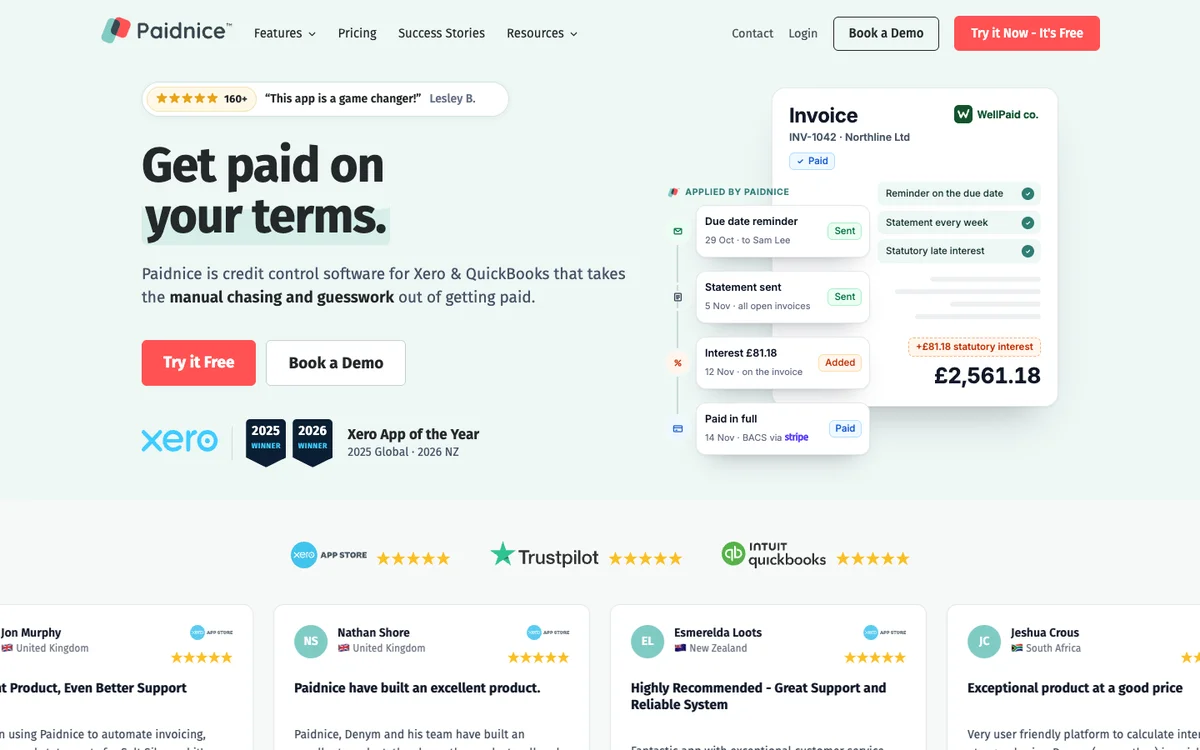
Behind the statement sit escalating email and SMS reminders sent from your own domain (on Pro) or through a connected Gmail or Outlook (Microsoft 365) mailbox, customer groups so different accounts get different treatment, payment plans on Pro, a customer payment portal, and automatic late fees and interest. The charge is raised on the ledger as Draft or Approved, and it is calculated on the balance net of any credit on the account.
Limitations with Paidnice. Xero and QuickBooks Online on every plan. Newer ledgers such as Rillet, Campfire, Digits, DualEntry, Puzzle, Accounting Seed and Odoo are available on every plan through Paidnice's closed testing program. Sage Accounting and other ERPs connect on the Custom plan. Some payment features differ between Xero and QuickBooks Online. Statement configuration is less granular than a dedicated statement tool, with nothing equivalent to Statey’s four age analysis calculation methods or its per-recipient delivery statistics.
The Essentials tier covers 150 invoices, 600 emails and two team members, and sends from outbound@paidnice.com, so a busy ledger or a team that wants payment plans or its own sending domain will want Pro.
2. Chaser, best for statements in chasing
Best for: A statement wrapped in a multi-channel chasing workflow, if a fixed monthly day is acceptable.
What is Chaser best for?
Choose Chaser if you are a finance team that treats the statement as one step in a chase rather than the document itself, and you will give up recipient control to get the rest.
- Fits
- Businesses with a named credit controller; the entry tier is priced for turnover under £4m, and the tiers run to £100m
- Regions
- UK-registered, trading since 2014, sells worldwide
- Entry cost
- £199/mo on Compact for turnover under £4m with 4 users; Core £599/mo for turnover under £10m; Complete £899/mo to £100m. Chaser offers a free trial (10 days on the Xero listing) or a conversation with an expert; no minimum term, 10% off yearly billing.
- Rated
- 4.98 from 374 Xero App Store reviews; 4.3 from 71 on G2 · Xero App Store listing
- Awards
- Finalist, UK Small Business App Partner of the Year, Xero Awards 2023
- Runs on
- Xero, QuickBooks, Sage 50, Sage 200, Sage Intacct, Business Central, NetSuite, Dynamics 365, AccountsIQ, SAP
- Late fees and interest
- Yes, as one set of late-fee rules, with four calculation types including the Bank of England base rate
- Does best
- Multi-channel chasing around the statement
- Customers
- Named on its website: Pact Coffee, Huttie and TaxAssist. Huttie's case study reports £15,000 of old debt recovered.
Chaser treats the statement as a feature in its own right, separate from its invoice reminders, so a customer can receive a full summary of everything outstanding as well as per-invoice chasing.
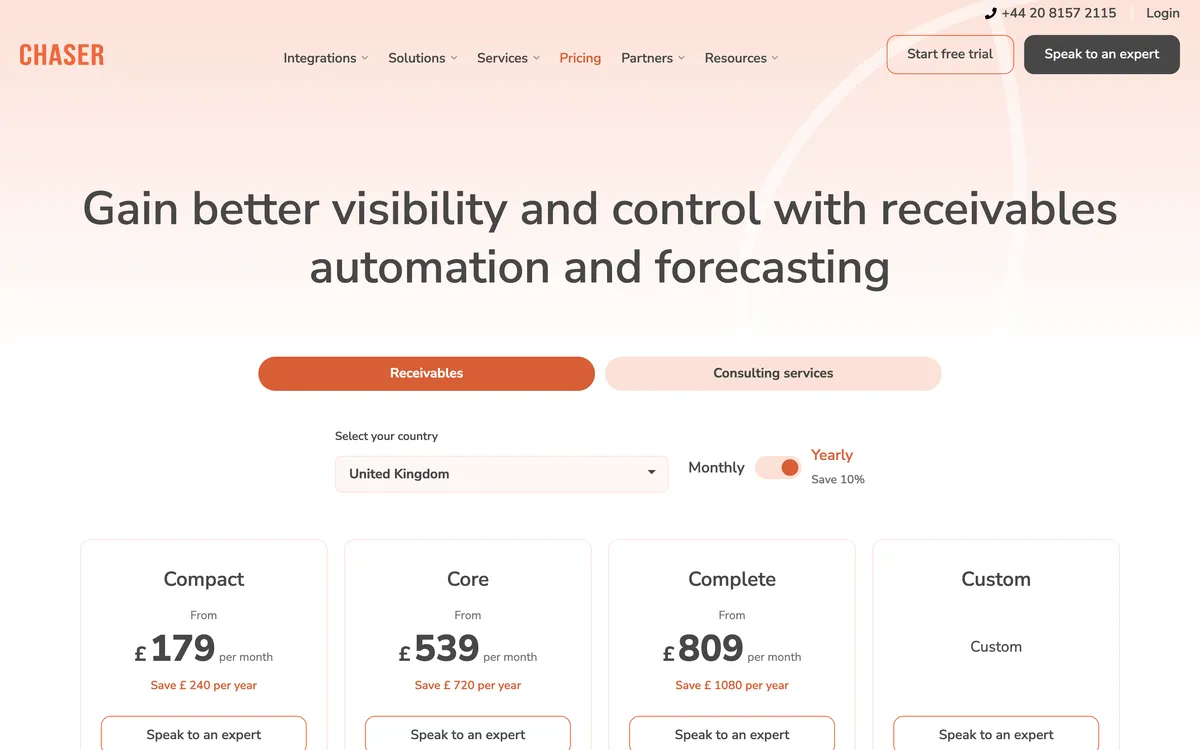
What surrounds it is a multi-channel collections workflow: escalating sequences from the team's own Gmail or Outlook mailbox, SMS, letters, a payer portal, Chaser Pay, Creditsafe credit reports and a collections referral through its partner Debitura.
Chaser credit checks are sold by credit on any plan and need Chaser billing, not Xero App Store billing; monitoring is not offered in Australia.Limitations with Chaser. Statements go monthly on a fixed day of the month, and the recipients and senders are not customisable, which is the one control a statements-focused buyer is most likely to want.
The late fee runs as one set of late-fee rules, across the account or for selected debtors, not tied to schedules, with no documented way to run different rules per group, and it raises no fee on payment-plan invoices. Chaser's help says a late fee cannot be added or updated after a part payment when written to Xero. Compact is £199 a month, more than a micro business sending the odd statement needs. The one-way automated calls are unavailable in New Zealand.
3. Kolleno, best for statements in a portal
Best for: Order-to-cash teams that want statements in a customer portal.
What is Kolleno best for?
Choose Kolleno if you are a mid-market finance team whose bottleneck is matching cash to invoices, and the statement is one document inside a wider order-to-cash platform.
- Fits
- Mid-market and enterprise order-to-cash teams, priced per user with a one-user minimum
- Regions
- London, founded 2020, sells worldwide
- Entry cost
- $650 per user a month on BusinessPay, or $545 per user on annual billing, for turnover under £1m; Business Plus $1,245 per user. Kolleno matches payments to invoices (auto-reconciliation) on Enterprise only, by quote. BusinessPay at $650 per user a month does not include it. Xero and QuickBooks connect on BusinessPay and Business Plus; NetSuite and SAP start on Enterprise.
- Rated
- 4.9 from 117 reviews on G2
- Awards
- None found
- Runs on
- NetSuite, SAP S/4HANA, Sage Intacct, Dynamics 365, Workday, Oracle JD Edwards, Xero, QuickBooks Online
- Late fees and interest
- None found
- Does best
- Cash application and reconciliation
- Customers
- Named on its website: Wise, Deel and Laundryheap. Laundryheap's case study reports 94% of payments collected on time.
Kolleno gives customers portal access to account statements and credit notes alongside reminders, disputes and payment plans, with trigger-based workflows that branch on invoice events and escalate on their own.

Its real strength sits behind the statement rather than in it: email remittance parsing with suggested matches, SFTP bank connections, BAI2, NACHA and ISO 20022 file handling, one-to-many and partial matching, credit note offsets, and NetSuite multi-currency journal entries for FX differences and bank fees.
Limitations with Kolleno. The statement is a portal download rather than a scheduled send, and no automatic statement schedule is documented. No late fee or interest feature appears anywhere in its public materials.
Kolleno includes 100 to 600 calls a plan. Its pricing page does not say which actions a workflow can hold. Pricing is per user from $650 a month, which is well above a statements brief, and custom sending domains are set up by an account manager rather than self-serve.
Statey
Best for: A Xero organisation that wants the statement automated and nothing else, from $10 a month.
What is Statey best for?
Choose Statey if your customers already pay on time and you simply want to stop generating the monthly statement manually, from $10 a month.
- Fits
- Any Xero organisation that wants the statement automated. Priced per Xero organisation, with unlimited users on every tier
- Regions
- South Africa; sold worldwide through the Xero App Store since May 2022; bills in USD, GBP, ZAR, AUD or NZD by the customer's location
- Entry cost
- $10/mo per Xero organisation on Starter, $25 on Standard, $50 on Pro, with a 32-day trial and no card required. These are the US dollar prices; Statey's pricing page also lists £8, £18 and £40 in the UK, R199, R499 and R999 in South Africa, A$15, A$35 and A$70 in Australia, and NZ$15, NZ$35 and NZ$70 in New Zealand.
- Rated
- 4.8 from 19 Xero App Store reviews · Xero App Store listing
- Awards
- None found
- Runs on
- Xero
- Late fees and interest
- None
- Does best
- Statement configuration, with four age analysis calculation methods
Statey is a statements-only tool, and that is the point. It runs weekly, fortnightly or monthly statement schedules, builds each statement from five configurable sections, and offers four age analysis calculation methods across invoice date or due date and calendar months or exact days, with customisable 30, 60 and 90 day columns.
Recipients are targeted with smart groups by balance, activity or criteria, smart recipient lists built from Xero contact lists, and a Do Not Send list, and delivery statistics show who is receiving statements and who is not. Standard adds watermark removal, Excel download and multi-currency; Pro adds multiple schedules and sending from your own domain.
Limitations with Statey. There is no chasing, no escalation, no late fee, no payments and no customer portal, by the vendor’s own description: statements only.
It works with Xero alone, with no QuickBooks connector, and it syncs from Xero every six hours rather than in real time. Its verified review base is 19 reviews.
4. Upflow, best for first-time AR measurement
Best for: Analytics-led finance teams, on pricing by gross invoice value with no published figures.
What is Upflow best for?
Choose Upflow if you are a finance team whose real problem is that nobody can measure collections, and you want the statement folded into a workflow you can report on.
- Fits
- Scaling finance teams, sold in five tiers by gross invoice value, from up to $10m to above $100m; 500+ clients in 30+ countries
- Regions
- Founded in Paris in 2018, headquartered in New York
- Entry cost
- Not published. The free Discover tier is analytics only with no automation, and Starter, Grow, Scale, Accelerate and Enterprise are quoted by gross invoice value. Upflow's last published prices were $440 a month for Grow and $880 for Scale; current prices are hidden and must be requested. Upflow takes payments through its optional Payments add-on: $390 a month platform fee, 3.5% + $0.30 per card payment, 0.8% capped at $5 for ACH.
- Rated
- 4.8 from 235 reviews on G2
- Awards
- None found
- Runs on
- Xero, QuickBooks Online, NetSuite, Sage Intacct, Stripe Billing, Chargebee, Zuora
- Late fees and interest
- No, applied through your ERP only
- Does best
- Collections analytics, countback DSO and CEI
- Customers
- Named on its website: Lattice, Vercel and Front. Lattice's case study reports 99% collection with one person in AR.
Upflow runs multi-step workflows across email, SMS, letters, calls and tasks, with a branded portal where a customer views their account, pays, saves a payment method and raises a dispute.

Its moat is measurement: countback DSO against best possible DSO, collection effectiveness index, an at-risk rate for balances past 90 days, ageing, and dashboards you can filter by workflow, country, account manager or custom field, with scheduled email delivery of the reports.
Limitations with Upflow. No statement generation feature is documented. The portal shows an invoice and account view, which is not the same thing as a statement you can schedule and brand. Late fees are applied through your ERP rather than computed here, and there are no instalment plans, only customer-initiated part payments.
Automatic actions fire once a day on business days only, sending through your own SMTP disables open and click tracking, and the QuickBooks connector polls every five minutes with no webhooks. No price is published.
What happens after the statement lands
A statement tells a customer what is outstanding and how old each item is, and then it is finished, so everything that decides whether the balance moves happens afterwards.
That is the difference between a statement add-on and credit control software. The first automates a document. The second automates the document and then keeps going: a firmer follow-up, a charge against the balance, different treatment for the customer who does this every single month.
Four things worth asking of any tool here, in the order they start to matter once the statement has been ignored:
- Does anything follow it? A reminder sequence that escalates, rather than the same statement arriving again next month with a larger number on it.
- Does being late cost anything? An interest charge or a fee raised against the overdue balance, on the ledger rather than inside the app.
- Can the good payers be left alone? Recipient control, so a customer who has never been late is not chased like one who always is.
- Does the statement stay true? A ledger sync tight enough that a paid invoice has dropped off before the next send, because one settled invoice on a statement undoes the rest of it.
Interest on a statement balance, recalculated at send
A statement interest charge is levied per customer against the whole overdue balance rather than invoice by invoice, which is what makes it a statement feature rather than an invoice feature. The rate is set per annum and prorated per day, so the amount grows for every day the balance sits unpaid.
For UK businesses the rate can be indexed to the Bank of England base rate, which moves several times a year. A long-overdue balance can span two or three rates, and the correct charge has to be prorated across each period.
Timing matters as much as the rate, and on a statement it matters more than on an invoice. A statement is a document the customer reads as a whole and checks line by line.
Interest recalculated at the instant it sends gives them a figure that is correct that morning. Interest carried forward from the last policy run is stale inside a week, and a customer who notices has a reason to reply rather than pay.
On £5,000 overdue for 45 days at 11.75% a year, interest accrues at £1.61 a day, so £72.43 has built up and the statement shows £5,072.43.
When a statement is the wrong tool
A statement summarises a balance. A payment plan schedules one. The moment a customer is on a plan, the statement stops helping and starts contradicting the arrangement you just made with them.
Picture the collision. You agree six instalments on a $9,000 balance, the customer pays the first, and on the first of the month your statement software sends a document saying $7,500 is outstanding today.
Technically it is correct. Practically you have told somebody who is complying with an agreement that they owe you everything, and the reply is a phone call rather than a payment.
So the setting to look for is whether a customer on a plan can be taken off the statement run without being taken off it permanently. Chaser sends monthly to a recipient list you cannot vary, which is the awkward case.
Paidnice targets statements by customer group, so a plans group can be excluded and put back. Statey has a Do Not Send list and smart recipient lists, which is the mechanism.
On the plans themselves: Paidnice, Chaser and Kolleno all schedule instalments against an open invoice. Chaser splits weekly through to yearly but keeps chasing the original invoice due date rather than the instalment dates, and its own documentation advises chasing the instalments manually.
Kolleno splits weekly, monthly or bi-monthly and links automations to the plan, with uneven totals divided manually. Upflow takes a promise to pay and ad-hoc part payments rather than a schedule.
$10 a month against a full credit control subscription
Published entry prices: Chaser £199 a month, Kolleno $650 per user, Paidnice £49 (US$69) (A$99, NZ$109 excluding GST, £49 (US$69)) and Statey $10 per Xero organisation. Upflow's last published prices were $440 a month for Grow and $880 for Scale; current prices are hidden and must be requested from Upflow. Xero’s own statements come with your subscription.
The interesting comparison is the narrowest one: $10 against £199, for two products that both send a Xero statement. Statey offers four age analysis methods and per-recipient delivery statistics, and it starts at $10 a month.
Read the unit before the number, because none of the four charges for the same thing. Chaser charges on company turnover, so the bill steps when the business grows rather than when the work does. Kolleno charges per user, so a receivables desk of three multiplies the price.
Paidnice charges on invoice volume with no per-seat fee, so a second person joining the chase costs nothing. Statey charges per Xero organisation with unlimited users on every tier, so it is cheap for one entity and multiplies across a group.
One Xero organisation, or several
Revenue is the wrong unit for a statements page. What decides the bill is how many Xero organisations you send from and how many people work the ledger, and Paidnice and Statey charge on opposite axes.
- One organisation, statements only. Statey at $10 a month, or Xero’s built-in statements if the contact list is short enough to send manually. Nothing else is needed.
- One organisation, and the balance is not moving. Paidnice from £49 (US$69) (A$99), because a statement is only worth automating if something follows it.
- Several organisations, one bookkeeper. Statey prices per Xero organisation, so eleven entities is eleven subscriptions. Paidnice adds organisations through a multi-entity add-on instead, which suits a group where each entity also needs chasing.
- A finance team rather than a person. Chaser at £199 for four users, or Kolleno at $650 per user where the statement is one document inside an order-to-cash platform.
Which Statey alternative fits your use case?
Start from what you need once the statement is sent.
| Use case | Start with | Why |
|---|---|---|
| A short contact list, statements once a month | Xero’s own statements | Included with your subscription, sent manually |
| One organisation, statements only, customers pay on time | Statey | Scheduled statements with four age analysis methods, from $10 a month |
| Statements, then reminders and a late fee, on Xero or QuickBooks Online | Paidnice | Interest recalculated at send and a policy per customer group, from £49 (A$99) |
| Statements inside a chase, with credit reports | Chaser | Multi-channel workflow and Creditsafe reports, from £199 a month |
| Several Xero organisations, one bookkeeper, statements only | Statey | $10 per organisation, with unlimited users on every tier |
| Matching cash to invoices on a larger ledger | Kolleno | Bank-file cash application, with statements as a portal download |
Questions about automating Xero statements
What does Statey do?
Statey is a Xero add-on that sends customer statements automatically on a weekly, fortnightly or monthly schedule, with four age analysis calculation methods, smart recipient targeting, a Do Not Send list and delivery statistics.
It automates statements but does not chase, escalate or apply a late fee, and it does not connect to QuickBooks. It starts at $10 a month per Xero organisation and holds 4.8 from 19 Xero App Store reviews.
What are the best Statey alternatives?
It depends on what follows the statement. Paidnice fits reminders and an automatic late fee behind the statement, from £49 (US$69) (A$99) a month, and Chaser fits statements inside a full chasing workflow with bureau credit checks, from £199 a month.
Kolleno and Upflow fit an order-to-cash platform where the statement is a small part of the brief, and Xero’s own statements fit a list short enough to send manually.
What is the difference between a statement tool and a credit control tool?
A statement tool sends customers a summary of what they owe. A credit control tool sends that summary and then works to reduce the overdue balance, with escalating reminders, a late fee and a way to flag a problem account. Statey is the first kind; Paidnice and Chaser are the second.
Does Xero send customer statements on its own?
Xero can produce and email outstanding and activity statements, but not on an automatic schedule. You generate and send them yourself, which is why businesses add a tool to automate the timing.
Can I send Xero statements only to overdue customers?
Yes, with the right tool. Paidnice targets statements at customers with an overdue balance using customer groups, and Statey targets recipients with smart groups, smart recipient lists and a Do Not Send list. Chaser sends statements monthly on a fixed day, and its recipients are not customisable.
Can a statement tool charge a late fee?
A statements-only tool cannot. To apply a late fee or interest to an overdue balance you need a tool that raises the charge on the ledger. Of the tools here, Chaser does it as one set of late-fee rules and Paidnice does it as a policy per customer group.
How much does a Xero statement add-on cost in 2026?
Paidnice is £49 (US$69) a month on Essentials, or A$99, NZ$109 excluding GST or £49 (US$69), Chaser is £199 a month for turnover under £4m, and Kolleno is $650 per user a month.
Statey is $10 a month per Xero organisation on Starter, $25 on Standard and $50 on Pro. Upflow's last published prices were $440 a month for Grow and $880 for Scale; current prices are hidden and must be requested from Upflow.
For tools on other ledgers, the credit control software buyer’s guide compares six tools across Xero, QuickBooks Online, Sage, NetSuite and Business Central.
More on Xero receivables
Buyer's guide
Best invoice chasing software for Xero
Six Xero chasing tools compared on the gaps they fill and verified reviews.
Buyer's guide
Track overdue Xero invoices as a team
The tools that give your team one shared view and chase the routine for you.
How-to
How to chase overdue invoices
The chase sequence, the channels that get a reply, and when to escalate.
Template
Customer statement template
A clean statement layout you can send from Xero or a spreadsheet.
Sources
11 sources, checked by Julie Turnbridge on November 3, 2026
- Xero Small Business Insights xero.com/uk/resources/small-business-insights
- Xero Small Business Insights xero.com/nz/resources/small-business-insights
- Xero Central central.xero.com/s/article/Send-a-customer-a-statement
- Capterra capterra.co.uk/software/254868/paidnice
- Xero App Store listing apps.xero.com/uk/app/paidnice
- G2 g2.com/products/chaser/reviews
- Xero App Store listing apps.xero.com/uk/app/chaser
- G2 g2.com/products/kolleno/reviews
- Xero App Store listing apps.xero.com/uk/app/statey
- G2 g2.com/products/upflow/reviews
- Bank of England base rate bankofengland.co.uk/monetary-policy/the-interest-rate-ban...