The best accounts receivable software for property management in 2026 is Paidnice, for a manager on Xero or QuickBooks Online that wants a different chasing and late fee rule for residential and commercial tenants.
Chaser, ezyCollect, BILL and Satago complete the five, compared on whether the tool raises a late fee on overdue rent and service charges itself and at what grain. Published entry prices start at $69 a month.
| Tool | Best for | ||||
|---|---|---|---|---|---|
| Best for | Residential and commercial rules on Xero or QuickBooks Online | Commercial rent roll with letters, calls and credit checks | Australian and New Zealand agencies on Xero or MYOB | US companies already paying owners in BILL | UK agents on Sage 50 wanting credit data |
| Paidnice | A manager on Xero or QuickBooks Online that wants a different chasing and late fee rule for residential and commercial tenants | ||||
| Chaser | A team with a named credit controller and a commercial rent roll that wants letters, calls and a covenant credit check | ||||
| ezyCollect | An Australian or New Zealand agency on Xero or MYOB with a long arrears list to consolidate into one chase per tenant | ||||
| BILL | A US management company that already pays owners and vendors in BILL and wants tenant invoicing in the same system | ||||
| Satago | A UK managing agent on Sage 50 or Xero that wants bureau credit data and invoice finance with its chasing |
A managing agent waits twice for the same money. Once on its own management fee, and again on the rent and service charges it collects for an owner and is judged on at the next review.
Xero's latest US small business data sets the baseline for the first of those: 29.7 days to be paid and 8.6 days past due.
What is accounts receivable software for property management, and what is it not?
Accounts receivable software for property management chases the invoices already raised on your accounting ledger. It reads Xero or QuickBooks Online, works out which tenants are overdue and runs the follow-up without anyone opening each account on the fifth of the month.
- Reminders by email and SMS, on a sequence set per customer group or per schedule.
- Statements that show every open charge on a tenant account in one document.
- Late fees and interest on overdue rent and service charges, where the lease allows them. Paidnice, Chaser and Satago raise one; ezyCollect and BILL do not.
- Payment plans that split existing arrears into installments.
- A payer portal where a tenant sees and settles the balance.
It is not a property platform. Buildium, AppFolio and Yardi hold the lease, post the rent charge and produce the owner report, and the AR tool has no view of the tenancy.
It is not the ledger. The receivable stays in Xero, QuickBooks Online, Sage or MYOB, and the tool reads it from there. It is not a collection agency or a lender either: ezyCollect can refer an account to a collections partner and Satago offers invoice finance, as extras beside the chasing.
Reminders and statements alone are a full use case. A late fee is optional, and the clause has to be in the lease or the management agreement before any tool raises one.
How this list was put together
This list helps a property manager chase overdue rent and service charges already raised on a Xero or QuickBooks Online ledger.
| What we checked | Where the evidence came from |
|---|---|
| Late fees on overdue rent and service charges, and at what grain | Vendor help pages on fees and interest |
| Chasing grain per tenant group | Vendor workflow documentation |
| Statements showing every open charge on a tenant account | Vendor feature pages |
| Payment plans and a portal | Vendor feature pages |
| Published from-price | The vendor's pricing page, and the last reported price where it is now hidden |
| Rating and review count | The Xero App Store or G2 |
Rent arrears are a monthly cycle
Every other buyer in this category chases invoice events: something was sold, an invoice was raised, it went past due. A rent roll does not behave that way. The charge is scheduled, the due date is the same date every month, and on the fifth the same names appear on the same list they appeared on last month.
A rent roll never empties, because next month’s charge is already posted, so what a managing agent needs is a rule that runs unattended against a fixed population, month after month, without anyone deciding on the fifth whether to press this tenant. It also means the arrears book is mostly part paid.
A tenant clearing $400 of a $1,200 balance and then $300 more is the ordinary state of the account rather than an exception to be handled, and that single fact decides which of the tools below will raise a charge on your ledger.
The second thing that separates this page from the rest of the category is whose money is being chased. Rent, service charges and recoveries are collected on behalf of an owner.
The agent is an agent, the receivable belongs to the landlord, and a late fee raised on a tenant is contractually the owner's income rather than the agent's. That decides where the charge is allowed to post, who has to approve it and whether it can be raised automatically at all.
Property management AR software compared: the table
 |
 |
 |
 |
 |
|
|---|---|---|---|---|---|
| Revenue fit | Any size up to $50m a year, or 50,000 invoices a year | Compact under £4m, Core from £4m, Complete to £100m | Not published. Tiers are set by debtor count, 200 on the entry plan to 3,000 | Not published. Priced per user | Not published |
| From (monthly) | $69 | £199 | A$275 on annual billing, plus setup from A$900 (last published; current prices hidden and must be requested) | $49 per user | £45 (£25 inside Sage 50) |
| Ledger integrations | Xero, QuickBooks Online and newer ledgers such as Rillet and Campfire (closed testing) on every plan; Sage Accounting and other ERPs on Custom | Xero, QuickBooks, Sage, NetSuite, Dynamics 365 Business Central | Xero, MYOB, NetSuite, Sage 300 and Intacct, SAP Business One; QuickBooks logo on homepage, no connector page | CSV only on Essentials; two-way QuickBooks Online and Xero from Team | Xero, Sage, Sage 50, QuickBooks, KashFlow, FreeAgent |
| Late fee grain | Yes (per customer group) | Yes (one set of late-fee rules, not tied to schedules) | None found | None found | Optional, added to reminder emails |
| Statements | Yes (any schedule) | Yes (monthly, fixed day) | Yes (monthly) | None found | Yes |
| Chasing grain | Yes (per customer group) | Yes (per schedule) | Yes (per customer workflow) | No (three reminder templates, set company-wide) | Yes (customer grouping) |
| Payment plans | Yes (on Pro) | Yes | Yes | None found | Not documented |
| Portal | Yes | Yes | Yes | Yes | Not documented |
| AI | Advanced Reads customer replies, drafts answers and follow-up actions (like PO updates) for your approval; MCP server for Claude, ChatGPT and other agents | Basic an AI email template generator as a paid add-on | None No AI in receivables (its AI agents are for payables) | None No AI feature found | |
| Rated (source, count) | 5.0 (84, Xero App Store) | 4.98 (374, Xero App Store) | 4.9 (35, Xero App Store) | 4.4 (1,806, G2) | 4.93 (92, Xero App Store) |
Satago is the row carrying "Not documented" down most of this column, because nothing published for it documents an installment schedule or a portal. A cell reading "Not published" means that vendor prints no price anywhere; "None found" means no evidence either way. Every price below is a from-price the vendor published.
The five tools in five checked facts
- Four of the five print a monthly price: BILL from US$49 per user, Satago from £45 a month (£25 inside Sage 50), Paidnice from £49 (US$69) and Chaser from £199. ezyCollect quotes.
- Four of the five connect to both Xero and QuickBooks Online; ezyCollect shows a QuickBooks logo on its homepage but no connector page.
- AI that handles collections work or customer replies: Paidnice. AI that does not handle replies: ezyCollect. No AI in receivables: BILL and Satago.
1. Paidnice, best for Xero or QuickBooks Online
Best for: Property managers invoicing on Xero or QuickBooks Online.
Any size up to $50m a year, or 50,000 invoices a year
What is Paidnice best for?
For a management company that wants a late fee raised on overdue rent and service charges automatically, and a different chasing rule for residential tenants, leaseholders and commercial accounts.
- Fits
- Property managers and management companies on Xero or QuickBooks Online of any size up to $50m a year, or 50,000 invoices a year, with or without a dedicated credit controller
- Regions
- United States, United Kingdom, Australia, New Zealand, Canada, South Africa
- Entry cost
- £49 (US$69) a month on Essentials, covering 150 invoices, 600 emails and up to 2 team members; Pro from £74 (US$99) a month with unlimited users and no per-seat fee.
- Rated
- 5.0 from 84 Xero App Store reviews; 4.9 from 14 on Capterra
- Awards
- Xero Global Small Business App of the Year 2025 and NZ Small Business App of the Year 2026
- Runs on
- Xero and QuickBooks Online on every plan. Stripe, Pinch Payments, CloudDepot, HubSpot, Pipedrive, Zapier. Newer ledgers such as Rillet, Campfire, Digits, DualEntry, Puzzle, Accounting Seed and Odoo are available on every plan through Paidnice's closed testing program. NetSuite, Sage Intacct, MYOB, Dynamics 365 Business Central, Sage Accounting and other ERPs on the Custom plan only
- Late fees and interest
- Yes. Two charge types available on the same customer group, an invoice late fee and a statement interest charge, both raised on the customer’s ledger as Draft or Approved. Compounding is on by default
Paidnice sits on top of Xero or QuickBooks Online and does the charging the ledger will not do.
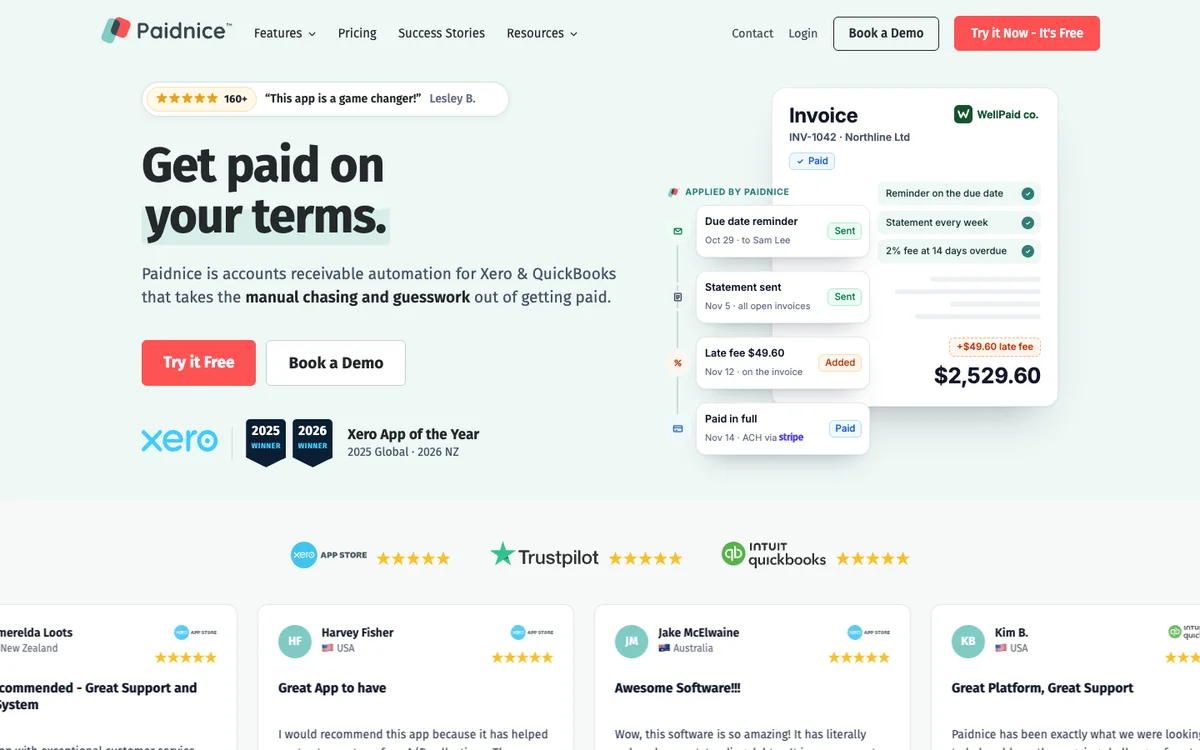
Reminder sequences, statement schedules, installment plans, a payer portal and the late fee policy all attach to a customer group, so the rule is defined once for a segment of the rent roll and then runs against it every month without anyone opening the account.
Email and SMS leave from the agency’s own authenticated domain, so what a tenant sees in the inbox is the name printed on the lease. Payment plans and sending from your own domain start on Pro.
One portfolio is several books at once. A residential tenant on a monthly charge, a leaseholder opening an annual service-charge demand and a commercial tenant on net 30 want three tones, three timings and three fee rules, and because policies hang off customer groups all three run simultaneously.
A service charge under query is lifted out of its policy by invoice reference, so the account stays in its group while the disputed line stops being chased. Statement interest is recalculated as the statement leaves rather than at the last policy run, so the balance the tenant opens is the balance that morning.
Limitations with Paidnice. Xero and QuickBooks Online are on every plan, and newer ledgers such as Rillet, Campfire, Digits, DualEntry, Puzzle, Accounting Seed and Odoo are available on every plan through Paidnice's closed testing program. NetSuite, Sage Intacct, MYOB, Dynamics 365 Business Central, Sage Accounting and other ERPs connect on the Custom plan as a build rather than a standard connector.
No rent roll, no tenancy record and no maintenance job live here, so it runs beside a property platform and never instead of one. Essentials stops at two team members, which a managing agent with a leasing assistant and a property accountant passes on day one.
And on the rating criterion the 5.0 from 84 above is beaten by Chaser's 4.98 from 374, because the second number is the larger verified base.
Prefer to watch? Here is the video version of this review.
2. Chaser, best for commercial rent rolls
Best for: Management companies with a named credit controller and a commercial rent roll, under £4m of revenue on the entry tier.
What is Chaser best for?
For a property team chasing a small number of large commercial invoices that wants email, SMS, posted letters and recorded calls in one schedule, plus a credit check before net 30 is agreed with a new tenant.
- Fits
- Businesses with a named credit controller; Compact is priced for revenue under £4m, Core from £4m, and the tiers run to £100m
- Regions
- UK-registered, trading since 2014, sells worldwide
- Entry cost
- £199/mo on Compact for revenue under £4m with 4 users; Core £599/mo under £10m; Complete £899/mo to £100m.
- Rated
- 4.98 from 374 Xero App Store reviews; 4.3 from 71 on G2; 4.9 from 45 on Capterra
- Awards
- Finalist, UK Small Business App Partner of the Year, Xero Awards 2023
- Runs on
- Xero, QuickBooks, Sage 50, Sage 200, Sage Intacct, Sage Business Cloud Accounting, NetSuite, Dynamics 365 Business Central, AccountsIQ, SAP, HubSpot, Gmail, Outlook
- Late fees and interest
- Yes. Four calculation types, recalculated daily, but one set of late-fee rules, across the account or for selected debtors, not tied to schedules, with no documented way to run different rules per group. No fee is raised on payment-plan invoices, and Chaser's help says a late fee cannot be added or updated after a part payment when written to Xero
- Customers
- Named on its website: Runway East, Huttie and The Community Energy Scheme. The Community Energy Scheme's case study reports £800,000 of old debt reclaimed.
Chaser has traded since 2014 and sends from the team’s own Gmail or Outlook mailbox, adding SMS, posted letters, a payer portal and partner collections. The channel ladder is what a commercial rent roll buys it for.
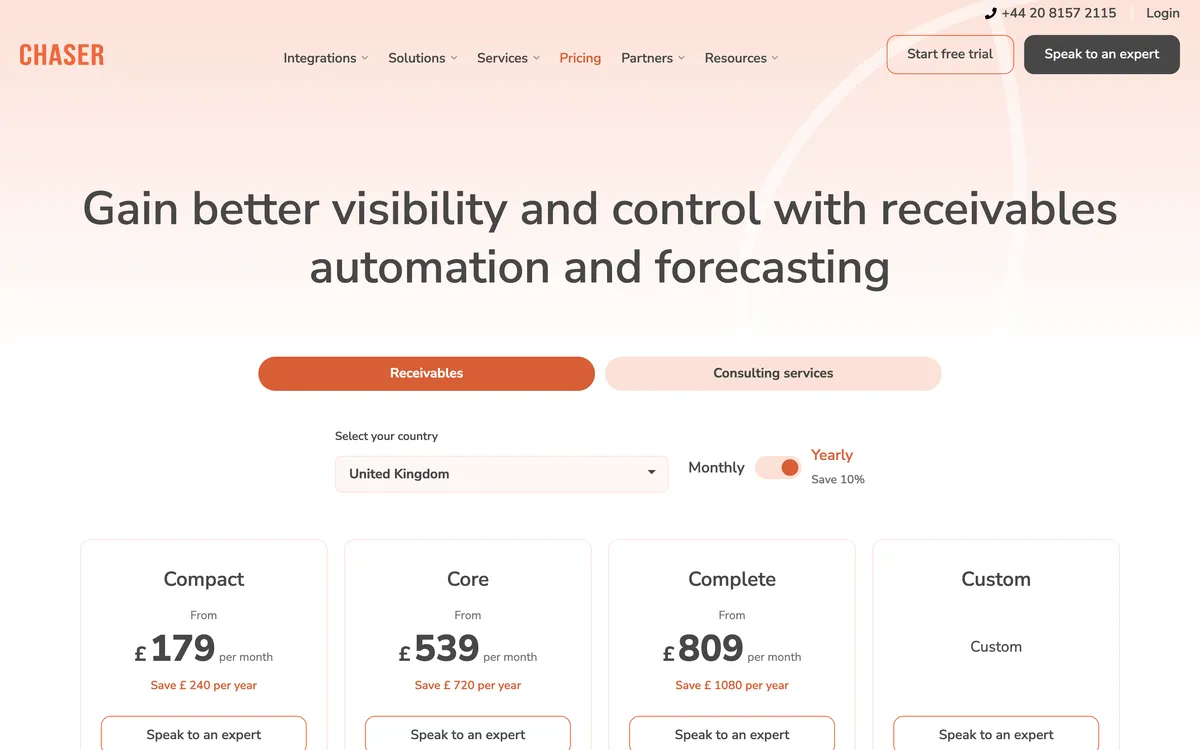
A letter delivered to a registered office against a quarterly rent demand is read by somebody different from the person ignoring the fifth email to the accounts payable inbox.
The in-app credit report comes from Creditsafe, carrying a score, a recommended limit, the customer’s payment score, credit event history, filing and director data, and continuous monitoring.
Limitations with Chaser. It has one set of late-fee rules, across the account or for selected debtors, not tied to schedules, and no documented way to run different rules per group, so a residential tenant and a commercial covenant it covers are charged under the same rules.
Chaser raises no fee on a payment-plan invoice, and its help says a late fee cannot be added or updated after a part payment when written to Xero, which on a rent roll is most of the arrears book. Statements are monthly and land on a day Chaser fixes, which will not line up with a quarterly service-charge cycle. Compact holds the team to four.
Chaser prices by revenue band, so the bill follows the size of the management business rather than the size of the ledger.
3. ezyCollect, best for ANZ Xero or MYOB
Best for: Property managers on Xero or MYOB in Australia and New Zealand, priced by debtor count.
What is ezyCollect best for?
For a management company with a long arrears list that wants every open charge on a tenant consolidated into one chase, with credit insight and a referral to a collections partner at the end of the sequence.
- Fits
- Businesses on Xero or MYOB in Australia and New Zealand. No revenue band published; tiers are set by debtor count, from 200 debtors and 3 users on the entry plan to 3,000 debtors and 20 users
- Regions
- Sydney head office, founded 2014, acquired by Sidetrade in October 2025; sells mainly in Australia and New Zealand
- Entry cost
- ezyCollect's last published prices were A$275 a month for ezyStart on annual billing, with a setup fee from A$900; monthly billing adds 20%. ezyGrow A$950/mo, ezyScale A$2,350/mo, ezyUltimate on quote. Current prices are hidden and must be requested. Last published on ezyCollect's pricing page, seen on the Wayback Machine.
- Rated
- 4.9 from 35 Xero App Store reviews; 4.7 from 25 on G2; 4.9 from 12 on Capterra
- Awards
- Not published
- Runs on
- Xero, MYOB AccountRight, Exo, Essentials and Acumatica, NetSuite, Dynamics, Sage 300 and Sage Intacct, SAP Business One, Pronto Xi, CSV; QuickBooks logo on homepage, no connector page
- Late fees and interest
- None found. No late fee or interest function appears anywhere in the vendor’s help center or in its relaunch materials; card surcharging is the only charge it adds
- Customers
- Named on its website: Feral Brewing, Hampers with Bite and Skillinvest. Feral Brewing's case study reports overdue accounts cut by over 50%.
ezyCollect works the customer rather than the invoice: a pre-reminder, then a set of follow-up steps (six in the help center's example) spread across email, SMS, letter and call tasks, with monthly statements and a payment hub where a tenant sees and settles everything outstanding in one place.

That shape suits a tenant carrying rent, a service charge and a repair recharge at the same time, because all three arrive as one conversation. Installments split a balance weekly through to monthly and direct debit collects them.
Credit Insights scores each account from your own aged trial balance, the terms you granted and external bureau data, then sorts the ledger into risk bands.
At the end of the sequence the platform issues an in-app demand letter or hands the account to a collections partner, which is the step a managing agent reaches for when an arrears balance has stopped moving and the owner is asking what happens next.
Limitations with ezyCollect.
- No late fee or interest is computed, so the interest clause written into the lease is enforced by a person or not at all.
- A tenant that runs past the end of a workflow stops being followed up, which on a long-running arrears account is exactly when the follow-up mattered.
- SMS, mail and fax are billed above the subscription, demand letters cost A$49 plus GST each, and a referred account runs from 25% of what is recovered.
- The entry plan holds 200 debtors, one workflow and three users, a ceiling a mid-sized portfolio passes quickly, and the setup fee is charged before any of it runs.
- The footprint is Australia and New Zealand, and the review base is thin and mostly older than 2024.
4. BILL, best for payables and receivables
Best for: Management companies that want payables and receivables on one platform, priced per user.
What is BILL best for?
For a US management company already paying owners and vendors in BILL that wants tenant invoicing, ACH and card acceptance in the same system rather than a second one.
- Fits
- US management companies already running payables in BILL. No revenue band published; the product is priced per user
- Regions
- San Jose head office, founded 2006, listed on the NYSE, selling mainly in the United States
- Entry cost
- $49 per user a month on Essentials, $65 on Team, $89 on Corporate, plus transaction fees of $0.59 an ACH payment, 2.9% on cards and $1.99 on a mailed check.
- Rated
- 4.4 from 1,806 G2 reviews; 4.1 from 563 on Capterra
- Awards
- Not published
- Runs on
- CSV import and export on Essentials; two-way QuickBooks Online and Xero sync from Team; NetSuite, Sage Intacct, Dynamics, Acumatica and QuickBooks Enterprise on Enterprise
- Late fees and interest
- None found. No native late fee or interest function on the receivables side; fees raised in QuickBooks Desktop sync in, but nothing calculates one
- Customers
- Named on its website (mostly payables): Marine Layer, KiwiCo and Spikeball.
BILL is a payables platform carrying a receivables module, and the pull for a management company is that owner disbursements and tenant invoicing sit in the same system. Invoices are built from templates with a live preview and go out by email or US mail, and a payment link reaches the tenant who will never sign in to a portal.
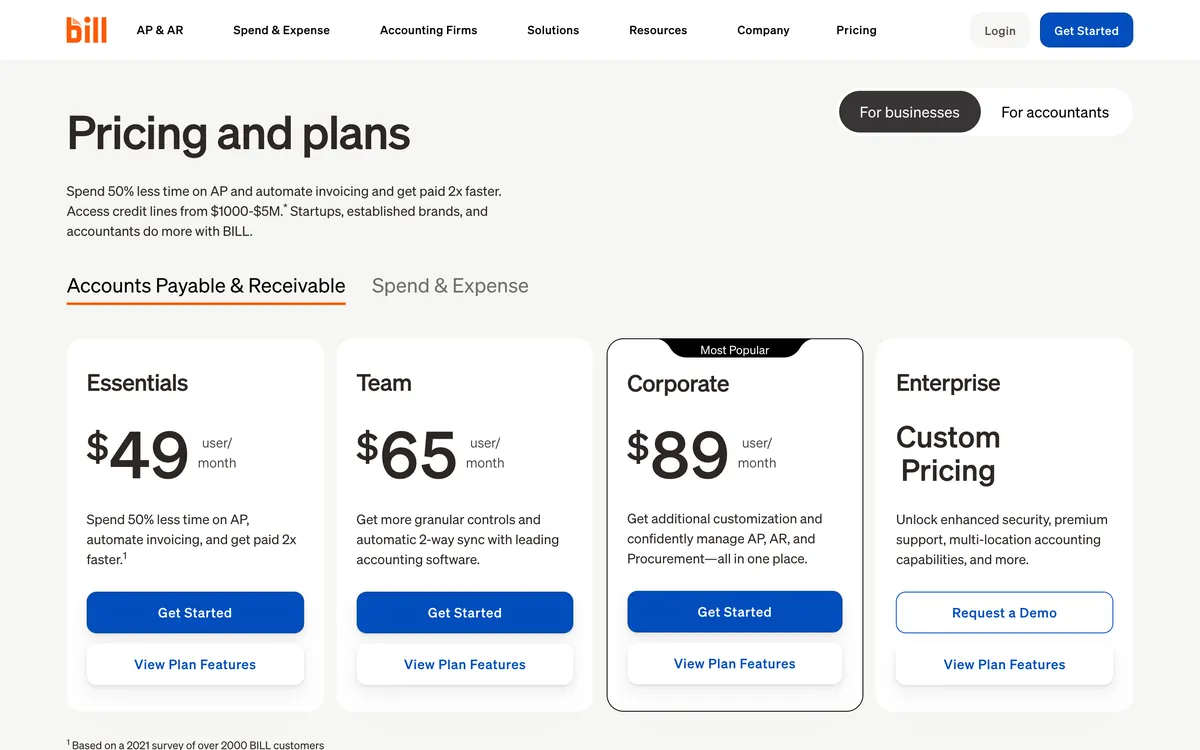
The receivables ceiling arrives fast. Automatic reminders stop at three templates set for the whole company, so the timing cannot change for one account, and the reminder goes to every contact on any customer carrying a balance, including the tenant who has already part paid this month.
On a rent roll that is the wrong default in both directions. Two-way accounting sync starts on the Team tier at $65 per user a month, and Essentials moves data by CSV.
Limitations with BILL. Three reminder templates for the entire company means a residential group and a commercial group are chased identically, which is the one thing a mixed portfolio cannot live with.
No fee or interest calculation, no statements and no installment schedules, so a repayment arrangement with a tenant in arrears becomes a recurring invoice with a placeholder amount on it. Estimates and quotes are not offered.
Pricing is per seat with transaction fees stacked on top, so a property team of six pays six times before a tenant pays once, and the receivables side has drawn no visible investment while the AI work has gone to payables.
5. Satago, best for UK bureau credit data
Best for: UK management companies on Sage 50 or Xero that want credit data with their chasing, no revenue band published.
What is Satago best for?
For a UK managing agent on Sage 50 or Xero that wants credit reports and invoice finance from the same provider that runs its service-charge and commercial rent chasing.
- Fits
- UK businesses in the Sage and Xero ecosystem. No revenue band published
- Regions
- United Kingdom only
- Entry cost
- £25/mo Standard and £45/mo Plus inside Sage 50, with Plus included on selected Sage 50 subscriptions; standalone £45/mo Basic, £80 Premium, £200 Platinum.
- Rated
- 4.93 from 92 Xero App Store reviews, UK listing
- Awards
- Not published
- Runs on
- Xero, Sage, Sage 50, QuickBooks, KashFlow, FreeAgent
- Late fees and interest
- Optional. Late fees are calculated in line with statutory limits and added to payment reminders once an invoice is overdue
Satago is a UK hybrid, with automated chasing and risk insights on one side and single and full invoice finance on the other. The Sage 50 embedded edition undercuts the standalone app at £25 a month on Standard, and Sage says the Plus tier comes with selected Sage 50 subscriptions without naming which ones.
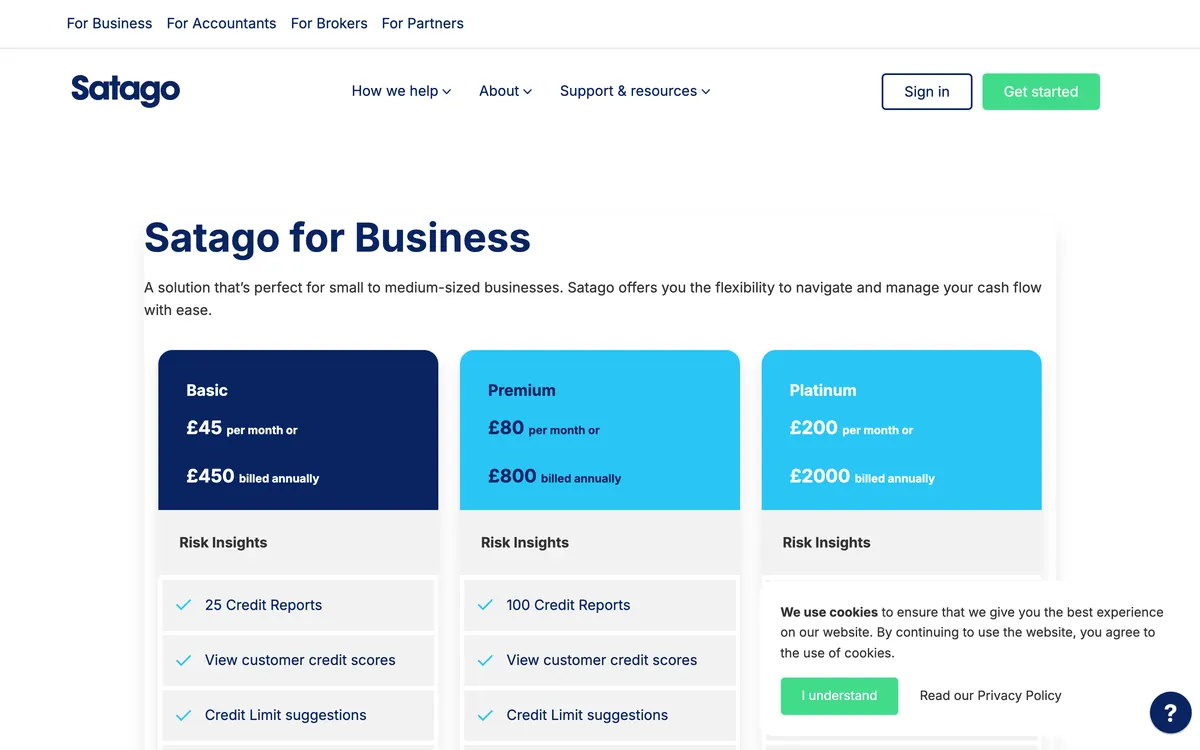
The embedded bundle covers reminders, statements, thank-you emails, customer grouping and scheduling, which is enough to hold leaseholders and commercial tenants apart on a Sage 50 ledger. The lending side is the part a managing agent reacts to, because a block’s costs fall due on a schedule the service-charge collection does not match.
Limitations with Satago. Basic holds you to 100 email reminders a month and does not list own-inbox sending; your own inbox starts at the £80 Premium tier.
Its late fee is optional and added to reminder emails. The footprint stops at the United Kingdom, which removes it for any agent holding property in more than one country.
Which tools can charge a tenant a late fee on behalf of an owner?
Three of the five compute the charge without help from the ledger. Paidnice attaches a policy to a customer group; Chaser runs the same kinds of calculation behind one set of late-fee rules; Satago adds an optional late fee to its reminder emails. No interest function is documented for ezyCollect or BILL.
In the United States the charge is a contract term rather than a statutory right, written into the lease before it can be raised, and state and local rules cap what a residential lease may charge at all.
The rule that mostly does not fire
Chaser raises no fee on a payment-plan invoice, and its help says a late fee cannot be added or updated after a part payment when written to Xero. On a trading ledger that is a small carve-out.
On an arrears book it is close to the whole population, because part paid is the normal state of a tenant in arrears: they clear $400 of a $1,200 balance, then $300, and the account is never at zero and never at full.
Paidnice hangs policies under customer groups instead, so a residential group, a commercial group and a group of service charges under query each carry their own rule at the same time, and the charge lands on the ledger as Draft or Approved rather than only as a message.
Behind Chaser’s one set of late-fee rules are four calculation types recalculated daily, which is a capable engine with no documented way to run different rules per group. Paidnice offers an annual rate prorated per day or a flat percentage of the balance, an invoice fee and a statement charge available together on the same group, and several policies live at once.
What a late fee is worth on one month of overdue rent
$3,500 of rent, 45 days late, at 12% a year: the charge is $51.78 today, another $34.52 every 30 days after that, and $103.56 by the time the account is 90 days down.
Client money, trust accounts and where the charge posts
A managing agent holding rent is holding somebody else’s money, usually in a designated client account under a regulator’s rules. Raising a charge against a tenant inside that arrangement is an accounting decision before it is a collections decision, and it is the question none of the five tools answers.
The charge is owner income by default. The lease is between the tenant and the landlord, so a late fee arising under it accrues to the landlord, and the agent is collecting it in the same capacity as the rent underneath it.
Some management agreements assign fees and interest to the agent, some split them, and most say nothing, which means the correct posting differs block by block on the same ledger.
That is the reason the Draft or Approved distinction on the ledger matters more here than anywhere else in this comparison. A charge raised as Draft exists, is dated, is attached to the account and has not yet become a receivable, so it can go to the owner for approval before it reaches the tenant.
A charge raised as Approved is live the moment the rule fires. Paidnice is the tool on this page that documents the choice; the others either raise nothing or do not say.
The rules underneath differ by market and none of the five implements any of them. UK client money protection requires rent and service-charge funds to be held separately and reconciled, and service charge monies sit under their own statutory treatment again.
In the United States, residential late fees are capped by state and sometimes city rule, both as a percentage and as a grace period, so the same policy is legal in one portfolio and not in the next.
In Australia and New Zealand, trust accounting rules govern the account the money passes through rather than the fee itself. Every one of those is configured outside the software, in the chart of accounts and the management agreement, and the tool only decides whether the charge is raised consistently once somebody has done that work.
Residential and commercial on the same rent roll
Most portfolios are a mix, and the mix decides the shortlist more reliably than the management fee income does.
- Residential only, one person on collections. High volume, small balances, a fixed due date and a fee capped by local rule. Paidnice at £49 (US$69) a month if the charge matters as much as the reminder, or Satago at £25 inside Sage 50 for a UK agent that wants chasing and bureau credit data and nothing more.
- Mixed, with the commercial side now material. Two populations that need different tone and different timing on one ledger. Paidnice for per-group policies on flat pricing, Chaser at £199 a month if letters and calls and a covenant check before signing are the reason you are buying, ezyCollect at A$275 a month (last published; now hidden, request a quote) in Australia and New Zealand when the arrears list has grown long.
- Commercial-weighted, quarterly cycle. Few tenants, large demands, purchase orders and payment runs, so this behaves like any business-to-business ledger. Chaser's Core tier at £599 a month for one system across a bigger book, ezyCollect's ezyGrow at A$950 for 500 debtors, or Paidnice on a higher invoice tier when the quarterly statement schedule is the deciding feature.
- A block-management team that keeps hiring. Count the seats before you count the features. BILL at $49 to $89 per user and ezyCollect's user caps both move with headcount, and a property team that grows faster than its invoice count pays for that growth twice.
Arrears repayment: what a tool does when a tenant is already paying it down
A tenant in arrears who has agreed to clear it over four months is the most common live account on a rent roll, and it is the account most tools handle worst. Paidnice (on Pro), Chaser and ezyCollect all schedule installments against an open balance; no installment function is documented for BILL, and Satago adds an optional late fee to its reminder emails.
What chases the plan decides whether the plan holds. Chaser splits a balance weekly through to yearly, but the chasing keeps following the original due date rather than the installment dates, and its own documentation advises chasing the installments manually.
ezyCollect splits weekly through to monthly and collects by direct debit, which is the right mechanism for a residential arrears plan, though the feature has to be turned on by support rather than by you.
BILL offers recurring invoices with auto-charge and tells you to use a placeholder invoice when the amount varies, which is a standing order rather than a repayment schedule.
Keep the two instruments apart. A rent schedule posts next month’s charge, forward looking, on the lease. A repayment plan splits a balance that already exists and is already late, and it sits on top of the rent that keeps arriving underneath it.
A tenant on a plan is therefore paying two things at once, which is why the fee rule that skips part-paid invoices matters so much on this book and why the statement, rather than the invoice reminder, is the document that tells the tenant where they stand.
Where AR software stops and the property platform starts
Buildium, AppFolio and Yardi hold the lease, post the rent charge, run the tenant portal and produce the owner report. None of them is a chasing layer over the agent's own invoicing, and that is where the management fee, the repair recharge and the commercial service-charge demand sit.
The invoiced side grows as a portfolio moves commercial. A residential tenant on a monthly charge either pays by standing order or does not.
A commercial tenant raises a purchase order, waits for a payment run and settles on net 30, and from that point the receivable behaves like any business-to-business receivable, which is precisely what the five tools above were built to work.
- Chasing that varies by group: tone, timing and channel defined per segment, so the residential arrears list and the commercial covenant on net 30 stop sharing a template.
- A clause that enforces itself: the fee written into the lease is only real if the charge appears without anyone deciding, on the fifth of every month, which tenants deserve it.
- Live reads from the ledger: invoices and payments pulled from Xero, QuickBooks Online or Sage as they land, so the chase stops the morning a tenant pays.
- Statements on your cycle: one document covering every open charge on an account, issued when the service-charge cycle says so rather than on a fixed day the vendor chose.
- Repayment schedules that are chased: installments set against arrears that already exist, with the installment dates driving the follow-up rather than the original due date.
Running these alongside Xero, QuickBooks or a property ledger
None of these tools reads a property platform. Each one reads the accounting ledger the platform posts into, so the question is which ledger sits in the middle of your stack, and the answer cuts the shortlist faster than price does.
- Xero in the middle. The widest field: Paidnice, Chaser, ezyCollect and Satago all connect, with BILL syncing two ways from the Team tier at $65 per user a month.
- QuickBooks Online in the middle. The same four connect. BILL's sync also starts on Team, and Essentials moves data by CSV alone, which is not a live view of an arrears book.
- A Sage 50 or Sage 200 practice ledger. Satago, embedded, and Chaser. Paidnice does not serve Sage 50 or Sage 200, and ezyCollect covers Sage 300 and Sage Intacct rather than the Sage 50 line, so the UK block-management default is a short list.
- MYOB, for an Australian or New Zealand agency. ezyCollect across AccountRight, Exo, Essentials and Acumatica, which is why it is the answer in that market. Paidnice reaches MYOB, NetSuite, Sage Intacct and Dynamics 365 Business Central on its Custom plan only, as a build rather than a connector.
What this costs against a month of arrears
Set the subscription against what the portfolio is carrying. Published entry prices are £45 a month for Satago (£25 inside Sage 50), $49 per user for BILL, £49 (US$69) for Paidnice, £199 for Chaser, and A$275 for ezyCollect on annual billing with A$900 of setup first (last published; now hidden, request a quote).
A single mid-sized block sitting a month down on rent covers most of that list.
The metric decides the bill. BILL charges per seat, so a property team of six pays six times before a single transaction fee. ezyCollect prices on debtor count, which is the one number a growing portfolio moves fastest, and adds setup on top.
Chaser prices on company revenue, so acquiring a management contract moves the software bill whether or not the tenant count moved with it.
Paidnice prices on invoice volume, flat, with no per-seat charge, which is the shape that survives hiring a second property accountant and a leasing assistant in the same year.
Then there are the rails, which sit outside every subscription here. BILL adds $0.59 per ACH payment and 2.9% on cards, ezyCollect charges a monthly gateway fee above its card rate, and both bill for mailed letters.
Which accounts receivable software for property management fits your use case?
| Use case | Start with | Watch out |
|---|---|---|
| Mixed residential and commercial portfolio on Xero or QuickBooks Online | Paidnice | Essentials holds two team members; Pro from £74 (US$99) has unlimited users |
| Commercial rent roll that needs letters, calls and a covenant credit check | Chaser | One set of late-fee rules; no fee on payment-plan invoices, none added after a part payment (Xero) |
| Australian or New Zealand agency on MYOB with a long arrears list | ezyCollect | No late fee or interest; setup from A$900 on the last published price |
| US company already paying owners and vendors in BILL | BILL | Three company-wide reminder templates and no statements |
| UK agent on Sage 50 that wants chasing and bureau credit data | Satago | Late fee sits in reminder emails; ledger posting not documented |
| Property team that keeps hiring | Paidnice | Priced on invoice volume with no per-seat fee; BILL and ezyCollect costs move with headcount |
Questions managing agents ask
What is the best accounts receivable software for property management in 2026?
On Xero or QuickBooks Online, Paidnice, because reminder, fee policy and statement schedule are all defined per customer group, so residential and commercial accounts carry different rules simultaneously, from $69 a month. For a commercial rent roll where letters and recorded calls belong in the same schedule as the email, Chaser at £199 a month.
Do I still need a property platform if I use AR software?
Usually yes. A property platform holds the lease, the rent roll, the tenant record and the maintenance job, while accounts receivable software chases what is already invoiced on your ledger, raises the late fee and sends the statement. Most management companies run one of each, with Xero or QuickBooks Online in the middle.
Which tools apply late fees to overdue rent automatically?
Three of them: Paidnice runs a policy per customer group and posts the charge to the tenant's ledger as Draft or Approved, with compounding on by default.
Chaser runs four calculation types behind one set of late-fee rules and, per its help, cannot add or update a late fee after a part payment when written to Xero. Satago adds an optional late fee to its reminder emails. Neither ezyCollect nor BILL documents a fee or interest function.
Can these tools send recurring tenant and service-charge statements?
Paidnice sends statements on any schedule, including consolidated parent accounts for a landlord with several units under one account. Chaser sends statements monthly only, on a fixed day, and ezyCollect sends monthly statements. Satago's embedded Sage 50 bundle includes them, and no statement function is documented for BILL.
How much does property management AR software cost?
Satago is from £45 a month (£25 inside Sage 50), BILL is $49 to $89 per seat plus transaction fees, and Paidnice is £49 (US$69) on Essentials with two team members and from £74 (US$99) on Pro with unlimited users.
Chaser Compact is £199 a month for revenue under £4m, with Core from £599, and ezyCollect is A$275 (last published; now hidden, request a quote) billed annually with setup from A$900 before it starts.
Can I chase residential tenants and commercial tenants differently?
Paidnice runs reminder sequences, late fee policies and statement schedules per customer group, so a residential group and a commercial group never share a rule.
Chaser varies the schedule but keeps one set of late fee rules, and ezyCollect runs customer-level workflows. BILL caps automatic reminders at three templates configured for the whole company, so timing cannot change for a single account.
What about arrears that a tenant is repaying over time?
Paidnice (on Pro), Chaser and ezyCollect all schedule installments against an open balance. The detail to check is what chases the schedule: Chaser's chasing follows the original invoice due date rather than the installment dates, and its own documentation advises chasing the installments manually. No installment function is documented for BILL.
Do I need AR software if my accounting package sends reminders?
The built-in reminder is one template on one schedule for everybody on the roll. It raises no charge, cannot tell a leaseholder from a commercial covenant, issues no statement on your cycle and reports nothing back about whether any of it brought the money in.
To compare the same tools for any business type, read the best credit control software guide, which sets out six tools by size, ledger and price.
Related reading for property managers
Buyer's guide
Best accounts receivable software (by business type)
The pillar guide: pick by size and accounting system, with a recommendation matrix.
Construction
Best AR software for construction and trades
Chase retainage and slow general contractors, and enforce your terms.
Payment plans
Best payment plan software
Installment plans against invoices that already exist, compared.
United Kingdom
Best credit control software for UK SMEs
UK statutory interest, chasing and credit risk, compared.
Sources
12 sources, checked by Julie Turnbridge on November 3, 2026
- Xero Small Business Insights xero.com/resources/small-business-insights/latest-united-...
- Xero App Store apps.xero.com/uk/app/paidnice
- Capterra capterra.com/p/254868/Paidnice
- Xero App Store apps.xero.com/uk/app/chaser
- G2 g2.com/products/chaser/reviews
- Capterra capterra.com/p/157101/CHASER
- Wayback Machine web.archive.org/web/20240617113004/https://ezycollect.io/...
- Xero App Store apps.xero.com/au/app/ezycollect
- G2 g2.com/products/ezycollect/reviews
- Capterra capterra.com/p/135729/ezyCollect
- G2 g2.com/products/bill-ap-ar/reviews
- Capterra capterra.com/p/166559/BILL