The best Chaser alternative in 2026 is Paidnice, for a team leaving Chaser over its one set of late-fee rules: it applies UK statutory interest per customer group, from £49 (US$69) a month.
Upflow, Satago, Credit Hound, Kolleno and ezyCollect complete the six, compared on fit for a team leaving Chaser, whether the tool applies late fees and statutory interest itself, and published entry price. Prices from £20 per user a month.
| Tool | Best for |
|---|---|
| Paidnice | teams leaving Chaser over the one set of late-fee rules or the entry price, on Xero or QuickBooks Online |
| Upflow | a leaver whose real complaint is that nobody can see the collections function, gross invoice value tiers, no printed price |
| Satago | keeping the credit reports and adding a funding line, on Sage 50 or Xero, at an eighth of Compact |
On Xero Small Business Insights data, the wait to be paid in the United Kingdom is 29.3 days, down from 29.6, and the average invoice settles 8.3 days past due against 9.2 a year before.
What is credit control software?
Credit control software chases unpaid invoices for you. It reads the open invoices in your accounting ledger and works them through a schedule you set, so a person steps in only when a customer replies or disputes.
- Reminder sequences by email, with SMS, letters or call tasks on some tools
- Customer statements, on a fixed day or on your own schedule
- Late fees and UK statutory interest, on the two tools that apply them
- A payment portal where the customer views and pays the invoice
- Payment plans that split an invoice into instalments
- Credit checks, and an escalation path when the chasing stops working
It is not your accounting system. Xero, QuickBooks Online or Sage stays the ledger. The chasing tool reads it and, where it charges a fee, posts the charge back into it.
It is not a debt collection agency. Chaser and ezyCollect can refer an uncollected debt to a partner, but that referral leaves the software and goes to a collector who takes a share of what is recovered.
It is not invoice finance. An instalment plan only moves the dates and leaves the credit risk with you. A finance provider such as Satago settles the invoice and takes the risk on, which is a lending product sold beside the software.
Reminders and statements alone are a full use case. Late fees, credit checks and finance are options you add when your ledger needs them.
How this list was put together
This list helps a UK team leaving Chaser find a tool that fits its ledger, its fee policy and its budget.
| What we checked | Where the evidence came from |
|---|---|
| Ledger integrations | Vendor integration pages for Xero, QuickBooks Online, Sage and the ERPs |
| Late fees and statutory interest under the Late Payment of Commercial Debts (Interest) Act 1998 | Vendor help pages on fees and interest |
| Published entry price | The vendor's pricing page, and the last reported price where it is now hidden |
| Statements, payment plans and a portal | Vendor feature pages |
| Credit checks | Vendor product pages |
| Rating and review count | The Xero App Store, the Sage UK Marketplace or G2 |
Why do teams leave Chaser?
Chaser is the incumbent, with 374 Xero App Store reviews behind it and a feature surface most of its rivals do not match, so a reader on this page has usually decided to leave already.
Trading since 2014, Chaser rates 4.98 from 374 Xero App Store reviews and 4.3 from 71 on G2. Reminders leave from the team’s own Gmail or Outlook mailbox, with SMS, posted letters and one-way automated calls behind them, a payer portal in front, Creditsafe credit reports inside and a referral to a collections partner at the end.
The fee engine carries four calculation types, one of them indexed to the Bank of England base rate and recalculated daily, and then runs the result as one set of rules for the account, at one rate for every debtor it covers, raising nothing at all on invoices that are on a payment plan or have been part paid.
Statements go out monthly, on a fixed day, and neither the recipients nor the senders can be changed. Payment plans split an invoice weekly through to yearly, and the chasing keeps following the original invoice due date instead of the instalment dates.
Then the bill. Compact is £199 a month for revenue under £4m with four users, Core £599 under £10m and Complete £899 to £100m, and Chaser prices by revenue band. Chaser offers a free trial (10 days on the Xero listing) or a conversation with an expert; no minimum term, 10% off yearly billing. Check current pricing with the vendor.
What you carry out of Chaser, and what you leave behind
Four things in a Chaser instance are not features you can tick off a comparison table: the mailbox your reminders leave from, the Creditsafe report behind each customer, the channels billed by credit, and the managed service. Each one gets a different answer from each replacement.
| What Chaser gives you | What happens when you leave |
|---|---|
| Sending identity | Chaser sends from your own Gmail or Outlook mailbox on every plan, so replies land in an inbox somebody already reads. Paidnice sends from your own domain on Pro, or through a connected Gmail or Outlook (Microsoft 365) mailbox, which keeps your address on the envelope and lets you point the replies wherever you want them. Satago’s standalone Basic tier does not list own-inbox sending, and your own inbox starts at the £80 Premium tier. Settle this before you look at features: a change of sending address is the one migration step your customers actually notice. |
| Creditsafe credit reports | A score with a recommended limit, the customer’s payment score, credit event history, Companies House filing and director data, and continuous monitoring. Chaser credit checks are sold by credit on any plan and need Chaser billing, not Xero App Store billing; monitoring is not offered in Australia. Satago carries its own credit reports, scores and suggested limits; ezyCollect carries Experian data for Australian and New Zealand buyers; Kolleno carries AI scores with bureau integrations. Credit Hound carries no bureau at all. Paidnice runs native credit checks from each customer's payment behaviour, and Creditsafe bureau checks through the API on the Custom plan. |
| Channels billed by credit | SMS, posted letters and one-way automated calls, metered, with the calls unavailable in New Zealand. Paidnice carries email and SMS, posted letters at £1.50 each in the UK, plus in-app calls a person makes, recorded and transcribed. ezyCollect carries email, SMS, post, fax and call tasks, also metered. Credit Hound, Satago and Upflow narrow you towards email. Kolleno includes 100 to 600 calls a plan. Its pricing page does not say which actions a workflow can hold. |
| Chaser Care and the referral | The managed service bundled with the software from £899 a month, plus referral of uncollected debt to a partner. ezyCollect is the only alternative with the same escalation shape: demand letters at A$49 each and agency referral from 25% of what is recovered. Satago finances the invoice instead of collecting it. Nothing else here replaces a person doing the chasing. |
Two of those four cut a shortlist in half before price is discussed. If the credit report is what you actually use Chaser for, the list is Satago in the United Kingdom and ezyCollect in Australia and New Zealand, whatever the fee engines do. Consider Paidnice for the chasing around the report.
If Chaser Care is what you use, you are shopping for a supplier rather than for software. Consider Paidnice for the chasing around the managed service, with escalation workflows.
Migration has a cost too: your reminder schedules and your templates do not export. Every replacement here starts from a blank sequence, so budget a working week of somebody’s attention to rebuild them.
How do the six Chaser alternatives compare?
Chaser is the first column, as the baseline everything else is read against. Only Paidnice applies UK statutory interest itself, and it does it per customer group. Satago and Credit Hound sit well under £199, Kolleno and Upflow sit above the UK SME band entirely, and ezyCollect is the Australian and New Zealand answer.
 |
 |
 |
 |
 |
 |
 |
|
|---|---|---|---|---|---|---|---|
| Best for | The baseline: wide ledger list, Creditsafe reports, managed service | Fee policy per customer group, on Xero or QuickBooks Online | Collections analytics over enforcement, quoted by gross invoice value | Credit reports and invoice finance, on Sage 50 or Xero | A Sage credit controller’s daily call list, per user | Cash application for order-to-cash teams on NetSuite or SAP | Australian and New Zealand trade credit with Experian data |
| Revenue fit | Compact under £4m, Core from £4m, Complete to £100m | Any size up to $50m a year, or 50,000 invoices a year | Gross invoice value tiers, up to $10m through above $100m | Not published | Not published | Under £1m on BusinessPay, tiers to £1bn and above | Not published (200 to 3,000 debtors by tier) |
| From (monthly) | £199 | £49 | Not published | £25 (inside Sage 50) | £20 per user (Sage Accounting) | $650 per user | A$275 a month for ezyStart, setup from A$900 (last published; current prices hidden and must be requested) |
| Ledger integrations | Xero, QuickBooks, Sage, NetSuite, Dynamics 365 Business Central | Xero, QuickBooks Online | Xero, QuickBooks Online, NetSuite, Sage Intacct, Stripe Billing, Chargebee, Zuora | Xero, Sage, Sage 50, QuickBooks, KashFlow, FreeAgent | Sage 50, Sage 200, Sage Intacct, Xero | NetSuite, SAP, Sage Intacct, Business Central, Xero, QuickBooks Online | Xero, MYOB, NetSuite, Sage 300, Sage Intacct, SAP Business One, Pronto Xi; QuickBooks logo on homepage, no connector page |
| Late fee grain | Yes (one set of rules for the account) | Yes (per customer group) | No (via your ERP only) | Not documented | None found | None found | None found |
| Statements | Yes (monthly, fixed day) | Yes (any schedule) | Portal PDF statement, no scheduled send | Yes | None found | Yes (in the portal) | Yes (monthly) |
| Payment plans | Yes (chased on the invoice due date) | Yes | No | Not documented | None found | Yes | Yes |
| Portal | Yes | Yes | Yes | Not documented | No (PayThem payment links only) | Yes | Yes |
| Credit checks | Yes (Creditsafe) | Yes: native checks from payment behaviour, plus Creditsafe via API on the Custom plan | Yes (light scoring) | Yes (credit reports and limits) | No (limits read from your ledger) | Yes (AI scores, bureau integrations) | Yes (Experian data) |
| AI | Advanced Reads customer replies, drafts answers and follow-up actions (like PO updates) for your approval; MCP server for Claude, ChatGPT and other agents | Advanced Collections and cash application agents, from suggest-only to autonomous (Scale plan and up; Cash Application Agent on Accelerate) | None No AI feature found | None No named AI feature | Advanced Insights, Copilot drafts and an autonomous Agent; AI agent support from Business Plus, fully automated agent runs and AP portal features billed separately by token use | Basic an AI email template generator as a paid add-on | |
| Rated (source, count) | 4.98 (374, Xero App Store) | 5.0 (84, Xero App Store) | 4.8 (235, G2) | 4.93 (92, Xero App Store) | 5.0 (12, Sage UK Marketplace) | 4.9 (117, G2) | 4.9 (35, Xero App Store AU) |
The first column is Chaser, as the baseline the other six are measured against. "Not documented": the vendor does not document the capability. "Not published": the vendor does not print a price. "None found": no evidence either way. Prices are the vendor's published from-price.
Six of the tools on this page in five checked facts
- Four of the six publish a starting price: Chaser from £199, Paidnice from £49 (US$69), Satago from £45 a month (£25 inside Sage 50) and Kolleno from US$650. Upflow and ezyCollect quote.
- Five of the six connect to both Xero and QuickBooks Online; ezyCollect shows a QuickBooks logo on its homepage but no connector page.
- AI that handles collections work or customer replies: Paidnice, Upflow and Kolleno. AI that scores or predicts only: ezyCollect. No AI in receivables: Satago.
Credit Hound is not in our checked dataset yet.
1. Paidnice, best for per-group late-fee rules
Best for: Teams leaving Chaser over the one set of late-fee rules or the entry price, on Xero or QuickBooks Online.
What is Paidnice best for?
For a Xero or QuickBooks Online business that wants the chasing Chaser does, with a fee and interest policy that varies by customer group instead of one rule for everyone.
- Fits
- Businesses on Xero or QuickBooks Online of any size up to $50m a year, or 50,000 invoices a year, with or without a credit controller
- Regions
- United Kingdom, Australia, New Zealand, United States, Canada, South Africa
- Entry cost
- £49 (US$69) a month on Essentials, £49 (US$69) in the United States, covering 150 invoices, 600 emails and up to 2 team members, with SMS and escalation workflows, sending from outbound@paidnice.com. Payment plans and sending from your own domain start on Pro. Pro from £74 (US$99) a month with unlimited users and no per-seat fee.
- Rated
- 5.0 from 84 Xero App Store reviews; 4.9 from 14 on Capterra
- Awards
- Xero Global Small Business App of the Year 2025 and NZ Small Business App of the Year 2026
- Runs on
- Xero, QuickBooks Online, Stripe, Pinch Payments, CloudDepot, HubSpot, Pipedrive, Zapier. Newer ledgers such as Rillet, Campfire, Digits, DualEntry, Puzzle, Accounting Seed and Odoo are available on every plan through Paidnice's closed testing program. NetSuite, Sage Intacct, MYOB and Dynamics 365 Business Central connect on the Custom plan
- Statutory late fees
- Yes. A Bank of England base rate toggle applies the base rate plus your own percentage, using the correct base rate for each period an invoice spans, and policies sit under customer groups so different groups run different rules at once
Paidnice covers the chasing Chaser does, on the ledgers it supports: reminder sequences per customer group, statements on any schedule you choose including consolidated parent and child contacts, payment plans on Pro, escalations and a customer payment portal, with email and SMS; sending from your own domain starts on Pro.
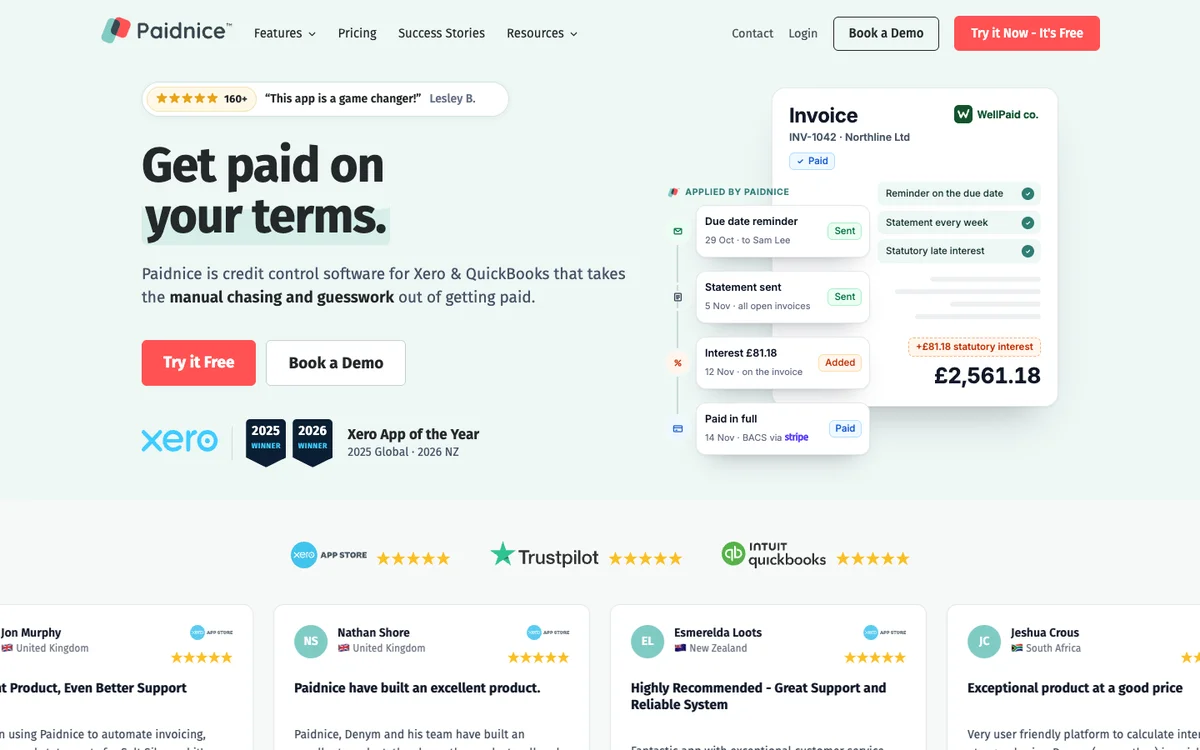
The reason a leaver usually ends up here is the fee. Chaser runs one set of late-fee rules, across the account or for selected debtors, with no documented way to run different rules per group; Paidnice hangs its policies under customer groups, so the wholesale accounts, the retail accounts and the ones in dispute each carry their own rule at the same time.
Statement interest is recalculated at the moment the statement sends rather than carried over from the last policy run, and the charge posts into the ledger as Draft or Approved, figured on the balance after any credit on the account.
Two charge types can run on one group: a fee per overdue invoice, and an interest charge against the whole overdue balance.
Limitations with Paidnice. One thing you use today works differently: Paidnice has no bundled collections referral, and escalation can be routed to any collection agency, solicitor or partner.
And the ledger list is narrower: Xero and QuickBooks Online on every plan, newer ledgers such as Rillet, Campfire, Digits, DualEntry, Puzzle, Accounting Seed and Odoo on every plan through Paidnice’s closed testing program, and NetSuite, Sage Intacct, MYOB and Dynamics 365 Business Central built to order on the Custom plan, where Chaser also reaches Sage and AccountsIQ. Essentials holds two team members against Compact’s four. On the review test it loses to the incumbent: 84 verified reviews against 374.
Prefer to watch? The six replacements, in about the time it takes to read one entry.
2. Upflow, best for collections visibility
Best for: Teams that want to see how their collections function performs, quoted by gross invoice value tier.
What is Upflow best for?
For a team giving up a fee engine on purpose, because the argument it needs to win internally is about visibility rather than about enforcement.
- Fits
- B2B finance teams that manage by metric, quoted in five tiers by gross invoice value, from up to $10m on Starter to above $100m on Enterprise
- Regions
- New York head office, Paris origin, customers in 30-plus countries
- Entry cost
- Not published. Upflow prints no figures and quotes five tiers by gross invoice value. Upflow offers a free Discover dashboard tier and a 14-day free trial on its Xero App Store listing; its pricing page lists no trial. Upflow’s last published prices were $440 a month for Grow and $880 for Scale. Current prices are hidden and must be requested. Upflow takes payments through its optional Payments add-on: $390 a month platform fee, 3.5% + $0.30 per card payment, 0.8% capped at $5 for ACH.
- Rated
- 4.8 from 233 G2 reviews; 4.5 from 15 on Capterra · Xero App Store listing
- Awards
- Not published
- Runs on
- Xero, QuickBooks Online, NetSuite, Sage Intacct, Stripe Billing, Chargebee, Zuora
- Statutory late fees
- No, via your ERP only. Upflow's own documentation points the job back to the ERP and there is no native computation
- Customers
- Named on its website: Lattice, Vercel and Front. Lattice's case study reports 99% collection with one person in AR.
Upflow is a measurement layer with chasing attached, and its numbers are the clearest here: countback DSO set against best possible DSO, collection effectiveness, at-risk balances past 90 days and billing-cohort cash forecasting, on dashboards filtered by workflow, country or account manager and delivered by email on a schedule. The free Discover tier shows all of it and chases nobody.
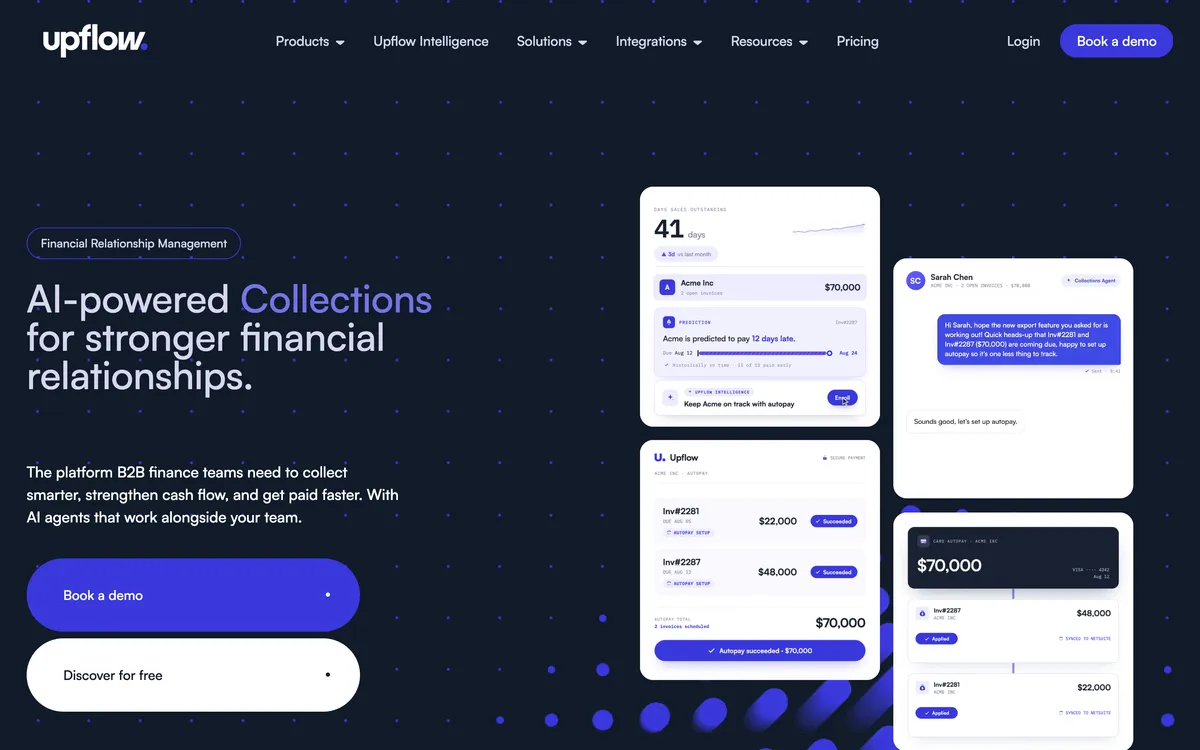
For a leaver it is a swap of enforcement for evidence. Chaser at least raises a fee, on one set of late-fee rules; Upflow raises none and points the calculation at your ERP, which a business on Xero or QuickBooks Online does not have.
Its prices are also hidden (Upflow’s last published prices were $440 a month for Grow and $880 for Scale, and current prices must be requested), where Chaser prints all three, so you would be leaving a priced product for a quoted one.
Limitations with Upflow. No native late fees at all. No instalment schedules, only part payments and promises to pay, which is thinner than the plans you already run. Automatic actions fire once a day, on business days only.
Sending through your own SMTP switches off open and click tracking, and the QuickBooks link polls every five minutes with payments landing in Undeposited Funds for somebody to reconcile. Its credit scoring is light beside a Creditsafe report.
3. Satago, best for credit reports plus funding
Best for: Keeping the credit reports and adding a funding line.
On Sage 50 or Xero, at an eighth of Compact
What is Satago best for?
For a business leaving Chaser mainly over price that still needs a bureau, and would rather finance an invoice than refer it to a collector.
- Fits
- UK businesses in the Sage and Xero ecosystem. No revenue band published
- Regions
- United Kingdom only
- Entry cost
- £25/mo Standard and £45/mo Plus inside Sage 50, with Plus included on selected Sage 50 subscriptions; standalone £45/mo Basic, £80 Premium, £200 Platinum. 14-day free trial.
- Rated
- 4.93 from 92 Xero App Store reviews, UK listing
- Awards
- Not published
- Runs on
- Xero, Sage, Sage 50, QuickBooks, KashFlow, FreeAgent
- Statutory late fees
- Optional. Late fees are calculated in line with statutory limits and added to payment reminders once an invoice is overdue
Satago is the closest thing on this page to the credit-data half of Chaser, sold as one subscription covering automated chasing, customer credit scores and suggested credit limits, with single and full invoice finance from the same provider.
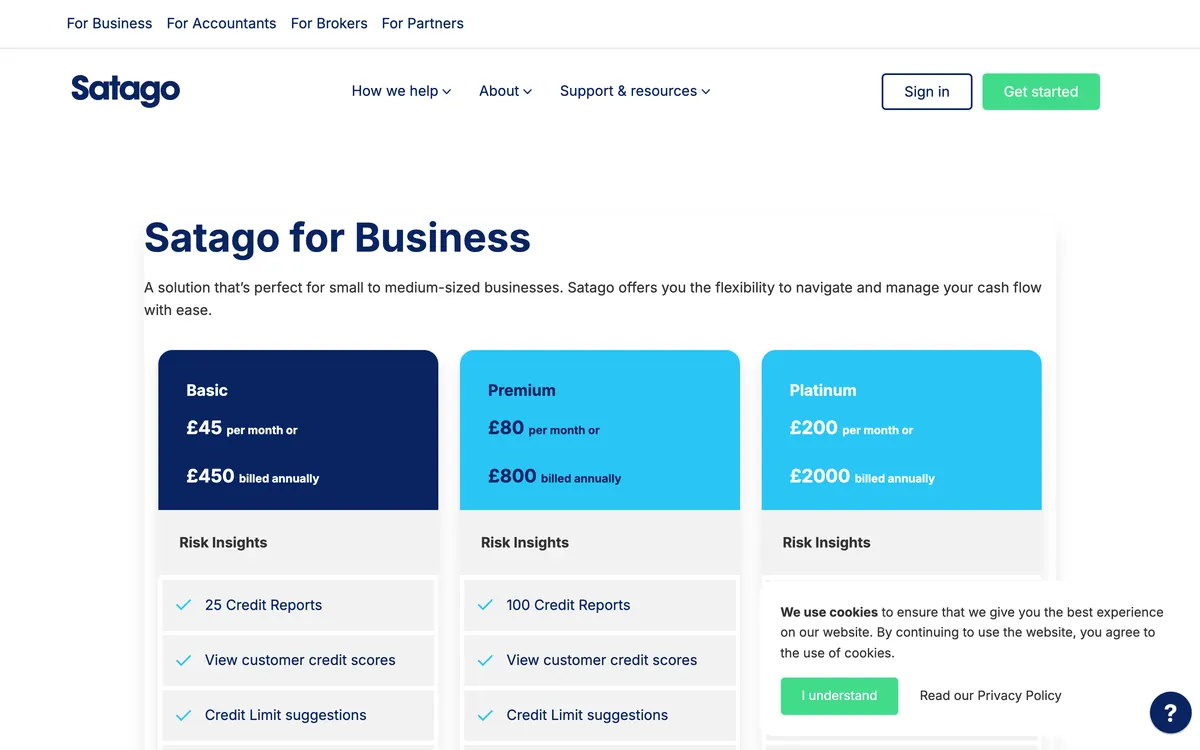
Inside Sage 50 the embedded edition runs £25 a month on Standard, an eighth of Compact, and Sage states that Plus is included with selected Sage 50 subscriptions without naming which. The embedded bundle covers payment reminders, statements, customer grouping and scheduling.
The lending is the part Chaser has no answer to. Where Chaser refers an uncollected debt to a partner and takes a share of the recovery at the end, Satago will advance against the invoice itself, before it is even late.
Limitations with Satago. Basic caps you at 100 email reminders a month and does not list own-inbox sending, so the thing Chaser gives you on every plan, sending from your own inbox, starts at the £80 Premium tier.
Its late fee is optional and added to reminder emails. Its Xero App Store score is 4.93 from 92 reviews. The footprint is the United Kingdom and nowhere else.
4. Credit Hound, best for Sage call lists
Best for: A Sage credit controller who wants a call list rather than a fee engine, £20 per user.
What is Credit Hound best for?
For a Sage 50 or Sage 200 team whose people do the chasing and want a daily worklist behind them, at a price that makes the trade-off worth arguing about.
- Fits
- Sage-first UK finance teams. No revenue band published; the product is priced per user
- Regions
- Core market is the UK Sage channel, with Sage 50 connectors for UK and Ireland, the US and Canada, and pricing published in GBP, EUR, USD, CAD, AUD and ZAR
- Entry cost
- £20 per user a month on Sage Accounting; £51 for the first user then £35 each on Sage 50 and Xero; £82 then £50 each on Sage 200; the PayThem payment module is £38/mo on top.
- Rated
- 5.0 from 12 reviews on the Sage UK Marketplace; 4.5 from a single review on G2, which is too small a base to read as a quality signal
- Awards
- Not published
- Runs on
- Sage Accounting, Sage 50cloud, Sage 100cloud, Sage 200 Standard and Professional, Sage Intacct, Infor SunSystems Cloud and Xero. No QuickBooks Online connector
- Statutory late fees
- None found. No interest, late fee, surcharge or fixed-sum function appears in the vendor's product pages, cloud feature list, FAQs, product guide or Sage-hosted brochure
Credit Hound sells through the Sage reseller channel and answers a narrower question than Chaser does: who to call this morning.
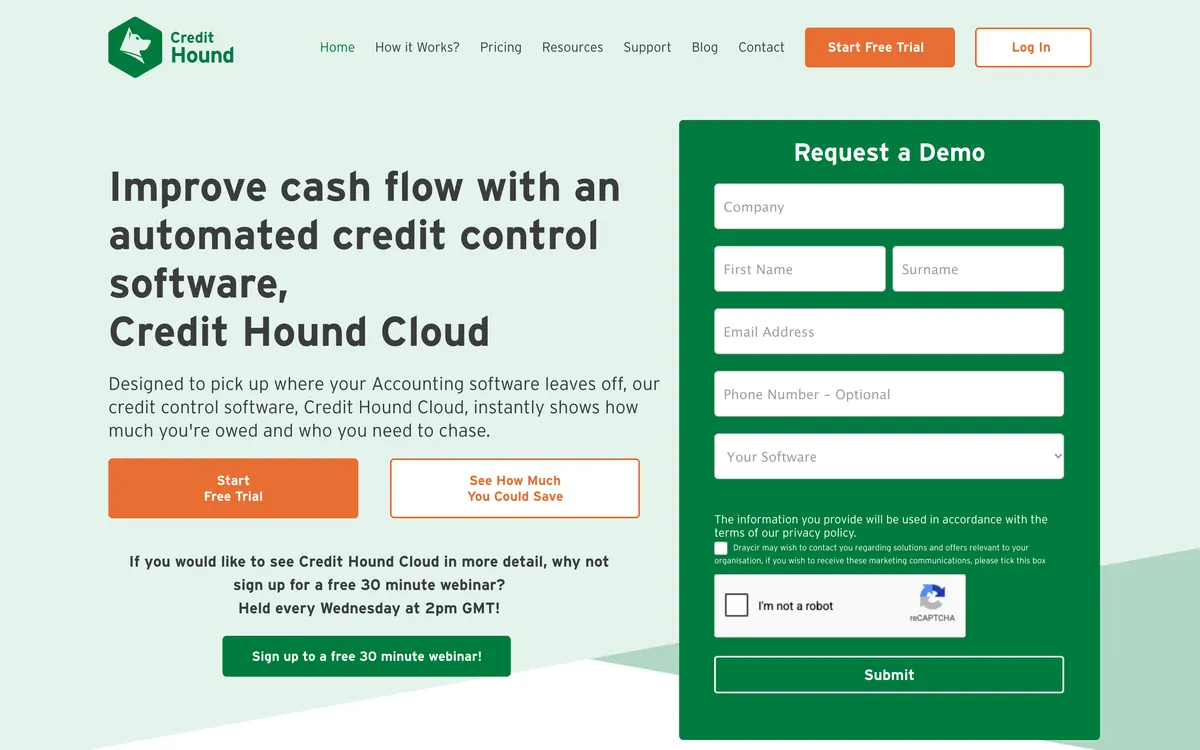
A credit controller gets a task dashboard with reasons attached, promise-to-pay records rolling into a promised-cash report, dispute logging with reason codes, internal and customer-facing notes with automated dispute notifications, and automatic account freezes on overdue customers. Its prices are published openly, which is rare in that channel.
Price is the headline. At £20 per user a month on Sage Accounting it is a tenth of Compact, and its dispute and promise-to-pay workspace goes deeper than anything in the product you are leaving. Three things you have today are missing: statements, payment plans, and any fee mechanic at all.
Limitations with Credit Hound. It chases and it does not charge.
No interest, late fee, statutory interest or fixed sum appears in the product pages, the cloud feature list, the FAQs, the product guide or the Sage-hosted brochure, and nothing describes writing a charge back to the ledger, so a team leaving over the one set of late-fee rules ends up with no rule.
There is no QuickBooks Online connector. Payments are a separate £38 a month module. Per-user pricing on Sage 200 and Xero scales badly, and its entire public review base is 12 reviews against the 374 behind Chaser on the Xero App Store alone.
5. Kolleno, best for step up from Chaser
Best for: A leaver moving up rather than sideways.
On NetSuite or SAP
What is Kolleno best for?
For a team outgrowing Chaser rather than objecting to it, where the bottleneck has become matching incoming cash rather than sending the reminder.
- Fits
- Order-to-cash teams: BusinessPay for turnover under £1m, Business Plus £1m to £100m, Enterprise £100m to £1bn
- Regions
- London head office, founded 2020, selling internationally
- Entry cost
- $650 per user a month on BusinessPay, $545 on annual billing, minimum one user, for turnover under £1m; Business Plus $1,245 per user. Default 24-month term, renews for 12 months, 90 days' notice, fees non-refundable.
- Rated
- 4.9 from 117 G2 reviews; 5.0 from 18 Xero App Store reviews; 5.0 from 8 on Capterra
- Awards
- G2 Best Software Awards 2024
- Runs on
- NetSuite, SAP S/4HANA and Business One, Sage Intacct, Business Central, Workday, Oracle JD Edwards, Epicor, Infor, Odoo, Zuora, Xero, QuickBooks Online
- Statutory late fees
- None found. No feature page or help article documents a late fee or interest calculation
- Customers
- Named on its website: Wise, Marshmallow and Laundryheap. Laundryheap's case study reports 94% of payments collected on time.
Kolleno is a wider platform at several times the price, built around the one capability Chaser has never had: cash application. Remittance emails parsed into suggested matches, SFTP bank connections carrying BAI2, NACHA and ISO 20022 files, one-to-many and partial matching, credit-note offsets, and foreign exchange and bank-fee handling including NetSuite multi-currency journal entries. Auto-reconciliation starts on the Enterprise tier, not on BusinessPay or Business Plus.

Kolleno lists AI agent support from Business Plus: insights, a copilot drafting messages for review, and an agent working a collections policy on its own. Fully automated agent runs are billed separately by token usage.
Read against Chaser that is a different purchase rather than a cheaper one. Chaser marks an invoice paid when the ledger says so; Kolleno reconciles the bank file that says so. Chaser raises a fee on one set of late-fee rules; Kolleno documents none, so UK statutory interest stays a job for a spreadsheet.
Limitations with Kolleno. BusinessPay costs $650 per user a month for turnover under £1m and leaves out workflow automation, more than double a £199 entry tier for a single seat, and the next tier nearly doubles it.
No late fee or interest function is documented anywhere in its materials. G2 reviewers name navigation and reporting depth as the recurring complaints. Kolleno includes 100 to 600 calls a plan. Its pricing page does not say which actions a workflow can hold.
6. ezyCollect, best for ANZ with Experian data
Best for: Australian and New Zealand teams that want Experian credit data and escalation with their chasing.
What is ezyCollect best for?
For an Australian or New Zealand wholesaler on MYOB, Pronto Xi or SAP Business One that wants a risk score on a buyer, then chasing, demand letters and collections referral in the same platform.
- Fits
- Receivables teams in Australia and New Zealand. Plans are sized by debtor count, 200 debtors on the entry tier up to 3,000. No revenue band published
- Regions
- Australia and New Zealand core, with US ACH payments; part of Sidetrade since October 2025
- Entry cost
- ezyCollect’s last published prices were A$275 a month for ezyStart, with a setup fee from A$900; ezyGrow A$950 and ezyScale A$2,350. Prices are on a 12-month plan, about A$330 a month for ezyStart month to month. Current prices are hidden and must be requested. Last published on ezyCollect’s pricing page, seen on the Wayback Machine. The 14-day trial starts when you connect your cloud accounting software.
- Rated
- 4.9 from 35 Xero App Store AU reviews; 4.7 from 25 on G2; 4.9 from 12 on Capterra
- Awards
- None found
- Runs on
- Xero, MYOB AccountRight, Exo, Essentials and Acumatica, NetSuite, Dynamics, Sage 300, Sage Intacct, SAP Business One, Pronto Xi, Attaché, JCurve; QuickBooks logo on homepage, no connector page
- Statutory late fees
- None found. No late fee or interest function appears in the help centre or the relaunch materials; card surcharging is the only charge mechanic documented
- Customers
- Named on its website: Feral Brewing, Hampers with Bite and Skillinvest. Feral Brewing's case study reports overdue accounts cut by over 50%.
ezyCollect is the closest structural match to Chaser in this list: chasing by email, SMS, letter and call task, statements, payment plans, a customer hub for viewing and paying, credit risk data and an escalation path to a debt collector. It was acquired by Sidetrade in October 2025.

What differs is the market and the meter.
The credit data comes from Experian rather than Creditsafe, which reads Australian and New Zealand trade rather than a Companies House view, and the extras are billed by use: SMS, mail and fax on top of the subscription, in-app demand letters at A$49 each plus GST, and an A$90 a month payment gateway fee before transaction rates.
Limitations with ezyCollect. No late fee or interest function appears anywhere in the help centre, so a team leaving over the one set of late-fee rules gets no engine at all. The entry tier carries an A$900 setup fee and caps you at 200 debtors, three users and one workflow, against Compact’s four users.
Customers past the end of a workflow receive no further automated follow-up. Reviewers report a quoted price well above the advertised one, and the public review base is thin and mostly predates 2024.
How do Chaser alternatives charge for late payment?
Chaser already does this, which makes it the sharpest comparison on the page. It applies UK statutory interest as one set of rules. Of the six alternatives only Paidnice applies it too, as a policy per customer group. Upflow hands the calculation to your ERP; Credit Hound, Kolleno and ezyCollect document no interest mechanic; Satago adds an optional late fee to its reminder emails.
Its engine carries four calculation types, one indexed to the Bank of England base rate and recalculated daily, which spares a team doing that arithmetic manually.
Under the Late Payment of Commercial Debts (Interest) Act 1998 a UK supplier may charge 8% above that base rate on an overdue business-to-business invoice, plus a fixed sum of £40, £70 or £100 by the size of the debt.
With the base rate at 3.75% on 30 June 2026 the total is 11.75% a year. The base rate rose to 4% on 5 November 2026. Because it moves, a long-running invoice spans two or three rates and each stretch has to be prorated separately. Chaser does that correctly, every day.
The limit is one set of rules, with no documented way to run different rules per group. One set of rules covers a customer you would never charge and a customer you always would. Chaser’s help says a late fee cannot be added or updated after a part payment when written to Xero, and it raises nothing on an invoice sitting under a payment plan. And the line-item sync that writes the fee back into the ledger works on Xero only.
Those three cases are exactly where a credit controller wants discretion, and discretion is the point of the whole exercise. A charge that has been raised can be waived deliberately, in writing, in exchange for payment today. A charge the rule was never allowed to raise gives you nothing to trade.
The statutory position, and what may change
- Statutory interest
- 8% above the Bank of England base rate, which is 11.75% in total. It moves with the base rate, so confirm the current figure before you invoice for it. GOV.UK
- Fixed compensation
- £40, £70 or £100 per invoice depending on the size of the debt, claimable on top of interest. GOV.UK
- Mandatory interest
- Proposed, not law. The Commercial Payments Bill would make statutory interest mandatory in commercial contracts rather than a default that can be contracted out of. Check its current stage before relying on it.
What changes when the rule can vary
Chaser: one set of rules
- Four calculation types, base rate included
- Recalculated every day the invoice runs late
- One set of rules, across the account or for selected debtors
- Silent on invoices under a plan, or part settled
- Written back to the ledger as a Xero line item
Paidnice: one rule per customer group
- Base rate plus your own margin, period by period
- Separate rules for separate groups, live at the same time
- A per-invoice fee and a whole-balance charge together
- Figured on the balance after credits are applied
- Posted into the ledger as a Draft or Approved invoice
On £5,000 overdue for 45 days at 11.75%, statutory interest is £72.43 and the fixed sum is £70, so £142.43 is claimable in total.
The interest figure is the overdue amount times the rate, spread across the days it ran late. The fixed sum steps at £40 below £1,000, £70 to £9,999.99 and £100 from £10,000. The rate follows the Bank of England base rate, which moves, so confirm the figure on GOV.UK the morning you invoice for it.
Your Chaser payment plans, and what happens to them on each tool
The test for a replacement is whether the follow-up understands the split. Paidnice (on Pro), Kolleno and ezyCollect all schedule instalments against an open invoice. Upflow does not, and no instalment function is documented for Credit Hound or Satago.
Kolleno divides an invoice weekly, monthly or bi-monthly and ties its automations to the plan, with uneven totals split manually. ezyCollect sells Payment Plans as a paid add-on, set up at the invoice or customer level.
Upflow records a promise to pay and takes ad-hoc part payments, which is a note rather than a schedule.
Ask any shortlisted vendor to demonstrate the fee engine and the schedule running together before you migrate a single customer.
Which Chaser alternative fits your turnover?
Chaser’s own tiers are the map: Compact under £4m, Core under £10m, Complete to £100m.
- Under £1m. You are paying an entry price set for a band four times your size. Credit Hound at £20 per user on Sage Accounting (£51 plus £35 per extra user on Sage 50), or Satago at £25 embedded in Sage 50, if chasing is the whole job. Paidnice at £49 (US$69) if the fee matters as much as the reminder.
- £1m to £4m. The band Compact is built for, and where the comparison bites hardest. On Xero or QuickBooks Online, Paidnice is the like-for-like swap at roughly a quarter of what you pay now. On Sage 50, Satago fits, and it keeps the credit reports.
- £4m to £20m. Chaser steps to £599 on Core from £4m and to £899 on Complete from £10m, which is where a lot of leavers first look up. Paidnice stays on flat invoice-volume tiers through the same growth. ezyCollect enters if your customers are Australian or New Zealand trade accounts.
- Above £20m. Complete at £899 stops being the expensive option and starts being the cheap one. Kolleno if matching cash is the real bottleneck, Upflow if nobody can measure the collections function, and both are quoted rather than priced.
Replacing Chaser on your ledger
Chaser’s ledger list is among the widest in the category: Xero, QuickBooks, Sage 50, Sage 200, Sage Intacct, NetSuite, Dynamics 365 Business Central, AccountsIQ and SAP. Whatever you run, something below matches it, but only two of the six match the breadth.
- Xero. Paidnice, Upflow, Satago, Kolleno and ezyCollect all connect. Credit Hound does too, at £51 for the first user and £35 for each one after, which is where its per-seat model starts to bite.
- QuickBooks Online. Paidnice, Upflow, Satago and Kolleno. ezyCollect shows a QuickBooks logo on its homepage but no connector page. Credit Hound has no QuickBooks Online connector at all, which ends the conversation for a QuickBooks business.
- Sage 50 and Sage 200. Credit Hound and Satago are the natives here, and both undercut Compact substantially. Paidnice does not reach Sage 50 or Sage 200; it connects to the Sage cloud products on its Custom plan.
- MYOB, Pronto Xi and SAP Business One. ezyCollect is built for these, with Kolleno covering SAP at the larger end. Paidnice reaches MYOB, SAP Business One and other ERPs on its Custom plan. This is one of the few places where a replacement widens your options rather than narrowing them.
- NetSuite, Sage Intacct and SAP. Kolleno and Upflow. Paidnice reaches NetSuite, Sage Intacct, MYOB and Dynamics 365 Business Central on its Custom plan as a build rather than a connector.
The bill after Chaser: £199 against the alternatives
Published entry prices: Credit Hound £20 per user a month on Sage Accounting, Satago £25 inside Sage 50, Paidnice £49 (US$69), ezyCollect A$275 a month on a 12-month plan plus a setup fee from A$900 (last published; current prices hidden and must be requested), Kolleno $650 per user. Upflow publishes nothing.
Paidnice bills on invoice volume on a flat tier with no per-seat charge above the entry plan, which is the closest thing here to a like-for-like on shape as well as on features. The cheapest way into Satago is not the Satago app: it is the edition Sage embeds inside Sage 50, at an eighth of what you pay now.
Satago publishes tier prices but not which Sage 50 subscriptions carry Plus for nothing. And before you compare any of it, add your credits: SMS, letters and calls are metered on your current bill, so a heavy month already costs more than the headline.
Which Chaser alternative fits your use case?
| Use case | Start with | Why |
|---|---|---|
| Xero or QuickBooks Online, with late fees or statutory interest that vary by customer group | Paidnice | Applies UK statutory interest per customer group, from £49 (US$69) a month |
| Credit reports are what you use Chaser for, in the UK | Satago | Credit reports, scores and suggested limits in the same subscription as the chasing |
| A Sage team that chases by phone | Credit Hound | A daily worklist with dispute and promise-to-pay tracking, from £20 per user |
| Matching incoming cash is the bottleneck, on NetSuite or SAP | Kolleno | Cash application with remittance parsing and bank files, from the Enterprise tier (BusinessPay at $650 per user has no auto-reconciliation) |
| Australian or New Zealand trade customers | ezyCollect | Experian credit data, demand letters and collections referral in one platform |
| Leadership wants collections metrics more than fees | Upflow | Countback DSO, collection effectiveness and at-risk dashboards, quoted rather than priced |
What a Chaser leaver asks before switching
What is the best Chaser alternative in 2026?
It depends on why you are leaving. For a Xero or QuickBooks Online business that wants statutory interest indexed to the Bank of England base rate as a separate policy per customer group, where Chaser runs one set of rules, Paidnice fits, from £49 (US$69) a month against Chaser's £199.
For a Sage 50 team, Satago at £25 a month or Credit Hound at £51 for the first user and £35 for each one after fit. For order-to-cash teams that need cash application, Kolleno fits, and for Australian and New Zealand trade credit, ezyCollect.
Why do teams look for a Chaser alternative?
Three structural limits come up most. The late fee engine runs one set of rules for the account, applied to every debtor or to selected debtors, and raises no fee on payment-plan or partially paid invoices. Statements go monthly only, on a fixed day, with no control over recipients or senders.
Payment-plan chasing follows the original invoice due date rather than the instalment dates. Price is the fourth reason: Chaser prices by revenue band, and the entry tier is priced on company turnover.
Is there a cheaper alternative to Chaser?
Yes. Chaser's entry tier is £199 a month for revenue under £4m. Credit Hound publishes £20 per user a month on Sage Accounting, Satago is £25 a month embedded in Sage 50 and £45 standalone, and Paidnice is £49 (US$69) a month on Essentials.
Which Chaser alternative applies UK statutory interest automatically?
Paidnice. It runs a Bank of England base rate policy per customer group and posts the charge to the Xero or QuickBooks Online ledger as Draft or Approved. Upflow points the calculation back to your ERP, Credit Hound, Kolleno and ezyCollect document no interest function, and Satago adds an optional late fee to its reminder emails.
Do Chaser alternatives integrate with Xero and QuickBooks?
Most do. Paidnice, Upflow, Kolleno, Satago and ezyCollect all connect to Xero, and all except Satago's Sage-embedded edition connect to QuickBooks Online, apart from ezyCollect, which shows a QuickBooks logo on its homepage but no connector page. Credit Hound is Sage-first, connects to Xero at £51 for the first user, and has no QuickBooks Online connector.
Which Chaser alternative has credit checking?
Satago carries credit reports, customer credit scores and suggested credit limits in the same subscription as the chasing. ezyCollect uses Experian data for Australian and New Zealand buyers, and Kolleno carries AI scores with bureau integrations.
Chaser's own credit report comes from Creditsafe. Paidnice runs native credit checks from each customer's payment behaviour, and Creditsafe bureau checks through the API on the Custom plan. Satago carries bureau reports on a smaller budget than Chaser. Consider Paidnice for the chasing around them.
To see where this tool sits in the wider market, the credit control software guide compares six tools on price, free trial, ledger and limits.
Next, if you are still deciding
Buyer's guide
Best accounts receivable software (by business type)
The pillar guide: pick by size and accounting system, with a recommendation matrix.
Alternatives
Best Upflow alternatives
The best Upflow alternatives by business type.
Alternatives
Best Kolleno alternatives
Five Kolleno alternatives compared by business type.
United Kingdom
Best credit control software for UK SMEs
UK statutory interest, chasing and credit risk, compared.
Sources
20 sources, checked by Julie Turnbridge on November 6, 2026
- Xero Small Business Insights xero.com/uk/resources/small-business-insights
- Xero App Store apps.xero.com/uk/app/chaser
- G2 g2.com/products/chaser/reviews
- Xero App Store apps.xero.com/uk/app/paidnice
- Capterra capterra.co.uk/software/254868/paidnice
- G2 g2.com/products/upflow-upflow/reviews
- Capterra capterra.co.uk/software/193097/Upflow
- Xero App Store listing apps.xero.com/us/app/upflow
- G2 g2.com/products/credit-hound
- G2 g2.com/products/kolleno/reviews
- Xero App Store apps.xero.com/uk/app/kolleno
- Capterra capterra.co.uk/software/227932/Kolleno
- Wayback Machine web.archive.org/web/20240617113004/https://ezycollect.io/...
- Xero App Store apps.xero.com/au/app/ezycollect
- G2 g2.com/products/ezycollect/reviews
- Capterra capterra.com/p/135729/ezyCollect/reviews
- Bank of England base rate bankofengland.co.uk/monetary-policy/the-interest-rate-ban...
- Late Payment of Commercial Debts (Interest) Act 1998 legislation.gov.uk/ukpga/1998/20/contents
- GOV.UK gov.uk/late-commercial-payments-interest-debt-recovery/ch...
- GOV.UK gov.uk/late-commercial-payments-interest-debt-recovery/cl...