The best accounts receivable software for recruitment in 2026 is Paidnice, for an agency on Xero or QuickBooks Online that wants late fees and interest applied per client group across a weekly contractor run, from £49 (US$69) a month. Chaser, Satago, ezyCollect, Kolleno, Upflow and Invoiced complete the seven, compared on enforcement, published price and verified reviews.
A staffing agency pays its contractors weekly and invoices its clients on net 30 to net 60, so the deadline that matters is the payroll date rather than the invoice due date.
| Tool | Best for | ||||||
|---|---|---|---|---|---|---|---|
| Best for | Late fees per client group on Xero or QuickBooks Online | Credit checks, letters and calls in one tool | UK chasing plus invoice finance | Australian and New Zealand agencies on MYOB | Matching bulk payments for staffing groups | Measuring collections by branch | Enterprise networks on NetSuite or Sage Intacct |
| Paidnice | An agency on Xero or QuickBooks Online that wants late fees and interest applied per client group across a weekly contractor run | ||||||
| Chaser | An agency with a named credit controller that wants Creditsafe checks, posted letters and calls in one tool | ||||||
| Satago | A UK agency that wants its chasing and the invoice finance that funds payroll from one provider | ||||||
| ezyCollect | An Australian or New Zealand agency on MYOB or an ERP that wants debtor-level chasing and collections referral | ||||||
| Kolleno | A multi-entity staffing group whose bottleneck is matching bulk client payments to contractor invoices | ||||||
| Upflow | A multi-branch agency that wants DSO and collection effectiveness measured by branch before it automates | ||||||
| Invoiced | A large staffing network billing through NetSuite or Sage Intacct that wants invoice-to-cash in one system |
What is accounts receivable software for recruitment, and what is it not?
Accounts receivable software for recruitment works the client invoices an agency has already raised on its ledger. It reads Xero, QuickBooks Online or the ERP, and chases the corporates on 60 or 90 day terms and the small employers on 14 without anyone opening each invoice.
- Reminders by email and SMS, and on some tools letters and calls, on a schedule per client group.
- Statements and aged listings, which an invoice finance provider lends against.
- Late fees and interest on overdue invoices. Paidnice, Chaser and Invoiced raise them at a documented grain, and Satago adds an optional fee to reminder emails; the other three do not, or do not say how.
- Payment plans, most often on a permanent placement fee.
- Credit checks before a placement, on Chaser, Satago, ezyCollect and Kolleno, and on Paidnice: native checks from payment behavior on every plan, plus Creditsafe via API on the Custom plan.
It is not the front office. Bullhorn or the agency's PSA approves the timesheet and raises the invoice, and none of the seven tools here touches that step.
It is not invoice finance. Software shortens the wait and leaves the credit risk with the agency, while a finance provider pays now and charges for it; Satago sells both, as two products. It is not a collection agency either, though Chaser and ezyCollect can refer an account to a collections partner.
Reminders and statements alone are a full use case. A late fee is optional, and outside the UK the placement contract has to carry the rate.
How this list was put together
This list helps a recruitment agency chase client invoices on 14, 60 or 90 day terms across a weekly contractor run.
| What we checked | Where the evidence came from |
|---|---|
| Late fee grain across client groups on different terms | Vendor help pages on fees and interest |
| Statements and aged listings an invoice finance provider lends against | Vendor feature pages |
| Credit checks on new clients | Vendor product pages |
| Payment plans and a portal | Vendor feature pages |
| Published from-price | The vendor's pricing page, and the last reported price where it is now hidden |
| Rating and review count | The Xero App Store, including the Australian store, or G2 |
Why a recruitment ledger is different: you pay before you are paid
Almost every other business on a shortlist like this one is chasing money it has already earned and already banked the cost of. A staffing agency has paid the contractor before the client has paid anything, every week, out of its own facility.
That inversion changes what the software has to do. The wait is a financing cost carried at a margin that is thin by the standards of any other business turning over the same money. A week of it is a real number, and it is the number every section below is written against.
It has a handful of large corporates on 60 or 90 day terms who are worth the wait, a long tail of small employers on 14 or 30 days, and a pile of invoices stuck behind a disputed timesheet that should never be chased automatically at all.
Xero Small Business Insights put the average US wait at 29.7 days in its latest US small business data, with invoices settling 8.6 days past their due date and California at 25.6 days.
- Volume without hand-work. Schedules that cover hundreds of small contractor invoices without anyone opening them one at a time, consolidated to one accounts payable contact rather than twenty separate emails.
- Enforcement at the right grain. A fee that can differ between a corporate on 60 day terms and a twelve-person employer on 14, applied without anybody deciding each month.
- A live ledger read. A payment received on Monday has to stop the chase on Monday, which means reading the ledger rather than a nightly export.
- Aging a funder will accept. Accurate aged listings and statements, because that is what an invoice finance provider lends against and what a credit insurer asks to see.
- Credit visibility before the placement. A score and a suggested limit before twenty contractors go on site at a client with long terms, so the bad debt is avoided instead of chased.
Recruitment AR software compared: the table
 |
 |
 |
 |
 |
 |
 |
|
|---|---|---|---|---|---|---|---|
| Revenue fit | Any size up to $50m a year, or 50,000 invoices a year | Compact under £4m, Core from £4m, Complete to £100m | Not published | Not published (plans sized by debtor count, 200 to 3,000) | Under £1m on BusinessPay, tiers to £1bn and above | Gross invoice value tiers, up to $10m through above $100m | Not published |
| From (monthly) | $69 | £199 | £45 (£25 inside Sage 50) | A$275 on annual billing, plus A$900 setup (last published; current prices are hidden and must be requested) | $650 per user | Not published | Not published |
| Ledger integrations | Xero, QuickBooks Online and newer ledgers such as Rillet and Campfire (closed testing) on every plan; Sage Accounting and other ERPs on Custom | Xero, QuickBooks, Sage, NetSuite, Dynamics 365 | Xero, Sage, Sage 50, QuickBooks, KashFlow, FreeAgent | Xero, MYOB, NetSuite, Sage 300, Sage Intacct, SAP Business One, Pronto Xi; QuickBooks logo on homepage, no connector page | NetSuite, SAP, Sage Intacct, Business Central, Xero, QuickBooks Online | Xero, QuickBooks Online, NetSuite, Sage Intacct, Stripe Billing, Chargebee, Zuora | NetSuite, Sage Intacct, Dynamics 365 Finance, Xero, QuickBooks Online |
| Late fee grain | Yes (per customer group) | Yes (one set of late-fee rules, not tied to schedules) | Optional, added to reminder emails | None found | None found | No (via your ERP only) | Yes (schedules assignable to customer groups) |
| Statements | Yes (any schedule) | Yes (monthly, fixed day) | Yes | Yes (monthly) | Yes (in the portal) | Portal PDF statement, no scheduled send | Not documented |
| Payment plans | Yes (on Pro) | Yes | Not documented | Yes (paid add-on) | Yes | No | Not documented |
| Portal | Yes | Yes | Not documented | Yes | Yes | Yes | Yes |
| Credit checks | Yes: native checks from payment behavior, plus Creditsafe via API on the Custom plan | Yes (Creditsafe) | Yes (credit reports and limits) | Yes (Experian data, risk groups) | Yes (AI scores, bureau integrations) | Yes (light scoring) | Not documented |
| AI | Advanced Reads customer replies, drafts answers and follow-up actions (like PO updates) for your approval; MCP server for Claude, ChatGPT and other agents | None No AI feature found | Basic an AI email template generator as a paid add-on | Advanced Insights, Copilot drafts and an autonomous Agent; AI agent support from Business Plus; fully automated agent runs and AP portal features are billed separately by token use | Advanced Collections and cash application agents, from suggest-only to autonomous (Collections Agent from Scale, Cash Application Agent from Accelerate) | Advanced Agentic AI (Assist, Automate, Advise) and CashMatch AI matching | |
| Rated (source, count) | 5.0 (84, Xero App Store) | 4.98 (374, Xero App Store) | 4.93 (92, Xero App Store) | 4.9 (35, Xero App Store AU) | 4.9 (117, G2) | 4.8 (235, G2) | 4.5 (418, G2) |
"Not documented": the vendor does not document the capability. "Not published": the vendor does not print a price. "None found": no evidence either way. Prices are the vendor's published from-price, in the currency the vendor publishes, without conversion.
The seven tools in five checked facts
- Four of the seven print a monthly price: Satago from £45 a month (£25 inside Sage 50), Paidnice from £49 (US$69), Chaser from £199 and Kolleno from $650. ezyCollect, Upflow and Invoiced do not publish one.
- Four of the seven apply a late fee themselves: Paidnice (per customer group), Invoiced (schedules assignable to customer groups), Chaser (one set of late-fee rules, not tied to schedules) and Satago (optional, added to reminder emails).
- Six of the seven connect to both Xero and QuickBooks Online; ezyCollect shows a QuickBooks logo on its homepage but no connector page.
- AI that handles collections work or customer replies: Paidnice, Upflow, Kolleno and Invoiced. AI that scores or predicts only: ezyCollect. No AI in receivables: Satago.
1. Paidnice, best for Xero or QuickBooks Online
Best for: Staffing agencies on Xero or QuickBooks Online.
Any size up to $50m a year, or 50,000 invoices a year
What is Paidnice best for?
For a recruitment agency on Xero or QuickBooks Online that raises hundreds of contractor invoices a month and wants the late fee applied per client group rather than manually.
- Fits
- Recruitment and staffing businesses on Xero or QuickBooks Online of any size up to $50m a year, or 50,000 invoices a year, with or without a credit controller
- Regions
- United States, United Kingdom, Australia, New Zealand, Canada, South Africa
- Entry cost
- £49 (US$69) a month on Essentials, covering 150 invoices, 600 emails and up to 2 team members; Pro from £74 (US$99) a month with unlimited users and no per-seat fee.
- Rated
- 5.0 from 84 Xero App Store reviews; 4.9 from 14 on Capterra
- Awards
- Xero Global Small Business App of the Year 2025 and NZ Small Business App of the Year 2026
- Runs on
- Xero, QuickBooks Online and newer ledgers (Rillet, Campfire, Digits, DualEntry, Puzzle, Accounting Seed and Odoo, through closed testing) on every plan; Stripe, Pinch Payments, CloudDepot, HubSpot, Pipedrive, Zapier. Sage Accounting, NetSuite, Sage Intacct, MYOB and Dynamics 365 Business Central on the Custom plan only
- Late fees and interest
- Yes. Two charge types, an invoice late fee and a statement interest charge, both raised on the ledger as Draft or Approved. Policies sit under customer groups, so a slow corporate group and a reliable client group run different rules at the same time
Paidnice sits on a Xero organisation or a QuickBooks Online company and covers the ground the ledger stops at: reminder sequences, statements on any schedule including consolidated parent accounts, payment plans on Pro, a client portal, and a charge raised on the client's own ledger when an invoice runs late.
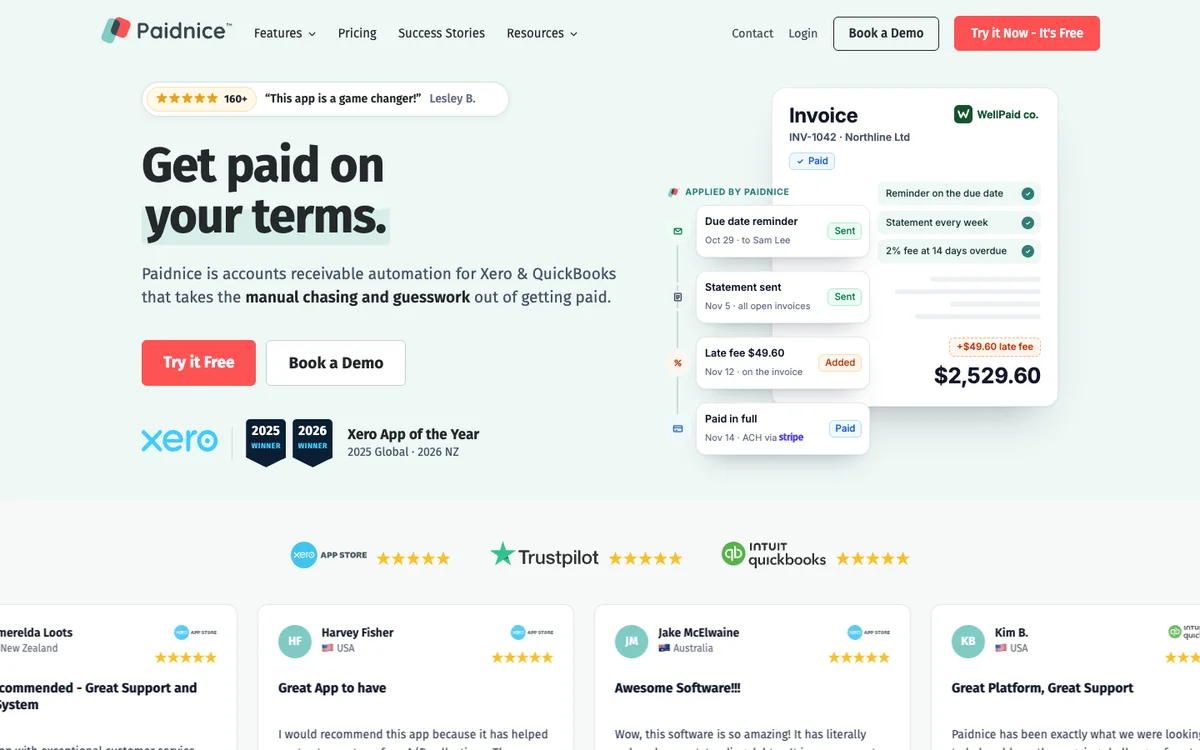
Sending from the agency's own domain starts on Pro, and Paidnice can also send through a connected Gmail or Outlook (Microsoft 365) mailbox, so a client sees the agency's name rather than a vendor's. Essentials sends from outbound@paidnice.com and includes SMS and escalation workflows.
Contact groups are what make it usable on a recruitment ledger. The corporate on 90 day terms, the small employer on 14 and the disputed-timesheet pile each get their own reminder schedule and their own fee policy, running at the same time rather than one after another.
Charges are calculated on the balance after any credit note, which matters when timesheet corrections generate credit notes every week, and statement interest is recalculated as the statement sends rather than at the last policy run.
Limitations with Paidnice. Xero and QuickBooks Online are on every plan, and newer ledgers such as Rillet, Campfire, Digits, DualEntry, Puzzle, Accounting Seed and Odoo are available on every plan through Paidnice's closed testing program. An agency on Bullhorn or a PSA still needs the invoice to reach one of those ledgers before anything here applies. Sage Accounting and other ERPs connect on the Custom plan, and getting to NetSuite, Sage Intacct, MYOB or Dynamics 365 Business Central means a build rather than a standard connector.
The entry tier covers two team members and 150 invoices a month, which one busy weekly billing run will go through. Criterion 4 goes against it: Chaser's 4.98 rests on 374 reviews against the 5.0 from 84 above.
Video: the same seven tools compared on late fee enforcement, published price and ledger fit.
2. Chaser, best for bureau checks and letters
Best for: Agencies that want credit checking and letters in the same tool, under £4m on the entry tier.
What is Chaser best for?
For a staffing agency with a named credit controller that wants Creditsafe credit checks, letters and phone chasing running from one system.
- Fits
- Agencies with a named credit controller; the entry tier is priced for turnover under £4m, and the tiers run to £100m
- Regions
- UK-registered, trading since 2014, sells worldwide
- Entry cost
- £199/mo on Compact for turnover under £4m with 4 users; Core £599/mo under £10m; Complete £899/mo to £100m.
- Rated
- 4.98 from 374 Xero App Store reviews; 4.3 from 71 on G2; 4.9 from 45 on Capterra
- Awards
- Finalist, UK Small Business App Partner of the Year, Xero Awards 2023
- Runs on
- Xero, QuickBooks, Sage 50, Sage 200, Sage Intacct, Sage Business Cloud Accounting, NetSuite, Dynamics 365 Business Central, AccountsIQ, SAP, HubSpot, Gmail, Outlook
- Late fees and interest
- Yes. Four calculation types, recalculated daily, but one set of late-fee rules, across the account or for selected debtors, not tied to schedules, with no documented way to run different rules per group. No fee is raised on payment-plan invoices, and Chaser's help says a late fee cannot be added or updated after a part payment when written to Xero
- Customers
- Named on its website: Bright Network, Pact Coffee and Huttie. Huttie's case study reports £15,000 of old debt recovered.
In the market since 2014, Chaser sends out of the team's own Gmail or Outlook mailbox and layers SMS, posted letters, recorded calls, a payer portal and a partner collections handoff behind the email.
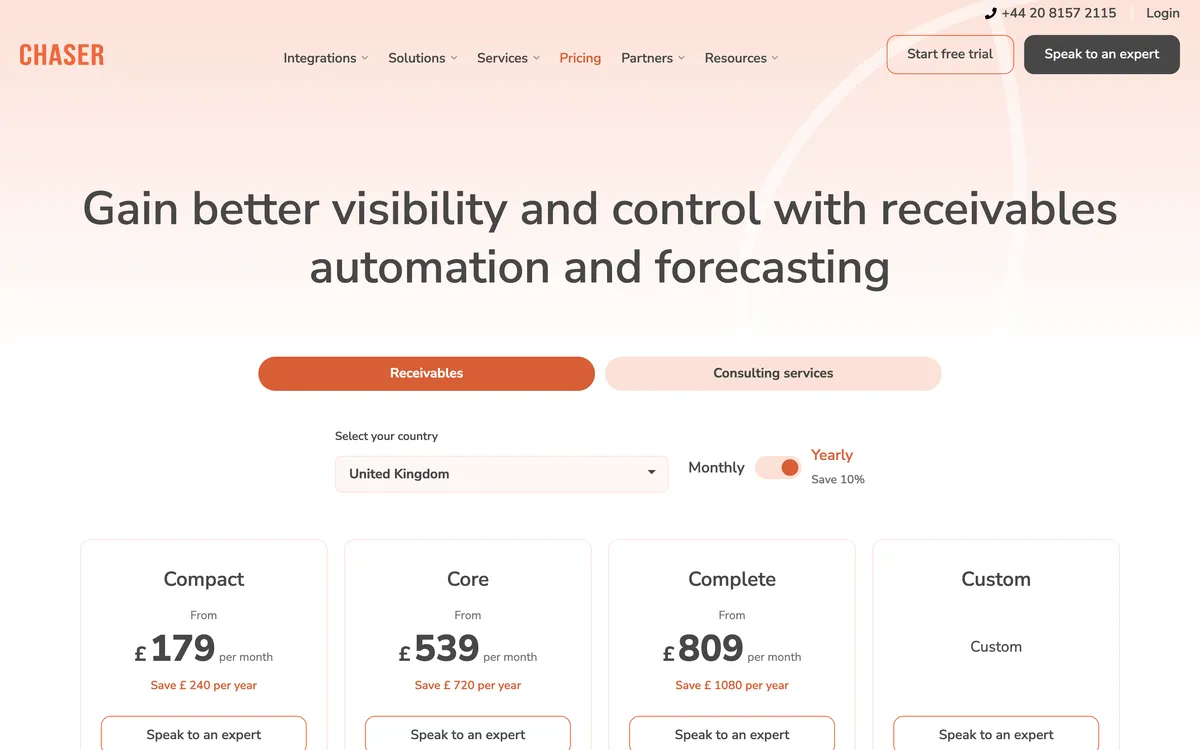
Against a corporate accounts payable department that has stopped opening email, the letter and the call are the escalation, and they arrive without anyone from the agency having to telephone the hiring manager who placed the order.
The Creditsafe report inside the app carries a score with a recommended limit, the client's own payment score, credit event history, and Companies House filing and director data, monitored continuously. Chaser credit checks are sold by credit on any plan and need Chaser billing, not Xero App Store billing; monitoring is not offered in Australia.
Limitations with Chaser. One set of late-fee rules, across the account or for selected debtors, not tied to schedules, and no documented way to run different rules per group, so the corporate on 90 day terms and the small employer on 14 get the same rate if both are covered. No fee is raised on payment-plan invoices, and Chaser's help says a late fee cannot be added or updated after a part payment when written to Xero.
Statements go monthly, on a fixed day. Compact stops at four users. Price is banded by company turnover rather than invoice volume, which is the wrong axis for an agency booking large billings on thin margins.
3. Satago, best for UK payroll funding
Best for: UK agencies funding payroll against the sales ledger.
No revenue band published
What is Satago best for?
For a UK staffing agency that wants credit reports and invoice finance from the same provider that runs its chasing.
- Fits
- UK businesses in the Sage and Xero ecosystem. No revenue band published
- Regions
- United Kingdom only
- Entry cost
- £25/mo Standard and £45/mo Plus inside Sage 50, with Plus included on selected Sage 50 subscriptions; standalone £45/mo Basic, £80 Premium, £200 Platinum.
- Rated
- 4.93 from 92 Xero App Store reviews, UK listing
- Awards
- Not published
- Runs on
- Xero, Sage, Sage 50, QuickBooks, KashFlow, FreeAgent
- Late fees and interest
- Optional. Late fees are calculated in line with statutory limits and added to payment reminders once an invoice is overdue
Satago is the one entry on this page that sells both halves of the payroll gap problem. On the software side it automates chasing and risk insight; on the lending side it offers single and full invoice finance.
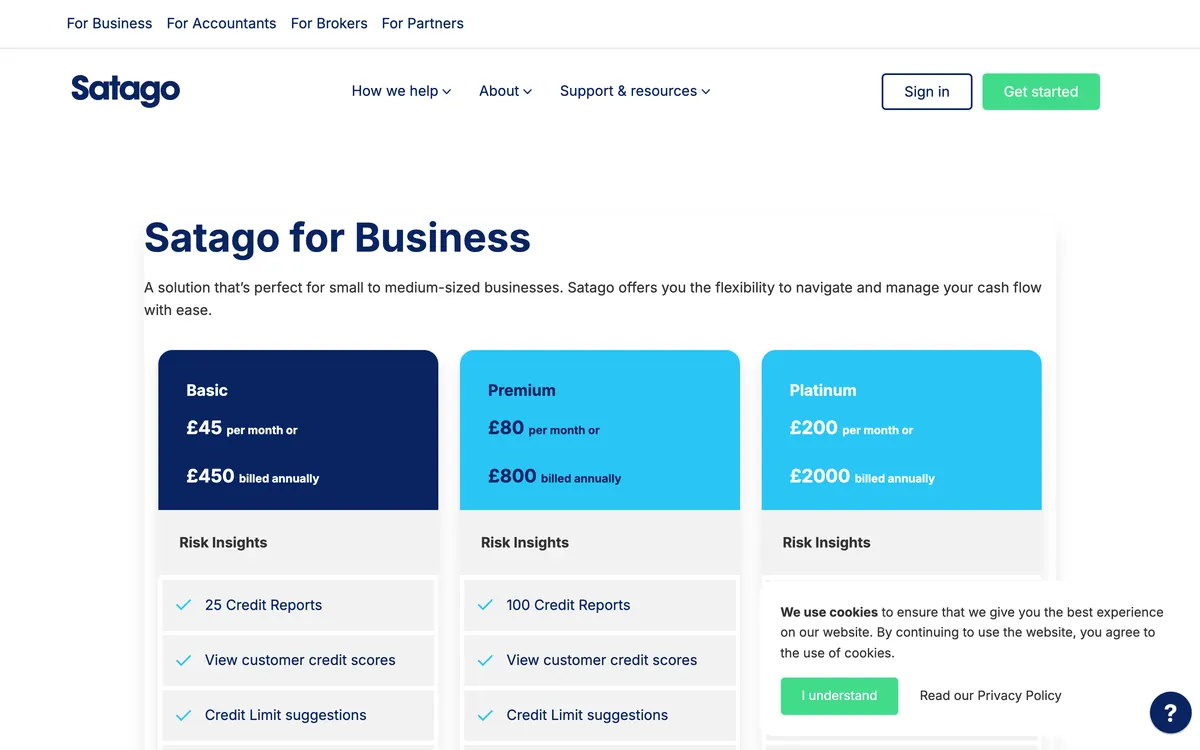
Weekly contractor payroll leaves the bank against a ledger that settles in 30 to 90 days, and Satago sells the chasing that shortens that wait and the advance that covers what is left of it.
The cheapest route in is the Sage 50 embedded edition at £25 a month for Standard rather than the standalone app, and Sage says Plus is included on selected Sage 50 subscriptions without naming which. Inside that bundle are payment reminders, statements, customer grouping and scheduling.
Limitations with Satago. Standalone Basic caps at 100 email reminders a month, which a single weekly billing run can exhaust, and it does not list own-inbox sending; reaching the agency's own inbox means the £80 Premium tier.
The late fee is optional and sits in reminder emails. Its 4.93 Xero App Store score from 92 reviews is published above. The footprint is the United Kingdom and nowhere else.
4. ezyCollect, best for ANZ recruitment agencies
Best for: Australian and New Zealand agencies, plans sized by debtor count rather than revenue.
What is ezyCollect best for?
For an Australian or New Zealand staffing agency on MYOB or an ERP that wants credit insights, demand letters and collections referral in one platform.
- Fits
- Receivables teams in Australia and New Zealand. Plans are sized by debtor count, 200 debtors on the entry tier up to 3,000. No revenue band published
- Regions
- Australia and New Zealand core, with US ACH payments; part of Sidetrade since October 2025
- Entry cost
- ezyCollect's last published prices were A$275 a month for ezyStart, with a setup fee from A$900; ezyGrow A$950 and ezyScale A$2,350. Prices are for a 12-month plan and exclude GST; month by month is 20% higher. Current prices are hidden and must be requested. Last published on ezyCollect's pricing page, seen on the Wayback Machine.
- Rated
- 4.9 from 35 Xero App Store AU reviews; 4.7 from 25 on G2; 4.9 from 12 on Capterra
- Awards
- None found
- Runs on
- Xero, MYOB AccountRight, Exo, Essentials and Acumatica, NetSuite, Dynamics, Sage 300, Sage Intacct, SAP Business One, Pronto Xi, Attaché, JCurve; QuickBooks logo on homepage, no connector page
- Late fees and interest
- None found. No late fee or interest function appears in the help center or the relaunch materials; card surcharging is the only charge mechanic documented
- Customers
- Named on its website: Alexander Symonds, Skillinvest and Knight BPO. Alexander Symonds' case study reports average days overdue cut from 13 to 7.
ezyCollect chases at debtor level rather than invoice level, and on a recruitment ledger that is the right default. An agency raising twenty small contractor invoices a fortnight against one corporate debtor does not want twenty separate chase emails arriving in the same accounts payable inbox, and consolidating the overdue balance into one conversation is what keeps the relationship intact.

Statements go monthly, payment plans split by subscription, fixed amount or fixed count, and the portal takes card and direct debit.
Its integration list is the deepest here for the Australian and New Zealand market, reaching MYOB AccountRight, Exo, Essentials, Acumatica, Pronto Xi and Attaché alongside Xero. Credit Insights scores a debtor from the agency's own aged listing plus external data, and escalation runs through in-app demand letters and referral to a collections partner without leaving the platform.
Limitations with ezyCollect. No late fee or interest function is documented anywhere, so enforcement stays a manual job. The entry tier adds a A$900 setup fee, caps the agency at 200 debtors and one workflow, and monthly billing costs 20 percent more than annual.
Mail, SMS and fax are metered on top, demand letters are charged per letter, and a collections referral runs at commission from 25 percent of what is recovered. Reviewers say the quoted price comes in well above the advertised tier.
5. Kolleno, best for multi-entity payment matching
Best for: Staffing groups on NetSuite or SAP.
What is Kolleno best for?
For a multi-entity staffing group whose bottleneck is matching thousands of client payments to invoices, not sending reminders.
- Fits
- Order-to-cash teams: BusinessPay for turnover under £1m, Business Plus £1m to £100m, Enterprise £100m to £1bn
- Regions
- London head office, founded 2020, selling internationally
- Entry cost
- $650 per user a month on BusinessPay, $545 on annual billing, minimum one user, for turnover under £1m; Business Plus $1,245 per user.
- Rated
- 4.9 from 117 G2 reviews; 5.0 from 18 Xero App Store reviews; 5.0 from 8 on Capterra
- Awards
- G2 Best Software Awards 2024
- Runs on
- NetSuite, SAP S/4HANA and Business One, Sage Intacct, Business Central, Workday, Oracle JD Edwards, Epicor, Infor, Odoo, Zuora, Xero, QuickBooks Online
- Late fees and interest
- None found. No feature page or help article documents a late fee or interest calculation
- Does best
- Cash application (Enterprise only, by quote), with email remittance parsing, BAI2, NACHA and ISO 20022 bank files, match scoring and NetSuite multi-currency journal entries
- Customers
- Named on its website: Deel, Fusion Consulting and Laundryheap. Fusion Consulting's case study reports late payments cut by 44%.
Kolleno is built around cash application, and on a staffing ledger that is a real bottleneck rather than a theoretical one. One corporate client pays a single amount covering forty contractor invoices with a remittance advice attached as a PDF, and somebody has to break that back down.

Kolleno parses the remittance into suggested matches, handles one-to-many matching, part payments and credit-note offsets, and writes the journal entries back.
Reminder workflows are trigger-based with conditional branches and run-hour restrictions, and its AI offers insights, a copilot that drafts messages for review, and an agent that works a collections policy on its own. Kolleno lists AI agent support from Business Plus, and fully automated agent runs and AP portal features are billed separately by token use.
Limitations with Kolleno. $650 per user a month on BusinessPay, a tier for turnover under £1m that leaves out workflow automation, puts it beyond most agencies, and the next tier nearly doubles it. No late fee or interest function is documented anywhere in its materials, so enforcement stays manual. Auto-reconciliation starts on Enterprise, which is quoted, not on BusinessPay or Business Plus. Xero and QuickBooks Online connect on BusinessPay and Business Plus; NetSuite and SAP start on Enterprise.
Kolleno includes 100 to 600 calls a plan. Its pricing page does not say which actions a workflow can hold. Reviewers keep naming navigation and reporting depth as the weak points.
6. Upflow, best for collections run by metric
Best for: Agencies that manage collections by metric.
Five gross invoice value tiers from up to $10m to above $100m
What is Upflow best for?
For a staffing finance team that wants countback DSO and collection effectiveness measured before it automates anything.
- Fits
- B2B finance teams that manage by metric, quoted in five tiers by gross invoice value, from up to $10m on Starter to above $100m on Enterprise
- Regions
- New York head office, Paris origin, customers in 30-plus countries
- Entry cost
- Not published. Upflow prints no figures and quotes five tiers by gross invoice value; its pricing FAQ mentions a free Discover plan for analytics, but it is not among the plan cards. Upflow’s last published prices were $440 a month for Grow and $880 for Scale
- Rated
- 4.8 from 235 G2 reviews; 4.5 from 15 on Capterra · Xero App Store listing
- Awards
- Not published
- Runs on
- Xero, QuickBooks Online, NetSuite, Sage Intacct, Stripe Billing, Chargebee, Zuora
- Late fees and interest
- No, via your ERP only. Upflow’s own documentation points the job back to the ERP and there is no native computation
- Customers
- Named on its website: Malt, Staffmatch and iziwork Italy. Malt's case study reports DSO cut by 58%.
Upflow measures rather than enforces, and its metrics are the clearest here: countback DSO against best possible DSO, collection effectiveness, at-risk balances and billing-cohort cash forecasting, on dashboards that filter by workflow, country or account manager.
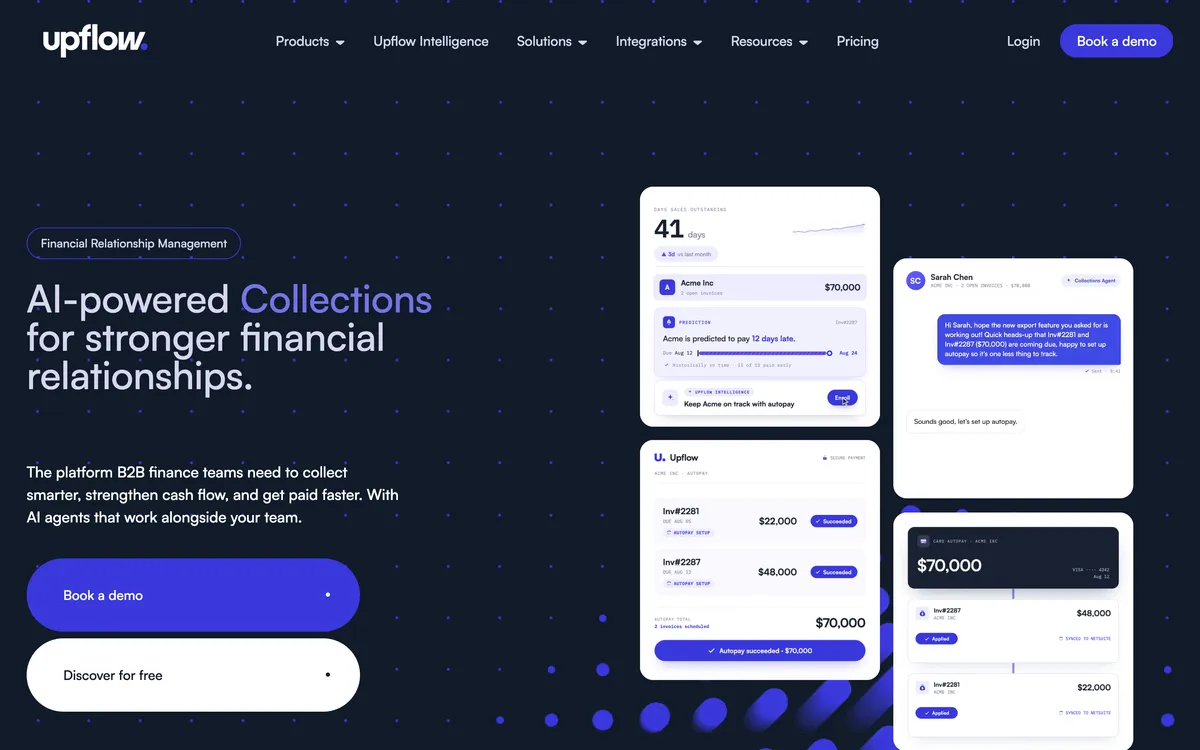
For a multi-branch agency that cannot currently say which branch or which consultant is sitting on the slow clients, that is the first genuinely useful thing it buys.
The free Discover tier reports those numbers and chases nobody.
Limitations with Upflow. Fees are pushed back to the ERP, and an agency on Xero or QuickBooks Online has nowhere to push them. No payment plans, just part payments the client starts and promises to pay.
Automated actions fire once a day and only on business days, which does not line up with a Friday payroll rhythm. Sending through your own SMTP switches off open and click tracking, and the QuickBooks link polls every five minutes with payments landing in Undeposited Funds for manual reconciliation. No price is printed at any tier.
7. Invoiced, best for NetSuite or Sage Intacct
Best for: Enterprise staffing networks on NetSuite or Sage Intacct.
No price published
What is Invoiced best for?
For a large staffing network that bills through an ERP and wants invoice-to-cash automation across the whole cycle rather than a chasing tool.
- Fits
- Large staffing groups and enterprise billing operations. No revenue band published
- Regions
- United States focus; part of Flywire
- Entry cost
- Not published. Invoiced prints no figures and quotes through sales
- Rated
- 4.7 from 149 reviews on Capterra; 4.5 from 418 reviews on G2
- Awards
- None found
- Runs on
- NetSuite, Sage Intacct, Dynamics 365 Finance, Xero, QuickBooks Online, QuickBooks Desktop and Enterprise
- Late fees and interest
- Yes. A flat or percentage fee after a grace period, added as a separate invoice line, with multiple schedules assignable to different customer groups, a per-invoice waiver, and payment-plan invoices excluded. Syncs to QuickBooks
- Customers
- Named on its website: WebPT, iWave and Apartment Life. Apartment Life's case study reports overdue accounts cut by 50%.
Invoiced covers billing, collections and cash application as one system, which is the shape a staffing network with several trading entities and a shared service center tends to buy rather than assemble. Integration pages for Xero and QuickBooks Online are still published, though the positioning has moved towards the ERP and enterprise end since the Flywire acquisition.

A dedicated late-fee automation use case sits in its materials: a flat or percentage fee after a grace period, with schedules that can be assigned to different customer groups, which makes it the second tool here after Paidnice to document a per-group grain.
Limitations with Invoiced. No price at any tier and no published feature inventory, so two of the five criteria cannot be scored for it. Its review scores are published, at 4.5 on G2 and 4.7 on Capterra. The enterprise positioning deprioritises the Xero and QuickBooks Online audience its integration pages nominally serve, and that is where most recruitment agencies sit.
Funding the gap: what each payroll cycle of waiting costs
Start with one contractor. Billed at $60 an hour on a 38-hour week, that is $2,280 of client billing. At a 12 percent gross margin the agency keeps $273.60 and pays out $2,006.40 the following Friday.
If the client settles at 45 days, the agency funds roughly six and a half weekly payrolls before the first payment arrives: about $12,900 of its own cash, against about $1,760 of margin earned over the same period. At forty contractors on the same terms the number is a financing requirement.
Scale it to the book and the arithmetic is the same shape. An agency billing $50,000 a week and settling at 45 days carries about 6.4 weeks of billing in unpaid invoices at any moment, which is roughly $321,000 sitting on the ledger.
Which is why days are the unit that matters, rather than percentages. Taking ten days off the average wait on that book releases about $71,000 of the agency's own cash, permanently, without a single extra placement. Set that against the price of anything on this page and the software line is the smaller number.
A late fee prices a share of the wait. On a $12,000 staffing invoice paid six weeks late, an annual rate of 12 percent is about $166. A client with two suppliers and one payment run pays the supplier that charges, so the fee changes which pile the invoice sits in before a cent of it is ever collected.
On $50,000 of weekly billings settled in 45 days, $321,429 sits in unpaid invoices, which is 6.4 weeks of billing outstanding. Collecting 10 days sooner releases $71,429.
The timesheet approval gate, and where the AR tool starts
The most common reason a staffing invoice is late has nothing to do with chasing. A line manager at the client has not approved a timesheet, so the invoice either has not been raised or has been raised against hours somebody now disputes.
None of the seven tools on this page approves a timesheet. That work sits in the front office, in Bullhorn or whichever PSA the agency runs, and it is a different purchase with a different buyer inside the business.
It also settles which system to shortlist against. Every tool on this page connects to the ledger, so the question is which ledger the receivable lands in rather than which system raised it. An agency running Bullhorn into Xero is buying a Xero tool.
Which recruitment AR tools apply late fees and statutory interest?
Four of the seven raise late fees themselves. Paidnice holds a policy per customer group, Invoiced assigns schedules to customer groups, Chaser holds one set of late-fee rules not tied to schedules, and Satago adds an optional fee to its reminder emails. The other three leave the job to the agency or to its ERP.
A large client pays slowly because paying slowly costs nothing. A charge that lands on that client's own ledger changes the arithmetic on their side: it enters their accounts payable system, their aged payables and their next payment run, and it is on the record if the account ever has to be escalated.
It is also something a credit controller can hand back deliberately, waived in writing in exchange for settlement this week.
UK agencies have a statutory floor rather than a purely contractual one. The Late Payment of Commercial Debts (Interest) Act 1998 allows interest on an overdue business-to-business invoice at 8% a year above the Bank of England base rate, plus a fixed compensation sum of £40, £70 or £100 according to the size of the debt.
On a £15,000 staffing invoice eight weeks late, that is the £100 fixed sum plus 56 days of interest at 8% over base. The base rate moves, so the current figure belongs on GOV.UK rather than in anyone's memory.
Outside the UK there is no statutory rate and the placement contract has to carry one, which is a reason to write the terms carefully before the first contractor starts.
A recruitment book is never one class of client, so a single rate across the corporate on 90 day terms and the small employer on 14 will suit one of them at most, even with the disputed-timesheet pile left out.
Software or invoice finance, priced side by side
The competing purchase for a recruitment agency is invoice discounting, and both are answers to the same question: who funds the wait.
They work differently. Chasing software shortens the wait and leaves the receivable and the credit risk on the agency's own balance sheet. A finance provider settles the invoice now, carries the risk and charges for it, and the aged listing is what it lends against, which is a second reason for the aging to be clean.
Satago is the one entry here where both live inside one relationship, and that, rather than its feature list, is why it appears on a recruitment shortlist despite a late fee that sits only in reminder emails.
Published entry prices for the rest: Paidnice £49 (US$69), Chaser £199, ezyCollect A$275 (last published; current prices are hidden and must be requested) on annual billing plus a A$900 setup fee, Kolleno $650 per user.
Neither Upflow nor Invoiced prints a figure at any tier. Upflow removed its prices and quotes five tiers by gross invoice value. Upflow's last published prices were $440 a month for Grow and $880 for Scale, and current prices are hidden and must be requested.
Chaser bands by company turnover, which is the wrong axis for an agency booking large billings on thin margins. ezyCollect charges by debtor count and adds a setup fee, which suits an agency with many invoices against few debtors.
By size of billings: under $1m, Satago at £25 inside Sage 50 for a UK agency, or Paidnice at £49 (US$69) if the fee matters as much as the reminder.
From $1m to $4m, Paidnice or Chaser, whose Compact tier is priced for turnover under £4m and sells credit checks by credit, with ezyCollect in Australia and New Zealand once the debtor count justifies the setup fee.
From $4m to $20m it is the real head-to-head between per-group fee policies and Chaser Core from £599. Above $20m, Kolleno if matching payments is the bottleneck, Upflow if nobody can measure collections by branch, and Invoiced if the group already bills through NetSuite or Sage Intacct.
Which tools schedule installments on a placement fee?
Paidnice (on Pro), Chaser, ezyCollect and Kolleno all schedule installments against an open invoice. Upflow takes client-initiated part payments instead, and no installment function is documented for Satago or Invoiced.
The place a plan gets used in recruitment is the permanent placement fee rather than the contractor run. A contractor invoice is weekly and small. A placement fee is one large invoice against a single hire, and it is the one a client asks to spread, usually while the hire is still inside a rebate period.
What decides the tool is what chases the plan afterwards. Chaser splits an invoice from weekly through to yearly, but the chasing follows the original invoice due date rather than the installment dates, and its own documentation advises chasing the installments manually. ezyCollect sells Payment Plans as a paid add-on, set up at the invoice or customer level.
Kolleno splits weekly, monthly or bi-monthly with automations tied to the plan, and an uneven total has to be split manually.
Bullhorn, the ledger, and which one the tool connects to
- Xero. All seven connect, so the ledger constrains nothing and the choice comes down to enforcement grain and pricing axis.
- QuickBooks Online. The same, except ezyCollect, which shows a QuickBooks logo on its homepage but no connector page. Upflow's link polls every five minutes and lands payments in Undeposited Funds for manual reconciliation, which is worth knowing before buying on that ledger.
- MYOB and the Australian ERPs. ezyCollect is the native option, reaching MYOB AccountRight, Exo, Essentials, Acumatica, Pronto Xi and Attaché. Paidnice reaches MYOB on the Custom plan only.
- NetSuite, Sage Intacct and SAP. Kolleno, Upflow and Invoiced, with Chaser also connecting. Paidnice reaches NetSuite, Sage Intacct, MYOB and Dynamics 365 Business Central on its Custom plan, as a build rather than a standard connector.
- Sage 50. Satago and Chaser, and Satago's embedded edition is the cheapest route in this comparison at £25 a month.
Which accounts receivable software for recruitment fits your use case?
| Use case | Start with | Watch out |
|---|---|---|
| Agency on Xero or QuickBooks Online that wants late fees per client group | Paidnice | Essentials covers 150 invoices; most agencies land on Pro |
| Credit checks before contractors go on site at a new client | Chaser | One set of fee rules; Compact stops at four users |
| UK agency that wants chasing and payroll funding together | Satago | Late fee sits in reminder emails; ledger posting not documented |
| Australian or New Zealand agency on MYOB | ezyCollect | No late fees; A$900 setup on the last published price |
| Staffing group matching one payment to forty invoices | Kolleno | $650 per user a month |
| Multi-branch agency that cannot measure collections by branch | Upflow | No late fees or payment plans; quote only |
What agency owners and credit controllers ask
Which tool should a recruitment agency shortlist first?
On Xero or QuickBooks Online, Paidnice, because it handles contractor invoices at volume and runs late fees and interest as a separate policy per client group, from £49 (US$69) a month. Where the escalation needs bureau credit checks and posted letters in the same system, Chaser, from £199 a month. Check current pricing with the vendor.
How does this help fund weekly contractor payroll?
By shortening the wait rather than lending against it: automated chasing and a fee that arrives on schedule pull the settlement date forward, which reduces the balance the agency funds between paying contractors and being paid.
On a $50,000 weekly book settling at 45 days, ten days off the wait releases about $71,000. Clean aging and statements also make the ledger easier to fund if the agency uses invoice finance.
Will any of these approve timesheets?
No. Timesheet approval belongs to the front office, in Bullhorn or whichever PSA the agency runs, and none of the seven tools here touches it.
Can these cope with hundreds of contractor invoices a month?
Yes, but check the pricing axis before the feature list. Paidnice tiers by invoice volume, ezyCollect by debtor count, Chaser by company turnover and Kolleno by user. An agency raising several hundred small invoices against a few dozen debtors will pay very different amounts depending on which axis the vendor picked.
Which of these apply late fees automatically?
Paidnice and Chaser: Paidnice runs a policy per customer group and posts the charge to the ledger as Draft or Approved, while Chaser runs one set of late-fee rules, not tied to schedules, raises no fee on payment-plan invoices, and its help says a late fee cannot be added or updated after a part payment when written to Xero.
Invoiced runs a flat or percentage fee with schedules assignable to customer groups. ezyCollect and Kolleno document no interest function, Upflow points the job back to your ERP, and Satago adds an optional late fee to its reminder emails.
What does it cost for a recruitment agency?
Satago is from £45 a month (£25 inside Sage 50), and Paidnice is £49 (US$69) a month on Essentials and £74 (US$99) on the first Pro tier.
Chaser is £199 a month for turnover under £4m, ezyCollect A$275 a month (last published; current prices are hidden and must be requested) on annual billing plus a A$900 setup fee, and Kolleno $650 per user a month. Neither Upflow nor Invoiced publishes a price.
Our ledger already sends reminders. What does this add?
Xero sends up to five email reminders per invoice and QuickBooks Online up to three. Neither escalates by client group, issues statements automatically, or reports collection performance by branch or account manager. On a ledger where the deadline is the payroll date rather than the invoice due date, one reminder template is not a credit control policy.
To compare the same tools for any business type, read the best credit control software guide, which sets out six tools by size, ledger and price.
Next for a staffing ledger
Buyer's guide
Best accounts receivable software (by business type)
The pillar guide: every tool in the category, sorted by size and ledger.
Agencies
Best AR software for agencies
Chasing a retainer without spending the client relationship.
Debt collection
Best AR software for debt collection agencies
Collecting your own commission and client fees, not your clients' debts.
Alternatives
Best Chaser alternatives
Six rivals measured against Chaser on fee grain, price and review base.
Sources
19 sources, checked by Julie Turnbridge on November 3, 2026
- Xero Small Business Insights xero.com/us/resources/small-business-insights
- Xero App Store apps.xero.com/app/paidnice
- Capterra capterra.com/p/254868/Paidnice
- Xero App Store apps.xero.com/uk/app/chaser
- G2 g2.com/products/chaser/reviews
- Capterra capterra.com/p/157101/CHASER/reviews
- Wayback Machine web.archive.org/web/20240617113004/https://ezycollect.io/...
- Xero App Store apps.xero.com/au/app/ezycollect
- G2 g2.com/products/ezycollect/reviews
- Capterra capterra.com/p/135729/ezyCollect/reviews
- G2 g2.com/products/kolleno/reviews
- Xero App Store apps.xero.com/uk/app/kolleno
- Capterra capterra.com/p/227932/Kolleno
- G2 g2.com/products/upflow-upflow/reviews
- Capterra capterra.com/p/193097/Upflow
- Xero App Store listing apps.xero.com/us/app/upflow
- Late Payment of Commercial Debts (Interest) Act 1998 legislation.gov.uk/ukpga/1998/20/contents
- Bank of England base rate bankofengland.co.uk/monetary-policy/the-interest-rate-ban...
- GOV.UK gov.uk/late-commercial-payments-interest-debt-recovery/ch...