The best accounts receivable software for MSPs in 2026 is Paidnice, for an MSP on QuickBooks Online or Xero that wants a different late fee policy per client group, whatever PSA produced the invoice.
Chaser, Alternative Payments, Invoiced, FlexPoint and ConnectBooster complete the six, compared on whether the tool charges a late fee itself, how it connects to your PSA and what it publishes as a price. Prices from £49 (US$69) a month.
| Tool | Best for |
|---|---|
| Paidnice | An MSP on QuickBooks Online or Xero that wants a different late fee policy per client group, whatever PSA produced the invoice |
| Chaser | An MSP with a credit controller that wants email, SMS, letters, calls and Creditsafe checks in one ledger-connected tool |
| Alternative Payments | A US or Canadian MSP that wants payments and a human collections escalation from one vendor |
| Invoiced | A larger MSP on NetSuite, Sage Intacct or Business Central whose bottleneck is billing complexity |
| FlexPoint | A US MSP whose biggest receivables cost is card and ACH fees and that wants compliant surcharging |
| ConnectBooster | A ConnectWise or Kaseya BMS shop that wants deep autopay inside the Kaseya 365 Ops bundle |
On Xero's latest US small business data shows a US small business waits 29.7 days to be paid and settles 8.6 days past due.
For an MSP those days repeat every month against the same clients, so a nine-day drift on a monthly agreement compounds into a permanent hole in working capital. Where the client sits matters too: 38.7 days in New York against 24.1 in California. A UK small business on the same data waits 29.3 days and settles 8.3 days past due.
What is accounts receivable software for MSPs, and what is it not?
Accounts receivable software for MSPs works the managed-services invoices your PSA has already written into QuickBooks Online or Xero. It chases each one after it goes out, raises a charge where the MSA allows one, and stops the chase when the payment posts.
- Reminders and statements. Sequences by email and SMS, in some tools letters or calls, and statements on a schedule.
- Late fees and interest. Paidnice, Chaser and Invoiced compute and raise the charge. FlexPoint passes through what the ledger already calculated.
- Payments and plans. Card and ACH collection, autopay, and installment plans or financing.
- Escalation. An account manager call, an AI voice call, or a collections team on success pricing. Some tools also log every reminder, charge and call as a dated record for a later dispute.
It is not the PSA. ConnectWise, Autotask, HaloPSA and SuperOps still run the agreement and raise the invoice, and some AR tools connect to them while others read only the ledger.
It is not a suspension tool: no tool here documents suspending services, which happens in the RMM and the PSA on your engineers' authority. It is not a merchant account either, except where the vendor sells payments, as Alternative Payments and FlexPoint do.
How this list was put together
This list helps a managed service provider chase the invoices its PSA writes into QuickBooks Online or Xero.
| What we checked | Where the evidence came from |
|---|---|
| PSA path: ConnectWise, Autotask, HaloPSA or Kaseya, direct or through the ledger | Vendor integration pages |
| Late fee grain, where the MSA allows a charge | Vendor help pages on fees and interest |
| Takes payment | Vendor payment pages; no price here includes card or ACH processing |
| Statements and payment plans | Vendor feature pages |
| Published from-price | The vendor's pricing page, with "Not published" where there is none |
| Rating and review count | The Xero App Store or G2 |
Chasing a client you also support
An MSP bills the same clients every month under a managed services agreement, and the person who has to send the second reminder often took their call at 2am. That single fact changes what good receivables software looks like here.
Under an MSA the same invoice is attached to a contract that renews, a service desk answering to the same client, and an account manager who is mid-negotiation on next year's seat count. Nothing you do to the invoice stays inside finance.
Four questions follow from that, and none of them appears on a feature comparison. Who does the reminder come from: accounts@, the account manager, or a platform the client does not recognize. Does the service desk know the account is 60 days out before it commits to another project.
Is suspension available at all, and does your MSA say what you think it says? And what does a 1.5% charge look like on a client you intend to keep for five years?
The second constraint is the stack. MSPs change PSA more often than they change ledger, and a receivables tool bound to a PSA connector has to be bought again when they do.
The money-in half of the same problem, what card and ACH cost per dollar collected, is a separate shortlist with a separate ranking, and it sits on the payment gateway guide for MSPs.
What an MSP should be looking for:
- Reminders a client reads as normal. Multi-channel follow-ups sent from your own authenticated domain, and where it matters from a named person rather than from a system.
- A charge the tool raises itself. A late fee or interest computed and posted to the ledger, rather than inherited from a QuickBooks setting somebody left switched off in 2023.
- Policy per client group. A flagship client on a three-year MSA and a month-to-month break-fix account cannot share one rule and both be handled correctly.
- A ledger connection as well as a PSA connection. The invoice reaches QuickBooks Online or Xero whichever PSA produced it, and that path survives a migration.
- Something the service desk can see. AR status that reaches the people actually talking to the client, so nobody promises a project start to an account that is 90 days out.
Six tools for MSP receivables
 |
 |
 |
 |
 |
 |
|
|---|---|---|---|---|---|---|
| Best for | MSP on QuickBooks Online or Xero wanting fees across any PSA | MSP with a credit controller wanting multi-channel chasing | North American MSP wanting payments and human collections | Larger MSP whose bottleneck is billing complexity on an ERP | US MSP cutting card and ACH fees with surcharging | MSP already inside the ConnectWise or Kaseya stack |
| Revenue fit | Any size up to $50m a year, or 50,000 invoices a year | Compact under £4m, Core from £4m, Complete to £100m | To $50k a month of processing on the entry tier, $100k on the second | Not published | To $50k a month of processing on the entry tier, unlimited on the top tier | Not published |
| From (monthly) | US$69 | £199 | US$199 | Not documented | US$249 | Not published |
| PSA integrations | No (reads from the ledger) | No (reads from the ledger) | ConnectWise, Autotask, HaloPSA, SuperOps | None found | ConnectWise, Autotask, HaloPSA, SuperOps | ConnectWise, Autotask, Kaseya BMS |
| Ledger integrations | QuickBooks Online, Xero and newer ledgers such as Rillet and Campfire (closed testing) on every plan; Sage Accounting and other ERPs on Custom | Xero, QuickBooks, Sage 50, Sage 200, Sage Intacct, NetSuite, Dynamics 365, AccountsIQ, SAP | QuickBooks Online and Desktop, Xero, Sage Intacct, NetSuite, Dynamics 365, Zoho Books, FreshBooks | NetSuite, Sage Intacct, Dynamics 365 Business Central, Xero, QuickBooks | QuickBooks Online and Desktop, Xero; Sage Intacct, NetSuite and Dynamics 365 Business Central above the entry tier | QuickBooks Desktop and Online, Xero, Sage Intacct, Dynamics GP |
| Late fee grain | Yes (per customer group) | Yes (one set of rules for the account) | None found | Yes (schedules assignable to customer groups) | No (from your ledger only) | None found |
| Statements | Yes (any schedule) | Yes (monthly, fixed day) | Not documented | Not documented | Yes | Yes |
| Payment plans | Yes (on Pro) | Yes | Yes (customer-paid financing, 30 to 150 days) | Not documented | Yes (financing, terms not published) | None found |
| Takes payment | Yes (Stripe and Pinch Payments) | Yes (Chaser Pay on Stripe rails) | Yes (own rails; no ACH fees on the pricing page) | Not documented | Yes (ACH $1.00 on Starter, cards 3.0% or Interchange+) | Yes (BNG gateway plus a separate merchant processor) |
| AI | Advanced Reads customer replies, drafts answers and follow-up actions (like PO updates) for your approval; MCP server for Claude, ChatGPT and other agents | None No shipped AI feature found | Advanced Agentic AI (Assist, Automate, Advise) and CashMatch AI matching | Basic AR Agents run reminder sequences and pause when a client replies | None No AI in the billing product | |
| Rated (source, count) | 5.0 (84, Xero App Store) | 4.98 (374, Xero App Store) | 4.7 (11, G2) | 4.5 (418, G2) | 4.8 (6, G2) | 4.4 (28, G2) |
"Not documented": the vendor does not document the capability. "Not published": the vendor prints no figure. "None found": the materials are silent. Prices are the vendor's published from-price, and none of them includes card or ACH processing.
The six tools in five checked facts
- Three of the six apply a late fee themselves: Paidnice (per customer group), Invoiced (flat or percentage, with schedules by customer group) and Chaser (one set of late-fee rules).
- All six connect to both Xero and QuickBooks Online.
- AI that handles collections work or customer replies: Paidnice and Invoiced. AI that does not handle replies: FlexPoint. No AI in receivables: Alternative Payments and ConnectBooster.
1. Paidnice, best for enforcement across any PSA
Best for: MSPs on QuickBooks Online or Xero that want enforcement across any PSA.
What is Paidnice best for?
For an MSP that wants late fees and interest applied automatically to overdue managed-services invoices, without wiring anything into ConnectWise or Autotask.
- Fits
- MSPs billing through QuickBooks Online or Xero of any size up to $50m a year, or 50,000 invoices a year, with or without a dedicated finance hire
- Regions
- United States, Canada, United Kingdom, Australia, New Zealand, South Africa
- Entry cost
- Essentials at £49 (US$69) a month covers 150 invoices, 600 emails and 2 team members. Pro at £74 (US$99) a month and above lifts the seat cap entirely, with no per-seat fee, which matters where the account manager and the service desk both want visibility
- Rated
- 84 Xero App Store reviews averaging 5.0, and 4.9 from 14 on Capterra. Neither base is MSP-specific
- Awards
- Xero Global Small Business App of the Year 2025 and NZ Small Business App of the Year 2026
- Runs on
- QuickBooks Online, Xero, Stripe, Pinch Payments, CloudDepot, HubSpot, Pipedrive, Zapier. Newer ledgers such as Rillet, Campfire, Digits, DualEntry, Puzzle, Accounting Seed and Odoo are available on every plan through Paidnice's closed testing program. NetSuite, Sage Intacct, MYOB, Dynamics 365 Business Central, Sage Accounting and other ERPs connect on the Custom plan
- Late fees and interest
- Yes. Flat fees, percentage fees and compounding interest, with policies sitting under customer groups so different groups run different rules at once, and the charge raised on the QuickBooks or Xero ledger as Draft or Approved
Paidnice has no PSA connector, and for an MSP that is the point. Your PSA already writes finished invoices into QuickBooks Online or Xero, so Paidnice reads the ledger and never needs to know whether ConnectWise, Autotask, HaloPSA or SuperOps produced the invoice.
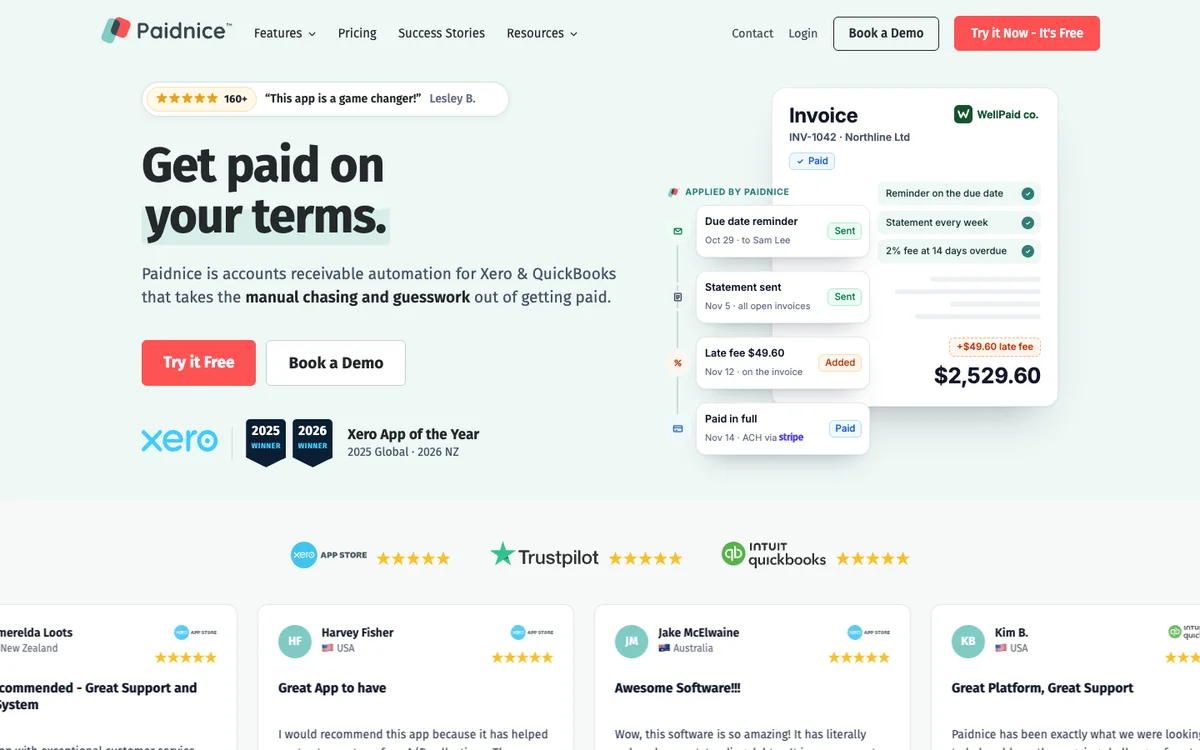
A PSA migration changes nothing on the receivables side. CloudDepot, one of its native connections, carries the ConnectWise and Autotask hop into Xero for MSPs that route billing that way.
On top of the ledger it runs reminder sequences per customer group by email and SMS. Sending from your own authenticated domain starts on Pro, and it is what lets an MSP send from accounts@ and then from a named director rather than from a platform the client has never heard of.
Statements go on any schedule, including consolidated parent accounts for a client billing through several entities, and payment plans (on Pro), a portal and escalation on the accounts that go quiet all sit on the same group. Its own reported outcome is half as many late invoices in the first 30 days.
Statement interest recalculates at the moment the statement sends rather than at the last policy run, so the figure a client opens is accurate that morning.
The charge is calculated on the balance net of any credit on the account, and it lands on the ledger as a real receivable, which is what puts it into the client's own accounts payable queue.
Limitations with Paidnice. The ledger mix an MSP runs is the constraint: QuickBooks Online and Xero are native, and a shop that has grown into Sage Intacct, NetSuite, MYOB or Dynamics 365 Business Central is on the Custom plan and a build rather than a connector, with some payment features differing between the two native ledgers.
It is not a merchant account, so card and ACH run on Stripe or Pinch Payments rather than its own rails, with no surcharging function, and an MSP wanting one vendor for processing and chasing is buying two. Essentials stops at two seats, which most shops outgrow before they outgrow the invoice allowance.
2. Chaser, best for ledger-connected chasing
Best for: MSPs that want multi-channel chasing from a ledger-connected tool, priced by company turnover.
What is Chaser best for?
For an MSP with a named credit controller that wants email, SMS, letters and calls running from one system, and can live with one set of fee rules.
- Fits
- Businesses under £4m turnover on the entry tier, with tiers running to £100m. Not MSP-specific
- Regions
- UK-registered, trading since 2014, sells worldwide. Automated calls are unavailable in New Zealand
- Entry cost
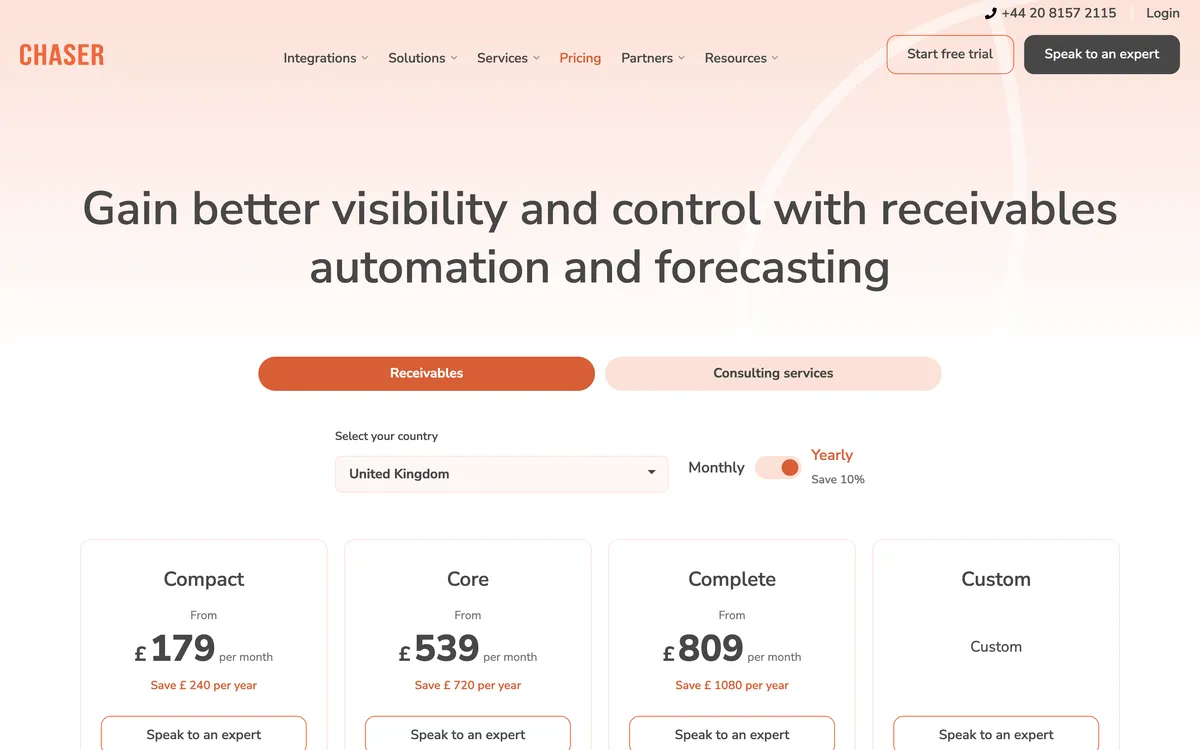
- £199/mo on Compact for turnover under £4m with 4 users; Core £599/mo under £10m; Complete £899/mo to £100m
- Rated
- 4.98 from 374 Xero App Store reviews; 4.3 from 71 on G2; 4.9 from 45 on Capterra, mostly dated 2020 to 2022
- Awards
- Finalist, UK Small Business App Partner of the Year, Xero Awards 2023
- Runs on
- Xero, QuickBooks, Sage 50, Sage 200, Sage Intacct, Sage Business Cloud Accounting, NetSuite, Dynamics 365, AccountsIQ, SAP, HubSpot, Gmail and Outlook. No PSA connector of any kind
- Late fees and interest
- Yes. Four calculation types including a UK Bank of England base rate type, recalculated daily, but one set of rules for the account, applied to every debtor or to selected debtors, and no fee is raised on payment-plan or partially paid invoices
- Customers
- Named on its website: Air IT, Huttie and TaxAssist. Huttie's case study reports £15,000 of old debt recovered.
Chaser reaches the invoice the same way Paidnice does, through the accounting ledger, so it survives a PSA change for the same reason.
The credit data is aimed at the moment an MSP signs a new managed-services client rather than at the moment one goes bad.
A Creditsafe report inside the app carries a credit score with a recommended limit, the prospect's payment score, credit event history, and Companies House filing and director data, with continuous monitoring behind it, so an MSA can be priced and termed against something better than a gut feel about the finance director.
It is UK-weighted, and checks are metered at one credit for the UK and Ireland and four elsewhere, which makes routine screening of a US client base expensive. Chaser credit checks need Chaser billing, not Xero App Store billing; monitoring is not offered in Australia.
Limitations with Chaser. Nothing in it is MSP-shaped: no PSA connector, no quoting integration, and no concept of an agreement behind the invoice. Chaser prices by revenue band, from £199 a month on Compact for revenue under £4m.
Statements go monthly only, on a fixed day, Compact caps the team at four users, and collections and forecasting are metered add-ons.
3. Alternative Payments, best for human escalation
Best for: MSPs that want payments and a human collections escalation in one platform.
What is Alternative Payments best for?
For a US or Canadian MSP that wants card and ACH processing and a team that will phone an overdue client, bought from one vendor.
- Fits
- Service businesses processing up to $50k a month on the entry tier and up to $100k on the second, with custom pricing above. MSPs are one of four named verticals alongside accounting, business services and telecom
- Regions
- United States and Canada only. Canada excludes Quebec, and installment financing and collections are unavailable there. No published support for the UK, Australia, New Zealand or South Africa
- Entry cost
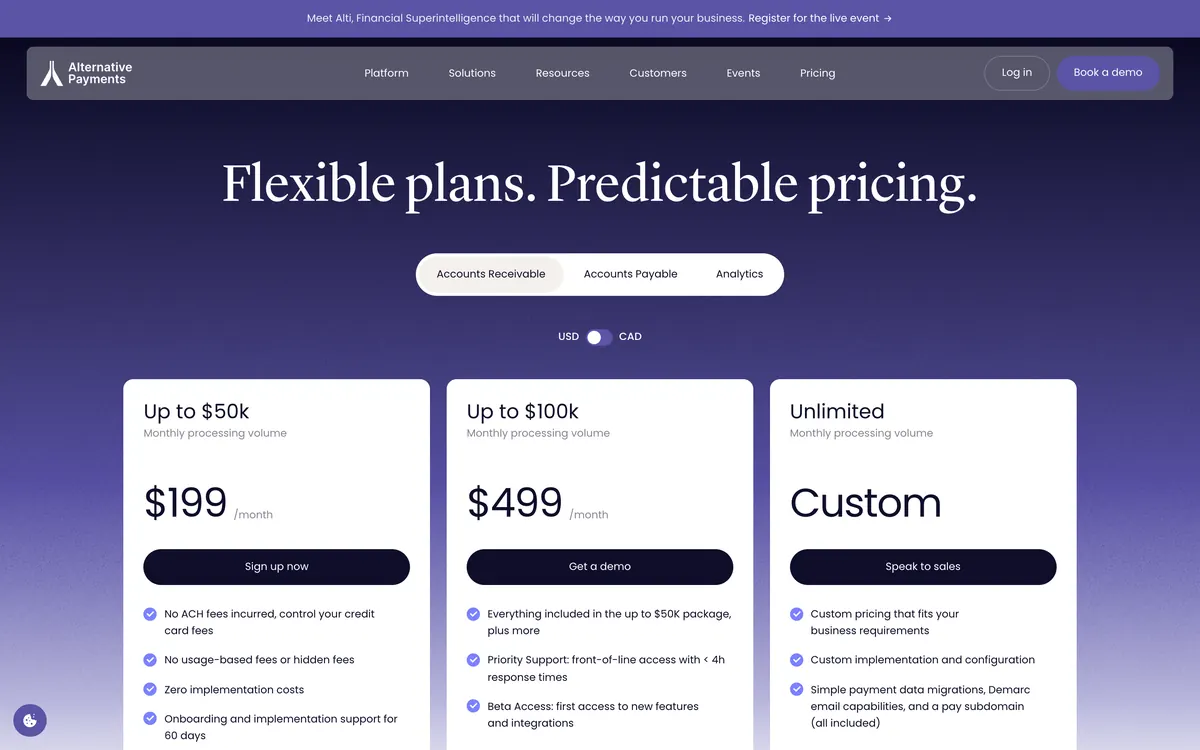
- US$199/mo up to $50k of monthly processing; US$499/mo up to $100k; custom above that. Cards 2.9% + $0.30, AMEX 3.5% + $0.30, no ACH fees on the pricing page, with a published chargeback schedule
- Rated
- 4.7 from 11 G2 reviews, a thin base for a vendor citing more than 1,000 customers. No Capterra listing found
- Awards
- None found
- Runs on
- ConnectWise PSA, Datto Autotask PSA, HaloPSA and SuperOps. QuickBooks Online and Desktop, Xero, Sage Intacct, NetSuite, Dynamics 365 Business Central, Zoho Books and FreshBooks. ConnectWise CPQ, ScalePad Quoter, QuoteWerks and Datagate. No Kaseya BMS or Syncro
- Late fees and interest
- None found. Nothing in the help center or on the receivables product pages calculates, posts or accrues a late fee or interest. The model is autopay and reminders first, then people
- Customers
- Named on its website: TeamLogic IT, Sage IT and CMIT Solutions Idaho. TeamLogic IT Utah Valley North's case study reports 40% of invoices paid on creation.
Alternative Payments publishes more of its commercials than anyone else in this comparison: a monthly subscription price, a card fee schedule, chargeback costs, and a stated zero implementation cost.
It carries the widest ledger list here.
Its installment product is financing rather than a schedule you control. A client pays over 30 to 150 days in equal installments every 30 days for a fee of 3.0% to 7.0%, the fee is paid by the client, the MSP is funded in full upfront, and Alternative Payments carries the credit risk and handles missed payments.
Limitations with Alternative Payments. North America only, and the Canadian product is materially reduced. No late fee or interest engine, so a 1.5% a month clause in your master services agreement has nothing in the platform to enforce it.
Customer statements are undocumented. A G2 reviewer reports payouts showing as paid when the underlying transaction had failed, which sits directly on the reconciliation claim. Contract length is not published, which is the one gap in an otherwise open pricing story.
4. Invoiced, best for complex MSP billing
Best for: Larger MSPs whose problem is billing complexity.
With no published price
What is Invoiced best for?
For an MSP running billing on NetSuite, Sage Intacct or Dynamics 365 Business Central that needs invoice-to-cash breadth rather than collections depth.
- Fits
- Upper-mid-market and enterprise B2B finance teams. No revenue band published, and the positioning has moved upmarket since the Flywire acquisition
- Regions
- United States-centered. No other market is documented
- Entry cost
- Not documented. No price is published
- Rated
- 4.7 from 149 reviews on Capterra; 4.5 from 418 reviews on G2
- Awards
- None found
- Runs on
- NetSuite, Sage Intacct and Dynamics 365 Business Central, with maintained integration pages for Xero and QuickBooks Online, Desktop and Enterprise. No PSA connector documented
- Late fees and interest
- Yes. Flat or percentage fee with a grace period and adjustable interval, posted as a separate invoice line, with multiple schedules assignable to different customer groups
- Customers
- Named on its website: JumpCrew, iWave and WebPT. iWave's case study reports 20 days cut from its time to collect.
Invoiced is a US invoice-to-cash platform, now part of Flywire, whose center of gravity has moved to the ERP end of the market: buyer pages written for CFOs, controllers and AR managers, a gated white paper library, and integrations led by NetSuite, Sage Intacct and Dynamics 365 Business Central.

Xero and QuickBooks integration pages are still maintained, and they are no longer the focus.
For an MSP the question is whether billing complexity or collections is the real bottleneck. Where a large MSP is running multi-entity or high-volume recurring billing, that breadth is worth paying for. Where the invoices already come out cleanly and the problem is that clients pay late, it is more platform than the job requires.
Limitations with Invoiced. One of the eight facts above is not published: the price. No PSA connector is documented, so an MSP would be relying on the ledger hop with none of the MSP tooling the platforms above carry.
5. FlexPoint, best for low-cost ACH and surcharging
Best for: MSPs that want low per-transaction ACH and compliant US card surcharging.
What is FlexPoint best for?
For a US MSP whose biggest receivables cost is card and ACH fees, and which wants AI agents drafting the follow-ups it never gets around to sending.
- Fits
- MSPs processing up to $50k a month on Starter, up to $100k on Growth, and unlimited on Plus. No revenue band published
- Regions
- United States. Every price, cap and rail published is USD, and no support for the UK, Canada, Australia, New Zealand or South Africa is published either way
- Entry cost
- Starter is $249 a month and Growth is $550 a month (pricing); Plus is quoted. ACH is $1.00 per transaction on Starter and $0.50 on Growth, cards are 3.0% or Interchange+, and Same-Day ACH carries an included monthly allowance per tier
- Rated
- 4.8 from 6 G2 reviews, too small a base to read as a quality signal; the Capterra listing carries no reviews at all
- Awards
- None found
- Runs on
- ConnectWise PSA, Autotask, HaloPSA and SuperOps. QuickBooks Online and Desktop and Xero on every tier, with Sage Intacct, NetSuite and Dynamics 365 Business Central above the entry tier. Quoter, QuoteWerks, ConnectWise CPQ, Rewst and Datagate. No Kaseya BMS or Syncro
- Late fees and interest
- No, from your ledger only. Their own guide states that QuickBooks late fee settings sync automatically, so FlexPoint displays, communicates and collects a fee the ledger already calculated
- Customers
- Named on its website: CharTec, Mainstay Technologies and tekRESCUE. tekRESCUE's case study reports 20 hours a month saved.
Surcharging is the feature FlexPoint leads with, and it is built properly: the platform calculates and applies the surcharge against current US state regulations and card network rules rather than offering a flat toggle.
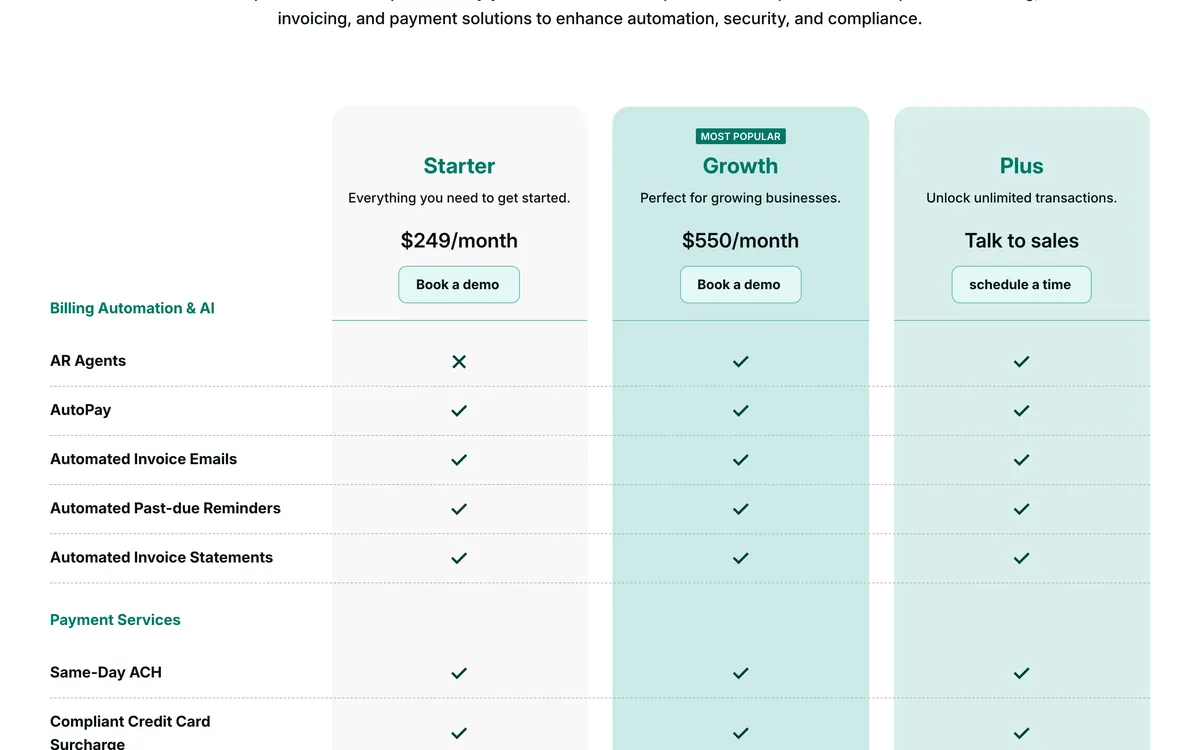
Same-Day ACH ships with a published included allowance per tier, and the Rewst integration plugs billing into the automation layer many MSPs already orchestrate everything else with.
The AI is the most substantive in this comparison and the escalation design is sensible: opt-in per capability, voice only after email, and a pending-approvals queue that surfaces what needs a human before anything goes out.
Limitations with FlexPoint. The Plus price is quoted only and the AR Agents add-on price is unpublished, so the published rates only tell you part of the cost.
Late fees are inherited rather than computed, which means an MSP with no fee logic in its ledger gets none from FlexPoint. Payment plans are a financing product whose partner, rates and terms are unpublished.
A custom portal domain and GL Connect are add-ons and premium ledgers are tier-gated, so the headline feature list overstates what the entry tier includes. FlexPoint says it has no long-term contracts; its Order Form sets the term. Six G2 reviews is close to no third-party evidence.
6. ConnectBooster, best for ConnectWise or Kaseya
Best for: MSPs already inside the ConnectWise or Kaseya stack.
Quoted price only
What is ConnectBooster best for?
For an MSP on ConnectWise or Kaseya BMS that wants a mature client portal and deep autopay, and can work with a quoted price.
- Fits
- ConnectWise and Kaseya MSPs, and MSPs already buying the Kaseya 365 Ops bundle. No revenue or volume band published; the product is quoted
- Regions
- The current product page names US-based support only. The vendor's own country list, covering the US, Canada, UK, Ireland, Australia, New Zealand and the Nordics with local card rates and local bank rails, has been deleted, so current availability is unconfirmed
- Entry cost
- Not published, quote only. Their own help article describes three separate charges: the software subscription, the BNG gateway fee, and merchant card processing billed by whichever processor you are on, with ACH invoiced separately again
- Rated
- 4.4 from 28 G2 reviews; 3.8 from 12 on Capterra, the only score below 4.0 in this comparison
- Awards
- G2 Leader in Small Business and High Performer
- Runs on
- ConnectWise Manage and PSA, Datto Autotask PSA and Kaseya BMS. QuickBooks Desktop and Online, Xero, Sage Intacct and Dynamics GP. Quoter, ConnectWise Sell, Zomentum, QuoteWerks QuoteValet, GreatAmerica, Datagate, CloudRadial and Invarosoft. No HaloPSA, SuperOps, Syncro or NetSuite
- Late fees and interest
- None found. No late fee or interest topic appears anywhere in the help documentation, across configurations, autopay, billing, accounting, gateway, client emails or reports
- Customers
- Named on its website: Blackline IT, Astute Technology Management and NEXTGen IT.
ConnectBooster is the incumbent, built in Fargo in 2010 by BNG Team and acquired by Kaseya in October 2022. It is the only tool here that connects Kaseya BMS, QuickBooks Desktop and Dynamics GP, and its reporting suite is deeper than the challengers': open invoices, transactions, scheduled payments, autopay configurations, expiring and locked cards, and email history.
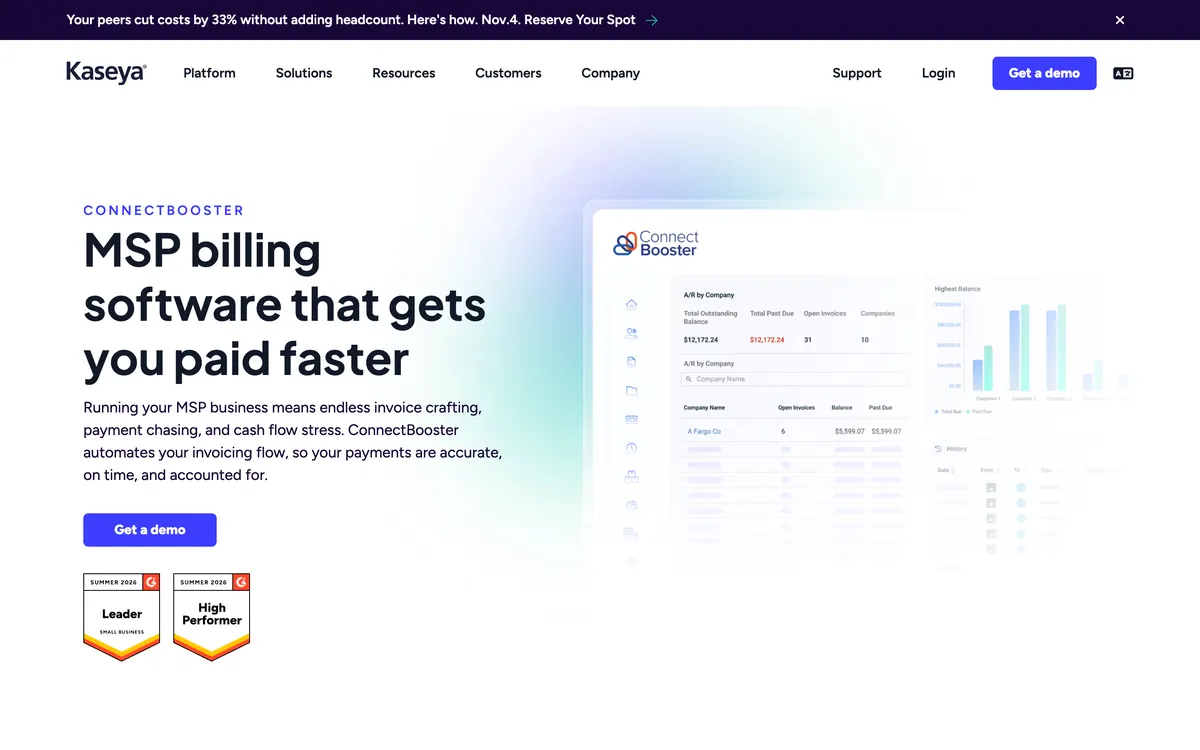
The connectbooster.com domain now redirects wholesale to a single Kaseya product page. Pricing, features, the FAQ and the countries page all land in the same place, and the product is now sold as a component of the Kaseya 365 Ops bundle rather than on its own.
Limitations with ConnectBooster. Cost is genuinely unknowable from public sources: an unpublished subscription, three separate bills and processor fees on a fourth timetable. The reviews are the weakest in this comparison and the complaints are structural rather than cosmetic, naming portal usability, sync failures that create duplicate entities, gateway timeouts and a transaction limit that blocked a payment.
There are no late fees, no interest, no installment plans and no surcharging documented. Kaseya's auto-renewal terms are a live objection for buyers, and the brand no longer has an independent web presence.
Suspension, service credits and what the MSA allows
An MSP has an escalation ladder no product business has, and no software on this page can climb the top half of it.
- The reminder. All six send one. Sender identity is the only thing that separates them here.
- The charge. Paidnice, Chaser and Invoiced compute and raise it. FlexPoint displays whatever the ledger already computed. The other two document nothing.
- The account manager call. Chaser has a one-way automated call and logged manual calls on Core and above. FlexPoint's AR Agents place an AI voice call, but only after email outreach has run. Alternative Payments sells Collections Assist, where their own team phones the client for you on success pricing.
- Suspension of non-critical services. No tool in this comparison documents it, and none should. Suspension happens in the RMM and the PSA, on your engineers' authority, not on a receivables policy.
- Suspension of support. The same, with a much shorter fuse on the relationship.
- Termination notice. Legal, not software.
Rungs four and five are where MSPs get into trouble, and the reason is the agreement rather than the tooling. Suspension for non-payment has to be an express right in the MSA, with a stated notice period and a stated cure period, or you are the party in breach.
Most well-drafted MSAs also carve out anything safety-critical or security-critical, which in practice is most of what an MSP runs.
Service credits run the other way and are worth checking at the same time. If your MSA gives credits for missed service levels, a client in a payment dispute will look for them, so the AR conversation and the service review need to be held by people who have read the same document.
What the software can genuinely do at these rungs is record. A dated log of every reminder, every charge, every call and every promise is what turns rung six from an argument into a paper trail, and it is worth switching on long before you expect to need it.
Which MSP tools can apply a late fee to a client on a three-year MSA?
Three of these six compute the charge themselves. Paidnice runs a policy per customer group, Invoiced assigns multiple schedules to customer groups, Chaser runs one set of rules, FlexPoint passes through whatever QuickBooks calculated, and no fee or interest mechanic is documented for Alternative Payments or ConnectBooster.
Most MSAs already carry a late payment clause, commonly 1.5% a month on overdue balances.
So grain decides this. Chaser's late fee is one set of rules for the account, applied to every debtor or to selected debtors, and it raises no fee on payment-plan or partially paid invoices, so a flagship client on a three-year MSA and a month-to-month break-fix account get the same rate if both are covered.
Paidnice's policies sit under customer groups, so a managed-services group on net 30, a project group and a disputed-accounts group each run their own rule at the same time.
The pattern that survives contact with an account manager is to switch the charge on for the groups that need it, leave the flagship group at zero, and move an account between groups when its behavior changes.
A charge that has landed is also something to give up. Waiving it deliberately, in writing, in exchange for payment this week works on an MSA client precisely because it reads as a concession from you rather than as a penalty they have to argue their way out of.
One set of rules for the account (Chaser)
- Four calculation types, including the UK base rate
- Recalculated daily
- One set of rules, across the account or for selected debtors
- No fee on payment-plan or part-paid invoices
A policy per customer group (Paidnice)
- Flat, percentage or compounding interest
- Multiple policies running at once
- An invoice fee and a statement charge together
- Raised on the ledger as Draft or Approved
Simple against compounding, across a recurring book
A tool that computes the charge can compound it, and a person who raises it manually once a quarter does not. On one invoice the difference is rounding. On a book of managed-services invoices that all sit three months out, on the same clients, every month, the gap adds up.
On $12,000 overdue for 3 months at 1.5% a month, a simple late fee is $540.00 and a compounding one is $548.14, a difference of $8.14.
A simple fee multiplies the balance by the monthly rate by the months overdue. A compounding fee charges each month on the balance including the fees already added, which is why the gap widens on a recurring book rather than on one invoice.
The rate itself comes from your MSA and from the ceiling your state sets, so confirm both before the first policy runs.
What breaks when you change PSA
ConnectWise to HaloPSA is the migration this market has been running for three years, and it is the event that decides whether a receivables tool bought today is still yours in 2029.
- A native connector has to exist for the new PSA, or the tool leaves with the old one. Alternative Payments and FlexPoint both cover ConnectWise, Autotask, HaloPSA and SuperOps, so a Halo migration is survivable on either. ConnectBooster covers ConnectWise, Autotask and Kaseya BMS and documents neither HaloPSA nor SuperOps, so the same migration ends it. No tool here documents a Syncro connector at all.
- A ledger-based tool never learns the migration happened. Paidnice and Chaser read QuickBooks Online or Xero, and the new PSA writes finished invoices into the same ledger the old one did. The reminder schedules, the customer groups and the fee policies all carry across untouched.
- Stored payment mandates may or may not travel. Autopay enrollments and stored cards live with the processor rather than with the PSA or the receivables tool, so the real question is whether the migration also changes processor. Ask before you commit, because re-enrolling every client on autopay is the cost nobody budgets for.
- QuickBooks Online and Xero. All six reach them.
- QuickBooks Desktop. Alternative Payments, FlexPoint, ConnectBooster and Invoiced. Not Paidnice, and not Chaser.
- Sage Intacct, NetSuite and Dynamics 365 Business Central. Alternative Payments, Invoiced and Chaser as standard, FlexPoint above the entry tier, and Paidnice on its Custom plan as a build.
- Dynamics GP. ConnectBooster alone.
Put a number on it before you sign. If you expect to change PSA once in the next five years, a PSA-bound tool is a five-year purchase with a rebuy in the middle, plus a re-implementation and a second round of client communications about how they pay you.
Installments against financing, and who carries the risk
Paidnice and Chaser schedule installments against an open invoice. Alternative Payments and FlexPoint sell financing instead, which is a different product with a different balance sheet. No installment function is documented for ConnectBooster, and Invoiced does not document one.
The distinction decides who is exposed if the client fails. An installment plan against your own invoice leaves the receivable and the credit risk with the MSP. A financing product settles the invoice in full, charges the client a fee, and moves the default to the provider.
Alternative Payments splits 30 to 150 days into equal installments every 30 days at a fee of 3.0% to 7.0% paid by the client, funds the MSP upfront, carries the risk itself, and does not offer it in Canada. FlexPoint lists working capital and financing on every tier and publishes no partner, no rate and no term.
On the scheduling side, ConnectBooster documents scheduled and recurring payments, which are future-dated charges rather than one invoice split into a schedule. What each tool does with an installment that fails, and what the plan does to the aged report and the tax point, is set out on the payment plan software guide.
Sizing it: solo MSP to multi-entity
- Owner-operator, under about 20 clients. One monthly invoice run, no finance hire, and the whole job is that nobody chases. Paidnice at £49 (US$69) a month covers 150 invoices and two users, which is the entire billing operation at this size.
- Small shop, 20 to 60 clients, one bookkeeper. Still Paidnice on invoice volume, with the seat cap the reason to move to Pro. Alternative Payments at US$199 where the same decision is also a decision to move processor.
- Growing MSP, 60 to 200 clients, a finance person. This is where client groups start to earn their keep, because the flagship accounts and the long tail now need different treatment. FlexPoint enters here if ACH volume is high enough that $1.00 against $0.50 a transaction is real money and surcharging is something you intend to use.
- ConnectWise and Kaseya shops, any size. ConnectBooster arrives bundled inside Kaseya 365 Ops, which is a distribution advantage no amount of product beats. Price it against the three separate bills rather than against the bundle line.
- Multi-entity and acquisitive MSPs. Invoiced where billing complexity across entities is the actual bottleneck, or Chaser's Core and Complete tiers for multi-channel chasing and credit data on one system. Consolidated parent-account statements matter more here than any other feature, because one client group now spans several billing entities.
What MSP receivables software costs in 2026
Published entry prices: Paidnice £49 (US$69) a month, Alternative Payments US$199 a month up to $50k of processing, Chaser £199 a month. FlexPoint publishes US$249 a month for Starter and US$550 for Growth. ConnectBooster and Invoiced publish nothing at all.
Three different meters are in play, and they scale against three different things. Alternative Payments and FlexPoint price by monthly processing volume, so the bill steps up when a large client renews rather than when the software does more.
Chaser prices by company turnover, from £199 a month under £4m revenue, so the price grows with the MSP's revenue. Paidnice prices by invoice volume on a flat tier with no per-seat fee above the entry plan, which for an MSP tracks client count rather than contract value.
Then count the bills. Only Alternative Payments publishes both the subscription and the card and ACH rates in one place. FlexPoint publishes ACH per transaction and prices cards at 3.0% or Interchange+. ConnectBooster arrives as three separate charges on three timetables before merchant processing, and no Invoiced price could be confirmed from public materials at all.
Which accounts receivable software for MSPs fits your use case?
| Use case | Start with | Why | Watch out |
|---|---|---|---|
| MSP on QuickBooks Online or Xero that wants fees per client group across any PSA | Paidnice | It reads the ledger, so a PSA change leaves the policies untouched | Not a merchant account, and no QuickBooks Desktop |
| Reminders and statements only, with flagship clients at zero fee | Paidnice | Sequences from your own domain on Pro or a connected Gmail or Outlook mailbox, and statements on any schedule; the fee is set per group or left off | Essentials stops at two seats |
| Payments and a human collections escalation from one vendor | Alternative Payments | Published card and ACH fees and Collections Assist | North America only, and no late fee engine |
| High ACH volume and US card surcharging | FlexPoint | ACH at $1.00 on Starter and $0.50 on Growth, compliant surcharging and AR Agents | Plus price quoted only; fees come from the ledger |
| ConnectWise or Kaseya BMS shop | ConnectBooster | A mature client portal and deep autopay, bundled in Kaseya 365 Ops | Quote only, three separate bills, and no HaloPSA |
| Named credit controller who wants letters, calls and credit checks | Chaser | Multi-channel chasing and Creditsafe checks in one tool | One set of fee rules, priced by turnover |
MSP receivables questions
What is the best accounts receivable software for MSPs?
For an MSP billing through QuickBooks Online or Xero, Paidnice, because it applies late fees and compounding interest as a separate policy per customer group and posts the charge to the ledger, from £49 (US$69) a month.
For an MSP that wants payments and a human collections escalation from one vendor, Alternative Payments, from US$199 a month up to $50,000 of monthly processing.
Does MSP accounts receivable software need a PSA integration?
No. Alternative Payments, FlexPoint and ConnectBooster maintain native PSA connectors, while Paidnice and Chaser read QuickBooks Online or Xero, where the PSA already writes finished invoices, so they work for any PSA.
Which MSP tools charge late fees and interest automatically?
Paidnice, Chaser and Invoiced. Paidnice runs flat, percentage and compounding charges as a policy per customer group and raises them on the ledger as Draft or Approved.
Chaser has four calculation types behind one set of late-fee rules, across the account or for selected debtors, with no documented way to run different rules per group, while FlexPoint passes through a fee that QuickBooks calculated and Alternative Payments and ConnectBooster document no fee mechanic, while Invoiced runs a flat or percentage fee.
How much does MSP accounts receivable software cost?
None of these figures includes card or ACH processing: Paidnice publishes £49 (US$69) a month for Essentials, with Pro from £74 (US$99) and no per-seat fee, and Alternative Payments publishes US$199 a month up to $50,000 of monthly processing.
Chaser publishes £199 a month for turnover to £4m, and FlexPoint publishes US$249 a month for Starter and US$550 for Growth, with ACH at $1.00 or $0.50 per transaction. ConnectBooster is quote-only, and no Invoiced price could be confirmed.
Can an MSP charge 1.5% a month on overdue invoices?
Your MSA has to provide for it and your state has to permit the rate, so confirm both before you set a policy.
What the software decides is narrower and more practical: whether the charge is raised at all without somebody remembering, whether it compounds, and whether the rule can be softer for the clients you least want to argue with.
Do I still need AR software if my PSA sends invoices?
A PSA issues the invoice and stops there. It does not escalate by client group, charge a late fee on the ledger, send statements on a schedule or report on collection performance. What happens on day 45 decides when a client pays.
To compare the same tools for any business type, read the best credit control software guide, which sets out six tools by size, ledger and price.
More for MSP finance
Buyer's guide
Best accounts receivable software (by business type)
The whole category compared by business size and accounting system.
MSPs
Best payment gateway for MSPs
Payment gateways built for managed service providers.
By accounting system
Best AR software for QuickBooks Online
Five accounts receivable apps for QuickBooks Online, compared.
Alternatives
Best Chaser alternatives
Six tools that reach further than a single set of fee rules.
Sources
13 sources, checked by Julie Turnbridge on November 3, 2026
- Xero Small Business Insights xero.com/us/resources/small-business-insights
- Xero App Store apps.xero.com/app/paidnice
- G2 g2.com/products/alternative-finance-alternative-payments/...
- G2 g2.com/products/invoiced/reviews
- G2 g2.com/products/flexpoint-flexpoint/reviews
- G2 g2.com/products/connectbooster/reviews
- Capterra capterra.com/p/254868/Paidnice
- Xero App Store apps.xero.com/uk/app/chaser
- G2 g2.com/products/chaser/reviews
- Capterra capterra.com/p/157101/CHASER/reviews
- pricing getflexpoint.com/product/plans
- Capterra capterra.com/p/10024207/FlexPoint
- Capterra capterra.com/p/192910/ConnectBooster