In ezyCollect vs Chaser, choose ezyCollect if you are an Australian or New Zealand business that wants Experian credit data inside the chasing tool, from a last-published A$275 a month. Choose Chaser if you are a UK team that wants Creditsafe data and a statutory interest charge raised for you, from £199 a month.
Where your customer is registered settles this comparison before any feature does, because a bureau only holds the market it covers.
The meter on top of it is priced for that market as well: ezyCollect sizes Experian monitoring by debtor count, and Chaser charges credits per check, four times as many outside the UK and Ireland. Chaser also raises the interest charge itself, which nothing on the Australian side of this page does.
The two home markets of these tools behave differently. An Australian small business waits 20.3 days to be paid and settles 4.3 days past due; a UK small business waits 29.3 days and settles 8.3 days past due, on Xero Small Business Insights data for June 2026.
Both markets improved on a year earlier, from 24.6 and 7.0 days in Australia and 29.6 and 9.2 days in the UK.
What does credit control software do?
Credit control software connects to your ledger, reads the overdue invoices and works each customer until they pay. ezyCollect and Chaser both do that, and both put a credit bureau view inside the same tool, so you can check a customer before you extend terms.
- Chasing by email, SMS and letter, with fax and call tasks on ezyCollect and one-way automated calls on Chaser.
- A credit view: Experian data on ezyCollect, a Creditsafe file on Chaser.
- Payment plans and online payment, through SimplyPaid on ezyCollect and Chaser Pay on Chaser.
- An interest charge, on Chaser only, as one set of rules.
- A referral to a collection agency when chasing stops working.
It is not the ledger. Xero, MYOB, QuickBooks Online, NetSuite or Sage stays the record of every invoice, and the tool reads from it. Chaser posts its late fee back to Xero as a line item.
It is not a debt collection agency. Both tools hand an account to a partner: ezyCollect at commission from 25 percent of what is recovered, Chaser through Debitura on a success fee.
It is not a credit bureau either. The data comes from a bureau: Experian for Australian and New Zealand buyers on ezyCollect, Creditsafe for UK buyers on Chaser.
ezyCollect and Chaser compared: the table
Both tools chase, take payment, run installment plans and refer out to a collection agency. Three rows separate them: which bureau sits behind the credit data, whether the tool raises the interest charge, and what the price is metered on.
 |
 |
|
|---|---|---|
| Best for | Australian and New Zealand trade businesses wanting Experian credit checks | UK teams wanting Creditsafe checks and statutory interest in one tool |
| Revenue fit | Not published; priced by active debtors, 200 on the entry tier and 3,000 at the top | Compact under £4m, Core from £4m, Complete to £100m |
| Home market | Australia and New Zealand | United Kingdom, sells worldwide |
| Entry price | A$275/mo on annual billing, about 20 percent more month to month, plus setup from A$900 (last published prices; current prices are hidden and must be requested) | £199/mo, no setup fee |
| Chasing channels | Yes (email, mail, SMS, fax and call tasks; mail, SMS and fax charged on top) | Yes (email from your own Gmail or Outlook inbox, SMS, letters and one-way automated calls; channels are credit-metered) |
| Late fees and statutory interest | None found in the help center or the July 2026 relaunch materials | Yes (one set of late-fee rules, across the account or for selected debtors); four calculation types including a Bank of England base rate type, recalculated daily |
| Credit data | Yes (Experian, through Credit Insights); debtor monitoring for 100, 200, 300 or a custom number of debtors | Yes (Creditsafe, with Companies House filing and director data, and monitoring); 1 credit per check in the UK and Ireland, 4 elsewhere |
| Payment plans | Yes (subscription, fixed-amount or fixed-count installments; enabled by support) | Yes (per invoice, weekly through to yearly); chasing follows the invoice due date rather than the installment dates |
| Payments | Yes (SimplyPaid: cards, wallets, direct debit, EFT); A$90 plus GST a month gateway fee | Yes (Chaser Pay: cards, wallets, Pay by Bank, ACH, BACS and BECS) |
| Collections referral | Yes (partner referral, from 25 percent of recovered amounts); in-app demand letters at A$49 plus GST each | Yes (through Debitura); UK and EEA success fees 20 percent down to 6 percent by size, elsewhere 30 percent down to 7.5 percent |
| Ledgers | Xero, MYOB, NetSuite, Dynamics, Sage 300, Sage Intacct, SAP Business One, Pronto Xi, Attaché; QuickBooks logo on homepage, no connector page | Xero, QuickBooks, Sage 50, Sage 200, Sage Intacct, Sage Business Cloud Accounting, NetSuite, Dynamics 365 Business Central, AccountsIQ, Odoo, SAP |
| Public API | Not published | Yes (open API) |
| Rated | 4.9 from 35 on the Australian Xero App Store; 4.7 from 25 on G2 | 4.98 from 374 on the Xero App Store; 4.3 from 71 on G2 |
The order on this page follows region first, then whether the tool raises the charge itself, then what each vendor prints as a price and how much verified review evidence stands behind it.
Where a capability exists in one tool and has no counterpart in the other, it is stated inside that tool’s entry rather than used to rank the other one down.
1. ezyCollect
Best for: Australian and New Zealand trade businesses that want Experian credit data before extending terms.
What is ezyCollect best for?
For a wholesale, distribution or trade business on MYOB, Pronto Xi or SAP Business One that screens a customer’s credit standing before it ships on account.
- Fits
- Australian and New Zealand wholesale, distribution and trade businesses; the entry tier covers 200 active debtors, 3 users and 1 workflow, and the range runs to 3,000 debtors
- Regions
- Australia and New Zealand. Founded in Sydney in 2014 and acquired by Sidetrade in October 2025
- Entry cost
- A$275/mo on ezyStart at the annual-billing rate, with month-to-month about 20 percent higher, plus a one-off setup fee from A$900 and from A$3,900 above the entry tier. Check current pricing with the vendor. ezyCollect's last published prices were A$275 a month for ezyStart, with a setup fee from A$900. Current prices are hidden and must be requested. Last published on ezyCollect's pricing page, seen on the Wayback Machine.
- Rated
- 4.9 from 35 reviews on the Australian Xero App Store listing; 4.7 from 25 on G2; 4.9 from 12 on Capterra
- Awards
- None found
- Runs on
- Xero, MYOB (AccountRight, Exo, Essentials, Acumatica), NetSuite, Dynamics, Sage 300, Sage Intacct, SAP Business One, Pronto Xi, Attaché, JCurve, CSV; QuickBooks logo on homepage, no connector page
- Late fees and interest
- None found. Late fees and interest are absent from the help center and from the July 2026 relaunch materials; the only charge the tool raises is a card surcharge
- Does best
- Live Experian credit data on an Australian customer before you extend terms
ezyCollect works a customer rather than an invoice. Overdue invoices are consolidated to customer level and run through a pre-reminder and a set of follow-up steps (six in the help center's example). Email is included in the subscription; mail, SMS and fax are charged on top, and a customer who falls outside the workflow window drops out of the automated follow-ups altogether.
Credit Insights is the part that earns the price. It blends live Experian data with your own aged trial balance and payment terms, and sorts customers into risk groups built from that combination.
For a distributor deciding whether to ship on account, the check lands before the stock leaves the warehouse rather than after the invoice goes unpaid.
Escalation exists and is priced separately at every step. An in-app demand letter is A$49 plus GST, and Send to Debt Collector is a manual referral to partner agencies at commission from 25 percent of what they recover.
Limitations with ezyCollect. No late fee or interest mechanic of any kind, so a contractual interest charge is raised outside the tool. Pricing is not published on the site and is set by active debtors, so the bill moves with the ledger rather than with usage.
A setup fee from A$900 lands in year one, month-to-month billing costs about 20 percent more than the annual rate, and mail, SMS, fax, demand letters and the A$90 plus GST monthly payment gateway all sit outside the subscription.
Payment plans are a paid add-on, set up at the invoice or customer level. Reviewers report a quoted price well above the advertised one. No public API documentation was found, and the review base is thin and mostly pre-2024.
Best suited for: Australian and New Zealand wholesale, distribution and trade businesses on MYOB, Pronto Xi or SAP Business One that want Experian credit data before they extend terms. It raises no late fee or interest, and a setup fee from A$900 lands in year one.
2. Chaser
Best for: UK teams that want Creditsafe credit checking in the same tool that sends the chase, under £4m on the entry tier.
What is Chaser best for?
For a UK finance team with a named credit controller that wants credit checks, statutory interest and multi-channel chasing running from one system.
- Fits
- UK-centred businesses with a named credit controller; the entry tier is priced for turnover under £4m, and the tiers run to £100m
- Regions
- UK-registered, trading since 2014, sells worldwide; automated calls are unavailable in New Zealand
- Entry cost
- £199/mo on Compact for turnover under £4m with 4 users; Core £599/mo under £10m; Complete £899/mo to £100m; 10 percent off for annual billing and no setup fee.
- Rated
- 4.98 from 374 reviews on the Xero App Store listing, the largest verified review base in the category; 4.3 from 71 on G2; 4.9 from 45 on Capterra
- Awards
- Finalist, UK Small Business App Partner of the Year, Xero Awards 2023
- Runs on
- Xero, QuickBooks, Sage 50, Sage 200, Sage Intacct, Sage Business Cloud Accounting, NetSuite, Dynamics 365 Business Central, AccountsIQ, Odoo, SAP, HubSpot, Gmail, Outlook
- Late fees and interest
- Yes. Four calculation types including a Bank of England base rate type, recalculated daily, but one set of late-fee rules, across the account or for selected debtors, not tied to schedules, and no fee is raised on payment-plan or partially paid invoices
- Does best
- Creditsafe credit checking and monitoring in the same tool as email, SMS and letter chasing
Chaser sells worldwide from a UK base and the product shows where it was built. Reminders leave the team’s own Gmail or Outlook mailbox on every plan, with SMS, physical letters, a customer portal and one-way automated calls layered on top.
The automated call announces itself as automated, cannot understand a reply, and cannot be placed in New Zealand at all. Channels are credit-metered, and only the final overdue step in a schedule repeats.
The credit report is a Creditsafe file, and Creditsafe’s depth is a UK depth: a credit score with a recommended limit, the customer’s payment score, credit event history, Companies House filing and director data, and continuous monitoring.
A check on a UK or Ireland registration costs one credit and a check on an Australian one costs four, which is the clearest available statement of where the product expects its customers to be.
Chaser also raises the interest charge, which is the capability with no counterpart on the Australian side of this page. The base rate calculation type recalculates daily and posts the fee to Xero as a line item.
Limitations with Chaser. One set of late-fee rules, across the account or for selected debtors, not tied to schedules, and no fee on payment-plan or partially paid invoices. Statements go monthly only, on a fixed day, with recipients and senders fixed.
The Compact tier is capped at four users. Payment plan chasing follows the original invoice due date rather than the installment dates, and Chaser’s own documentation advises chasing the installments manually.
The entry price is tiered by company turnover rather than invoice volume, and it carries no setup fee, which is the figure that matters in the year-one comparison below. Credit checks cost four credits each outside the UK and Ireland. Chaser credit checks need Chaser billing, not Xero App Store billing; monitoring is not offered in Australia.
Best suited for: UK finance teams with a named credit controller that want Creditsafe checks, statutory interest and multi-channel chasing in one system. Its late-fee rules are one set across the account or for selected debtors, and credit checks cost four credits each outside the UK and Ireland.
Experian or Creditsafe: what each bureau sees
Both tools show you a credit view before you ship on account. They are reading different registries, and neither one can see into the other’s.
ezyCollect names Experian's commercial credit registry as its source for Australia and New Zealand. What ezyCollect surfaces through Credit Insights is an Experian score blended with your own aged trial balance and payment terms, with customers sorted into risk groups built from that combination.
It answers a question about an Australian or New Zealand business and has nothing useful to say about a company registered in Manchester.
Creditsafe is where Chaser’s report comes from, and in the UK that means the statutory record: Companies House filings, who the directors are, registered credit events, a payment score built from how the business settles its other suppliers, and a recommended limit to set terms against.
It answers a question about a UK company and charges four times as much to look anywhere else.
The two also differ in what they blend in. ezyCollect mixes bureau data with your own ledger, which is why its risk groups are specific to your book and mean nothing to anybody else.
Chaser presents the bureau file as it stands, with monitoring over the top, which is why its output is something you can attach to a credit paper or show an insurer.
Two phrases in the table above are used in a fixed sense for this reason. “None found” means the vendor’s own materials say nothing either way, not that the vendor was asked and declined. “Not published” means no figure is printed anywhere public. Both appear where the evidence stops, rather than being filled in with an inference.
How many credit checks each tier buys
The credit view is metered on both sides, on two different meters, and the meter is what the feature actually costs a business opening new trade accounts.
ezyCollect allocates credit scores by tier: 40 a month at the bottom of the range, rising to 140 at the top. That is an allowance rather than a purchase, so the cost per check falls the more of it you use, and running out is a hard stop inside the month rather than an extra line on the invoice.
Chaser meters per check. A UK or Ireland check costs one credit, a check anywhere else costs four, and credits are sold at £2 to £3 each. A distributor screening 40 UK customers a month is spending roughly £80 to £120 on top of the subscription. The same 40 checks against Australian registrations cost four times that.
The difference shows up mid-month. On ezyCollect the allowance stops and screening waits for the next cycle or the next tier, which turns into a commercial decision about whether to ship without a check. On Chaser credits are bought as needed, so screening carries on and the bill grows instead.
For a wholesaler opening accounts in volume this is the row to price out first, because it moves with how much new business you take on rather than with how much you already have on the ledger.
How to choose by region
Region decides this comparison more than feature count does, because the credit data, the pricing currency and the ledger list all follow the vendor’s home market.
Australia and New Zealand. ezyCollect. The Experian data, the AUD pricing and the local collection partners point one way, and so does the ledger list: MYOB AccountRight, Exo, Essentials and Acumatica, SAP Business One, Pronto Xi, Attaché, JCurve and Sage 300 run on ezyCollect and on nothing else here.
Chaser sells into the market, charges four credits per credit check there, and cannot place automated calls in New Zealand.
United Kingdom and Ireland. Chaser. Creditsafe reports with Companies House filing and director data cost one credit, statutory interest is applied inside the tool, the price is published in sterling, and Sage 50, Sage 200, Sage Business Cloud Accounting and AccountsIQ appear on its list alone.
Everywhere else. Chaser sells worldwide and ezyCollect does not, but the credit-data advantage thins outside the UK and Ireland at four credits a check. Xero and NetSuite run both tools, so the decision falls back to price and to Chaser’s open API. ezyCollect documents a payment webhook but no public API.
One detail worth checking on Xero: Chaser’s late fee syncs as a ledger line item on Xero only, so a QuickBooks Online team gets the calculation without the posting.
Which of the two applies late fees and statutory interest
This row is a jurisdiction question before it is a feature question. A UK supplier holds an entitlement in law that an Australian supplier does not, and only one of these two tools carries it.
The Late Payment of Commercial Debts (Interest) Act 1998 lets a UK business charge interest on an overdue B2B invoice at 8% a year over the Bank of England base rate, with a fixed sum of £40, £70 or £100 on top according to the size of the debt.
That entitlement is why Chaser’s base rate calculation type exists, and the rate moves, so check the current figure on GOV.UK before you invoice for it.
Australia has no equivalent statutory rate for ordinary commercial debts. Interest on a late payment is a term of the contract you wrote, so the rate, the trigger and whether it compounds are whatever your terms of trade say.
The software still has work to do: the charge has to be calculated from the due date, raised against the customer and posted to the ledger, and ezyCollect documents no mechanism for any of the three.
So an Australian ezyCollect customer with interest written into its terms raises the charge in MYOB, in Xero or on a spreadsheet, and the only charge the tool itself raises is a card surcharge. A UK Chaser customer gets the calculation run daily and posted to Xero, at one rate for the whole account.
What Chaser can and cannot vary
The constraint on the UK side is grain rather than existence.
- Calculation types
- Four: a fixed amount, a percentage, a daily percentage, and the UK Bank of England base rate type, recalculated daily
- Number of rules
- One set of rules, across the account or for selected debtors, not tied to schedules. There is no documented way to run different rules per group
- Excluded invoices
- No fee is raised on payment-plan or partially paid invoices, which is where a chased account usually ends up
- Ledger posting
- Line-item sync to Xero only
Chaser documents no way to run different rules per group, such as one interest policy for wholesale accounts and another for retail. ezyCollect has no late-fee rules at all. A charge you can waive in writing in exchange for payment today is only on the table for the side that raised one.
What ezyCollect actually costs in year one
The setup fee and the annual-billing discount both land inside the first twelve months, so neither headline rate is what the first year costs.
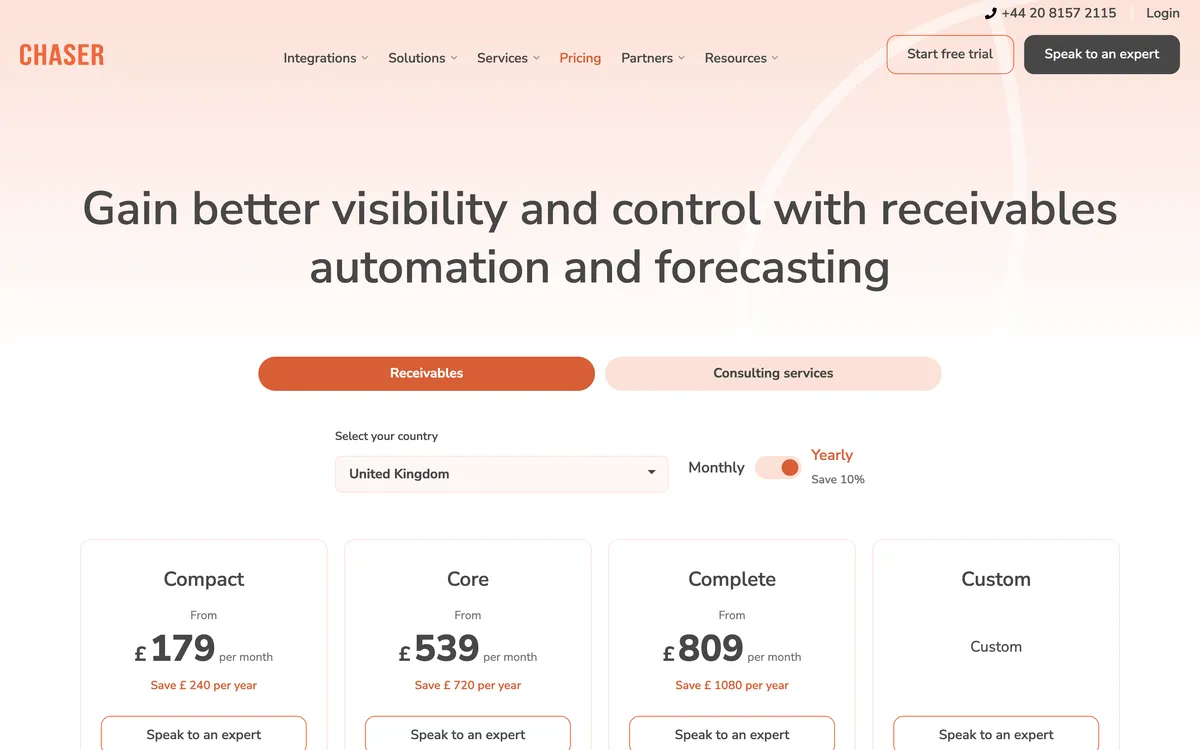
ezyCollect prices by active debtors, so the bill steps with the size of the ledger. Chaser prices by company turnover, so it steps with the size of the business whether the ledger grows or not. ezyCollect publishes in Australian dollars only. Chaser publishes in sterling. No conversion is applied anywhere on this page.
ezyCollect plans
| Plan | Monthly price | Includes | Setup |
|---|---|---|---|
| ezyStart | A$275 | 200 active debtors, 3 users, 1 workflow | A$900 |
| ezyGrow | A$950 | 500 active debtors, 5 users, 3 workflows | from A$3,900 |
| ezyScale | A$2,350 | 1,500 active debtors, 10 users, 5 workflows | from A$3,900 |
| ezyUltimate | Custom | 3,000 active debtors, 20 users, 10 workflows | from A$3,900 |
ezyCollect's last published prices are shown. Current prices are hidden and must be requested. Last published on ezyCollect's pricing page, seen on the Wayback Machine. Annual-billing rates in Australian dollars, ex GST. Month-to-month is about 20 percent higher, which puts ezyStart at about A$330. Credit monitoring covers 100, 200, 300 or a custom number of debtors; mail, SMS and fax are extra; the payment gateway is A$90 plus GST a month.
Chaser plans
| Plan | Monthly price | Includes | Setup |
|---|---|---|---|
| Compact | £199 | Turnover under £4m. 4 users, 30 templates, 4 schedules, 100 SMS and 100 call credits | None |
| Core | £599 | Turnover under £10m. Unlimited users, templates and schedules, 600 credits, multi-entity, call recording | None |
| Complete | £899 | Turnover to £100m. 1,200 credits, AR forecast, account manager | None |
| Custom | Quote | Above the Complete tier | None |
| Care | from £899 | Managed service bundled with the software (Compact + Care): follow-ups, phone calls and inbox management alongside the software | None |
Sterling, on the published monthly rates, with 10 percent off for annual billing. Add-ons: extra user £10, extra template or schedule £5 on Compact, AR forecast £9, separate Cash flow plan £29, letters £1.25 to £1.50 a credit, SMS £0.05 to £0.07, calls £0.08 per credit-minute, credit checks £2 to £3.
The first twelve months, priced
Change the figures below to match the quote you are given, because the advertised rate and the quoted rate are reported to differ.
On A$275 a month for 12 months plus a one-off A$900 setup fee, the subscription is A$3,300 and the first year costs A$4,200 in total, an effective A$350 a month.
Year one is the plan rate multiplied by the months, plus the one-off setup fee. ezyCollect's last published prices are shown. Current prices are hidden and must be requested. Last published on ezyCollect's pricing page, seen on the Wayback Machine.
Use A$330 as the monthly rate to price month-to-month billing, which runs about 20 percent above the annual rate. Mail, SMS, fax, demand letters at A$49 plus GST each and the A$90 plus GST monthly payment gateway sit outside this figure.
Chaser has no first-year step at all. There is no setup fee, annual billing takes 10 percent off, and the published £199 a month is what the first twelve months cost before credit checks and channel credits.
Set against ezyStart at A$275 a month plus a setup fee from A$900, the year-one cost is A$4,200 against Chaser's flat subscription with no setup fee, so compare year-one totals instead of headline rates.
Which credit control software fits your use case?
Where your customers are registered decides most of this. Your ledger, and whether you want the interest charge raised for you, decide the rest.
| Use case | Start with | Watch out |
|---|---|---|
| Customers registered in Australia or New Zealand | ezyCollect | Current prices are hidden and must be requested; last published at A$275 a month plus setup from A$900 |
| Customers registered in the UK or Ireland | Chaser | The Compact tier is capped at four users and turnover under £4m |
| Statutory interest raised for you and posted to Xero | Chaser | One set of rules, and no fee on payment-plan or partially paid invoices |
| MYOB, Pronto Xi, SAP Business One or Attaché | ezyCollect | Payment plans are a paid add-on |
| Sage 50, Sage 200, Sage Business Cloud Accounting or AccountsIQ | Chaser | The late fee posts as a ledger line item on Xero only |
| Customers registered outside Australia, New Zealand, the UK and Ireland | Chaser | It sells worldwide, but each credit check there costs four credits |
Common questions
Short answers on the bureau, the credit-check allowance, the interest charge and the first-year cost, each in the currency the vendor publishes. If Satago is also on the shortlist, see Chaser vs Satago.
Is ezyCollect or Chaser better?
The answer is set by where your customers are registered. Choose ezyCollect if you are an Australian or New Zealand wholesale, distribution or trade business that wants Experian credit data before extending terms.
Choose Chaser if you are a UK team that wants a Creditsafe file with Companies House filing and director data in the same tool that sends the chase.
Which credit bureau does each tool use?
ezyCollect uses Experian, through Credit Insights, blended with your own aged trial balance and payment terms. Chaser uses Creditsafe, presented as a report with a score, a recommended limit, a payment score, credit event history, Companies House filings and director data, plus monitoring.
How many credit checks does each plan include?
ezyCollect sizes Experian monitoring by debtor count, at 100, 200, 300 or a custom number of debtors. Chaser meters per check instead: one credit for a UK or Ireland check and four for anywhere else, with credits sold at £2 to £3 each, so screening continues and the bill grows.
How much do ezyCollect and Chaser cost?
ezyCollect's last published prices were A$275 a month for ezyStart at the annual-billing rate, with month-to-month about 20 percent higher, plus a one-off setup fee from A$900. Current prices are hidden and must be requested. Chaser is £199 a month on Compact, with no setup fee. Check current pricing with the vendor.
Which one applies late fees and statutory interest?
Chaser. It offers four calculation types including a UK Bank of England base rate type, recalculated daily, but as one set of late-fee rules, across the account or for selected debtors, not tied to schedules. It raises no fee on payment-plan or partially paid invoices.
ezyCollect documents no late fee or interest mechanic, so in Australia, where interest is a contract term rather than a statutory entitlement, the charge is raised outside the tool.
Do ezyCollect and Chaser integrate with Xero and QuickBooks?
Both connect to Xero and NetSuite. Chaser connects to QuickBooks Online; ezyCollect shows a QuickBooks logo on its homepage but no connector page. Only ezyCollect connects to MYOB, SAP Business One, Pronto Xi and Attaché. Only Chaser connects to Sage 50, Sage 200, Sage Business Cloud Accounting and AccountsIQ. Both connect to Sage Intacct and Dynamics 365 (Chaser's is Business Central). Confirm the exact ledger and edition you run before you commit.
How do ezyCollect and Chaser use AI?
ezyCollect sells an AI email template generator as a paid add-on. Chaser's automated calls are one-way: they announce themselves and cannot understand a reply.
To see where this tool sits in the wider market, the credit control software guide compares six tools on price, free trial, ledger and limits.
Alternatives
Best ezyCollect alternatives
Five ezyCollect alternatives for Australian businesses, compared.
Alternatives
Best Chaser alternatives
Six Chaser alternatives on enforcement, price and reviews.
Buyer’s guide
Best accounts receivable software in 2026
The pillar guide by business size and accounting system.
UK shortlist
Best credit control software UK
Six tools compared on statutory interest grain and published price.
Sources
12 sources, checked by Julie Turnbridge on November 3, 2026
- Xero Small Business Insights xero.com/au/resources/small-business-insights
- Xero Small Business Insights xero.com/uk/resources/small-business-insights
- Wayback Machine web.archive.org/web/20240617113004/https://ezycollect.io/...
- Xero App Store listing apps.xero.com/au/app/ezycollect
- G2 g2.com/products/ezycollect/reviews
- Capterra capterra.com/p/135729/ezyCollect
- Xero App Store listing apps.xero.com/uk/app/chaser
- G2 g2.com/products/chaser/reviews
- Capterra capterra.com/p/157101/CHASER
- Late Payment of Commercial Debts (Interest) Act 1998 legislation.gov.uk/ukpga/1998/20/contents
- Bank of England base rate bankofengland.co.uk/monetary-policy/the-interest-rate-ban...
- GOV.UK gov.uk/late-commercial-payments-interest-debt-recovery/ch...
Last updated October 19, 2026. Independent comparison; pricing and ratings from public sources and subject to change.