Chaser vs Kolleno: choose Chaser if you want a citable Creditsafe file and an automatic interest charge on a flat turnover price from £199 a month; choose Kolleno if an order-to-cash team on NetSuite or SAP needs bank-file cash application. Both sell credit risk as a headline capability and read it by opposite methods.
Kolleno runs a score of its own that updates continuously and moves the credit limit with it, from $650 per user a month.
The second difference is the shape of the bill. Chaser’s price answers to how large the business is and holds still when the team grows. Kolleno’s answers to how many people log in, with a minimum seat count on every tier, so three credit controllers cost three times the headline before anything is added.
A US small business waited 29.7 days to be paid and settled 8.6 days past due, on Xero’s latest US small business data; California is faster, at 25.6 days.
No average tells you which of your customers will be the slow one. That is the question both products on this page were built to answer, and they answer it by opposite methods.
What does credit control software do?
Credit control software automates the chase on unpaid invoices. Both tools here read open invoices from the ledger, send reminders by email and SMS, issue statements, run payment plans and a customer portal, and hold a credit score or credit file on each customer.
Each adds its own layer on top. Chaser adds a late fee on one set of rules, posted letters and automated calls. Kolleno adds cash application against emailed remittances and bank files, and an AI agent that works a collections policy.
What it is not:
- Not the ledger. Xero, QuickBooks Online, NetSuite or SAP holds the books. Chaser marks an invoice paid there, and Kolleno writes NetSuite multi-currency journals from its matches.
- Not a credit bureau. Chaser buys its file from Creditsafe, metered in credits. Kolleno feeds bureau data into a score it computes itself.
- Not a collection agency. Chaser offers a partner collections route next to its own chasing; the tool itself only reminds, charges and escalates.
- Not the bank. Payments land in your bank account, and the tool marks or matches them against invoices.
It sits between the ledger and the customer. Invoices and payments come in from the accounting system, and reminders, scores, charges and matches go back out, so the ledger stays the record of what is owed.
What sets the order
Four things separate the two tools, and credit risk is the first of them, because both vendors lead with it and neither means the same thing by it.
- How credit risk is read. A named bureau file you can cite, or a model score the vendor computes and keeps current.
- What the bill does as the team grows. A flat band set by turnover, or a per-seat rate with a seat minimum underneath it.
- What the vendor actually prints. A published figure, in the vendor’s own currency.
- How deep the verified review base runs. A score on its own proves little; the count and the platform go with it.
Chaser leads on the third and the fourth, at a printed £199 against $650 per user and 374 verified reviews on its largest platform against 117 on Kolleno’s.
Kolleno leads on ERP reach and on cash application, which Chaser does not match at any tier. On the first criterion neither is better: they are different instruments, and the two sections after the entries are about which one your situation calls for.
How do Chaser and Kolleno compare?
Three rows carry the purchase: credit risk data, billing model and cash application. The rest of the table is close enough that it will not decide anything.
Two phrases below are used in a fixed sense. “None found” means neither the vendor’s feature pages nor its help center document the capability either way, rather than that we asked and were told no.
Prices are each vendor’s own published from-price, in the currency the vendor prints. Check current pricing with the vendor.
 |
 |
|
|---|---|---|
| Best for | Credit teams wanting Creditsafe files and a base rate late fee | Order-to-cash teams on NetSuite or SAP needing cash application |
| Revenue fit | Compact under £4m, Core from £4m, Complete to £100m | Under £1m on BusinessPay, with tiers stepping at £1m, £100m and £1bn |
| Billing model | Flat monthly price set by company turnover band | Per user, per month, with a minimum seat count on every tier |
| From (monthly) | £199 | $650 per user |
| Ledger integrations | Xero, QuickBooks, Sage 50, Sage 200, Sage Intacct, Sage Business Cloud Accounting, NetSuite, Dynamics 365 Business Central, AccountsIQ, Odoo, SAP | NetSuite, SAP S/4HANA and Business One, Sage Intacct, Business Central, Workday, Oracle JD Edwards, Epicor, Infor, Odoo, Zuora, Xero, QuickBooks Online |
| Late fee grain | Yes (one set of late-fee rules, across the account or for selected debtors, not tied to schedules); four calculation types, including a Bank of England base rate type | None found |
| Credit risk data | Yes (Creditsafe report with a score and recommended limit, plus monitoring) | Yes (continuously updated AI credit scores, bureau integrations, auto-adjusting limits) |
| AI | Yes (insights and a copilot; AI agent support from Business Plus; fully automated agent runs and AP portal features are billed separately by token use) | |
| Cash application | Partial (auto-marks paid in Xero and QuickBooks Online, no bank-file matching) | Yes (remittance parsing, BAI2, NACHA and ISO 20022 bank files, match scoring; auto-reconciliation starts on Enterprise) |
| Statements | Yes (monthly only, on a fixed day) | Yes (in the customer portal) |
| Payment plans | Yes (weekly through yearly, chased on the invoice due date) | Yes (weekly, monthly or bi-monthly, with plan-linked automations) |
| SMS | Yes (credit-metered, alongside letters and automated calls) | Yes (100 to 600 included, by tier) |
| Rated | 4.98 from 374 on the Xero App Store, 4.3 from 71 on G2, 4.9 from 45 on Capterra | 4.9 from 117 on G2, 5.0 from 18 on the Xero App Store, 5.0 from 8 on Capterra |
1. Chaser
Best for: Teams that want bureau credit checks and a base rate late fee in the same tool, under £4m turnover on Compact.
What is Chaser best for?
For a finance team with a named credit controller that wants Creditsafe credit checks, email, SMS, letter and call chasing, and an automatic interest charge, all running from one system.
- Fits
- Businesses with a named credit controller; Compact is priced for turnover under £4m, Core from £4m, Complete to £100m
- Regions
- UK-registered, trading since 2014, sells worldwide
- Entry cost
- £199/mo on Compact for turnover under £4m with 4 users; Core £599/mo under £10m; Complete £899/mo to £100m; Chaser Care, the managed service sold bundled with the software, from £899/mo on Compact (£1,599 on Core, £2,099 on Complete). Check current pricing with the vendor.
- Rated
- 4.98 from 374 Xero App Store reviews; 4.3 from 71 on G2; 4.9 from 45 on Capterra, mostly 2020 to 2022
- Awards
- Finalist, UK Small Business App Partner of the Year, Xero Awards 2023
- Runs on
- Xero, QuickBooks, Sage 50, Sage 200, Sage Intacct, Sage Business Cloud Accounting, NetSuite, Dynamics 365 Business Central, AccountsIQ, Odoo, SAP, HubSpot, Gmail, Outlook
- Late fees and interest
- Yes. Four calculation types, including a Bank of England base rate type, recalculated daily, but one set of late-fee rules, across the account or for selected debtors, not tied to schedules, with no documented way to run different rules per group, and no fee is raised on payment-plan invoices. Chaser’s help says a late fee cannot be added or updated after a part payment when written to Xero
- Does best
- Creditsafe credit checking and monitoring in the same tool as email, SMS, letter and call chasing
Chaser sends from the credit controller’s own Gmail or Outlook mailbox rather than from a platform domain, so the chase arrives in the thread the customer already has and carries the sending reputation your business built rather than one shared with every other tenant.
SMS, letters, a payer portal and a partner collections route sit around that, metered as credits rather than bundled into the tier.
The credit check is bought from Creditsafe and opens inside the app instead of in a separate browser tab. What one check returns is set out in the Creditsafe section below, because the contents are the whole argument for buying Chaser over a tool that scores customers itself.
Chaser also raises the charge. Four calculation types are available, one of them tracks the Bank of England base rate and recalculates daily, and the result posts to Xero as an invoice line, which is how an overdue invoice here ends as money owed rather than as another email.
Limitations with Chaser. One set of late-fee rules, across the account or for selected debtors, not tied to schedules, with no documented way to run different rules per group, and no fee on payment-plan invoices. Chaser’s help says a late fee cannot be added or updated after a part payment when written to Xero. Statements go out monthly, on one fixed day. Compact stops at four users.
Payment plans split an invoice weekly through yearly, but the chasing follows the original invoice due date rather than the installment dates, and Chaser’s own documentation advises chasing the installments manually.
Cash application stops at marking the invoice paid in Xero or QuickBooks Online, with no bank-file matching. The price is set by company turnover rather than by invoice volume, and it does not move when a fifth person joins the team, which is where Kolleno’s meter starts.
Best suited for: A finance team with a named credit controller that wants Creditsafe checks, every chasing channel and an automatic interest charge, from £199 a month for turnover under £4m. The drawback is one set of late fee rules, monthly statements on a fixed day and no bank-file cash application.
2. Kolleno
Best for: Order-to-cash teams on NetSuite or SAP that need cash application and AI agents.
What is Kolleno best for?
For a NetSuite or SAP order-to-cash team that needs remittance parsing and bank-file cash application as well as reminders, and can absorb per-seat pricing.
- Fits
- Order-to-cash teams: BusinessPay for turnover under £1m, Business Plus £1m to £100m, Enterprise £100m to £1bn
- Regions
- London head office, founded 2020, selling internationally
- Entry cost
- $650 per user a month on BusinessPay, $545 on annual billing, minimum one user, for turnover under £1m; Business Plus $1,245 per user, $995 annual, minimum two users; Enterprise and Enterprise Plus are quoted.
- Rated
- 4.9 from 117 G2 reviews; 5.0 from 18 Xero App Store reviews; 5.0 from 8 on Capterra
- Contract terms
- Default 24-month term, renews for 12 months, 90 days’ notice, fees non-refundable
- Awards
- G2 Best Software Awards 2024
- Runs on
- NetSuite, SAP S/4HANA and Business One, Sage Intacct, Business Central, Workday, Oracle JD Edwards, Epicor, Infor, Odoo, Zuora, Xero, QuickBooks Online
- Late fees and interest
- None found. No feature page or help article documents a late fee or interest calculation
- Does best
- Cash application, with email remittance parsing, BAI2, NACHA and ISO 20022 bank files, match scoring and NetSuite multi-currency journal entries
Kolleno does not buy a credit report, it computes one. A score is held live on every customer, bureau feeds sit behind it rather than in front of it, and the credit limit moves as the score moves, so a limit agreed in January is not the limit in June unless the customer’s behavior stayed still.
Three AI layers run in the product, and most AI features are in the subscription. Insights predict payment likelihood and keep those scores current. A copilot drafts email, SMS and call scripts for a person to approve.
An agent works a collections policy on its own and adjusts credit limits as it goes. Kolleno lists AI agent support from Business Plus; fully automated agent runs and AP portal features are billed separately by token use. Workflows fire on triggers such as invoice created, an ERP payment or an email bounce, with conditional branches and run-hour restrictions.
Sending is platform-side rather than mailbox-side. That buys one consistent voice across a team of any size, and gives up the individual controller’s own thread with the customer, which is the trade Chaser makes in the other direction.
Limitations with Kolleno. $650 per user a month on BusinessPay, a tier for turnover under £1m that leaves out workflow automation, puts Kolleno above the budget of a smaller finance team, and the second tier nearly doubles that before the minimum seat count is applied.
No late fee or interest function is documented anywhere in its materials, so an interest charge stays a manual job or a ledger job. Kolleno includes 100 to 600 calls a plan. Its pricing page does not say which actions a workflow can hold. Payment plans split evenly, and an uneven total has to be split manually.
Reviewers return to navigation and to the depth of the reporting, and describe the mobile app as basic. Kolleno's terms set a default 24-month term, renewing for 12 months, with 90 days' notice and non-refundable fees.
Best suited for: An order-to-cash team on NetSuite or SAP that needs remittance parsing and bank-file cash application as well as reminders. The drawback is per-seat pricing from $650 a user a month, with no late fee or interest function documented.
How do Chaser and Kolleno read credit risk?
Chaser hands you a document. Kolleno hands you a number. A buyer who reads those as the same feature will pick the wrong one.
A bureau file is factual and late. Accounts are filed months after the period they cover, a director change is recorded once it has been registered, and a credit event appears after it has happened.
What the file gives you is evidence: something you can put in front of an auditor, a credit insurer or a board that wants to know why the account was opened at that limit.
A model score is current and inferred. Kolleno’s score moves with the behavior it observes and drags the credit limit along behind it, so a customer who has quietly slipped from paying at day 30 to paying at day 55 is downgraded long before anything is filed anywhere.
What the score cannot give you is a source. It is the vendor’s well-informed opinion, and it is not a document.
The working split: a filing decides whether to open the account, and a model decides whether to leave it open at the same limit next quarter.
Risk and enforcement part company at the same point. Chaser can turn a slow payer into a charge, on one set of late-fee rules with four calculation types including a Bank of England base rate type recalculated daily.
Kolleno documents no fee of any kind, so its answer to a customer who pays late is to score them lower and work the account harder.
One set of late-fee rules (Chaser)
- Four calculation types, including a base rate type
- Recalculated daily
- One set of late-fee rules, across the account or for selected debtors, not tied to schedules
- Nothing raised on plan invoices
- No late fee added or updated after a part payment written to Xero
No fee mechanic (Kolleno)
- No feature page or help article documents one
- Interest stays a manual or ledger job
- Nothing to waive in exchange for payment
- Credit risk is scored, not charged
What each product does once the risk has turned into an overdue invoice. Chaser converts it into a charge on one set of late-fee rules. Kolleno scores the customer down and works the account harder, and raises nothing.
What does a Creditsafe report contain?
The credit check is metered, so it is worth knowing exactly what one credit buys before the feature is priced into the decision.
- A credit score with a recommended limit, which is the figure a controller sets terms against rather than guessing at.
- The customer’s own payment score, built from how it settles its other suppliers as well as how it settles you.
- Credit event history, so a recent judgment or a registered charge is visible before the goods go out.
- Companies House filing and director data, including who signs the accounts and whether they were filed late.
- Continuous monitoring, so the file is watched for as long as the account stays open. Monitoring covers fewer countries than reports: the UK, USA and Canada, not Australia.
Checks are metered in credits. A check on a UK or Ireland registration costs one credit, and a check anywhere else costs four, with credits sold at £2 to £3 each. That prices the feature comfortably for a UK ledger and prices it awkwardly for a debtor book spread across Europe. Credit checks are sold by credit on any plan and need Chaser billing, not Xero App Store billing.
Kolleno buys nothing you can name. Bureau integrations feed its own score, no per-check meter is published, and what comes out is always current and never citable. On an account you have to justify to a credit insurer or to a board, that is the difference the two methods make.
What does a team of three cost in Chaser and Kolleno?
The two meters run in opposite directions. Chaser’s bill answers to how large the business is. Kolleno’s answers to how many people sign in.
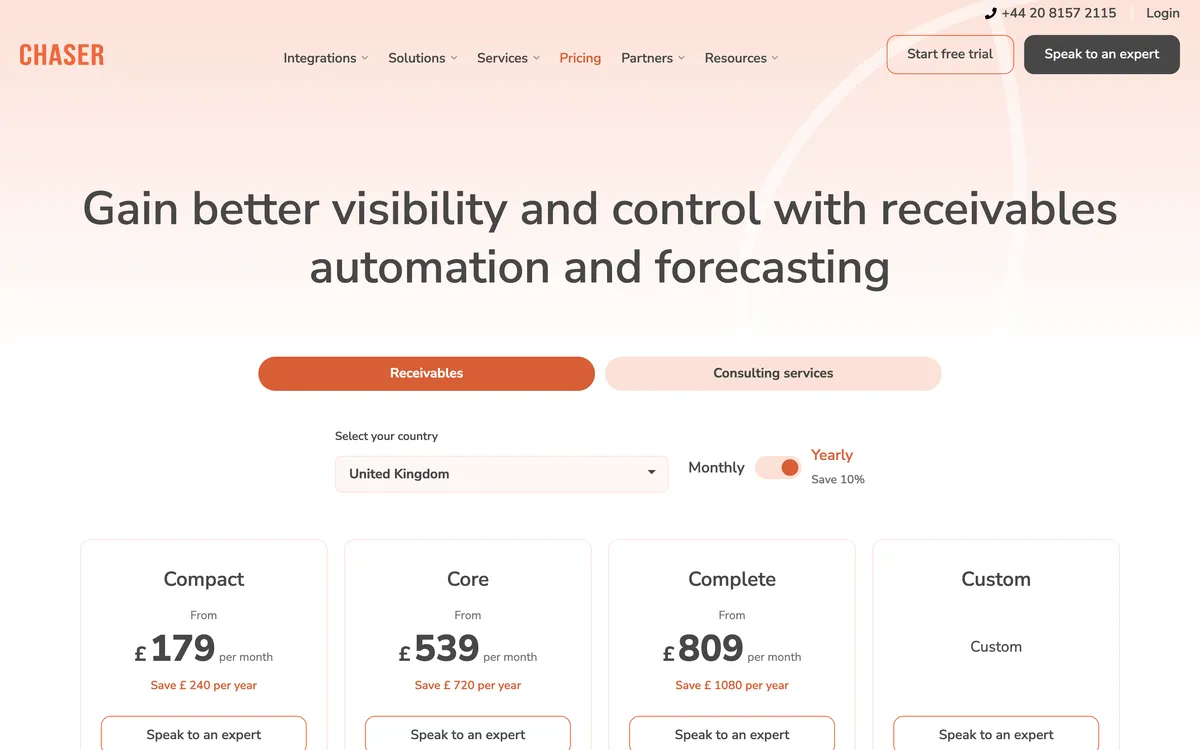
Chaser’s Compact tier is £199 a month for turnover under £4m and includes four users, with a fifth at £10 a month. Core is £599 under £10m with unlimited users, templates and schedules, multi-entity and call recording. Complete is £899 to £100m. A credit control team that doubles in size changes nothing on the invoice.
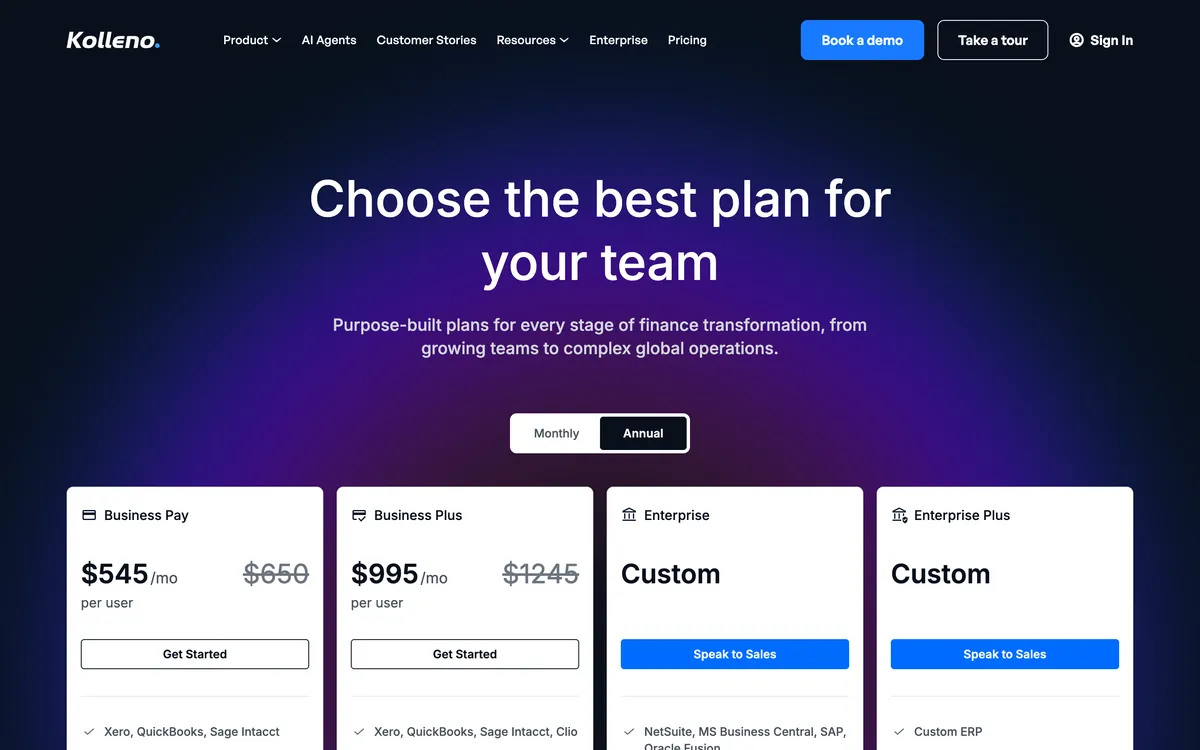
Kolleno’s BusinessPay is $650 per user a month, or $545 on annual billing, minimum one user, for turnover under £1m. Three controllers is $1,950 a month at the monthly rate before a single add-on. Business Plus is $1,245 per user, $995 annual, and starts at two seats, so its real floor is $2,490 a month rather than $1,245.
Treat this as a hiring decision first. A team that plans to add people to collections is charged for the plan by the per-seat meter. A team that plans to hold headcount and grow revenue is charged for that instead by the turnover band.
Both meters have a second layer. Chaser charges the channels on top: SMS at 5p to 7p, letters £1.25 to £1.50, calls 8p a credit-minute, credit checks £2 to £3, the receivables forecast £9 a month and the separate Cash flow plan £29.
Kolleno’s own pricing page prints a per-user rate with seat minimums that rise by plan, so the bill grows with the size of the AR team.
Which tool handles cash application?
This is the row where the two products are not close. Chaser marks the invoice paid. Kolleno matches the money.
Auto-reconciliation starts on Kolleno’s Enterprise tier. Kolleno parses remittance emails into suggested matches, connects to banks over SFTP, reads BAI2, NACHA and ISO 20022 files, scores every match, and handles one-to-many, partials, credit-note offsets, foreign exchange differences and bank fees. BusinessPay at $650 per user a month does not include auto-reconciliation. Xero and QuickBooks connect on BusinessPay and Business Plus; NetSuite and SAP start on Enterprise. On NetSuite it writes the multi-currency journal entries that fall out of the match.
Chaser’s equivalent is to auto-mark an invoice paid in Xero or QuickBooks Online. That closes the chase, which is what a reminder tool needs it to do, and it will not reconcile one lump payment against eleven invoices.
The test is what lands in your bank account. Payments arriving one invoice at a time with a reference attached are handled by marking. Payments arriving in batches, across currencies, with the remittance advice inside a PDF, are the job itself, and only one of these two products does that job.
That is also why the integration lists diverge. Kolleno reaches SAP S/4HANA and Business One, Workday, Oracle JD Edwards, Infor and Zuora. Chaser reaches Sage 50, Sage 200, Sage Business Cloud Accounting and AccountsIQ.
Xero, QuickBooks Online, Sage Intacct, NetSuite and Business Central run both, so for most Xero and QuickBooks teams the ledger row decides nothing and the three rows above it decide everything.
Which credit control software fits your use case?
Pick the row that matches the job in front of you. Each names the tool on this page that does that job and the reason from the sections above.
| Use case | Start with | Why |
|---|---|---|
| Opening accounts you must justify to an auditor or credit insurer | Chaser | A Creditsafe file with Companies House filings, directors and credit events gives the decision a source |
| Watching open accounts for slipping payment behavior | Kolleno | Its score updates continuously and moves the credit limit with it |
| Charging interest automatically on overdue invoices | Chaser | Four calculation types, including a Bank of England base rate type, on one set of late-fee rules |
| Batch payments, PDF remittances and several currencies | Kolleno | Remittance parsing, BAI2, NACHA and ISO 20022 files, match scoring and NetSuite journals |
| A team that plans to add collectors | Chaser | The price is set by turnover band; Compact includes four users and Core is unlimited |
| A ledger on Workday, Oracle JD Edwards or Infor | Kolleno | Chaser does not list these ledgers |
Common questions
If Satago is also on the shortlist, see Chaser vs Satago.
Is Chaser or Kolleno better?
They fit different teams. Choose Chaser if you want a citable bureau file and an automatic interest charge on a flat price from £199 a month. Choose Kolleno if you run an order-to-cash team on NetSuite or SAP that needs bank-file cash application and AI agents, from $650 per user a month.
Whose credit data can I show to an auditor?
Chaser’s. The report is a Creditsafe file, and it carries filed Companies House data, directors, credit events, a payment score and a recommended limit, so the decision has a source behind it. Kolleno’s score is computed by Kolleno from bureau feeds and behavioural data, which makes it current but leaves nothing to attach to a credit paper.
What does a credit check cost in each tool?
Chaser meters them: one credit for a UK or Ireland check and four for anywhere else, with credits sold at £2 to £3. Kolleno publishes no per-check price, because scoring is part of the platform rather than a metered lookup.
How much do Chaser and Kolleno cost for a team of three?
Chaser’s Compact tier is £199 a month whether the team is one person or four, with a fifth user at £10. Kolleno’s BusinessPay is $650 per user a month, so three seats is $1,950 a month, or $1,635 at the $545 annual rate. Business Plus is $1,245 per user with a two-seat minimum.
Which one charges late fees and statutory interest automatically?
Chaser. It offers four calculation types, including a Bank of England base rate type, recalculated daily, applied as one set of late-fee rules, across the account or for selected debtors. Kolleno documents no late fee or interest feature in its public materials, so the charge stays a manual job or an ERP job.
Do Chaser and Kolleno integrate with Xero and QuickBooks?
Both do. Chaser also reaches Sage 50, Sage 200, Sage Business Cloud Accounting, Sage Intacct, NetSuite, Dynamics 365 Business Central, AccountsIQ, Odoo and SAP; Kolleno reaches NetSuite, SAP S/4HANA and Business One, Sage Intacct, Business Central, Workday, Oracle JD Edwards, Epicor, Infor, Odoo and Zuora. Check that the exact ledger you run is on the list before committing.
Which one is stronger on cash application?
Kolleno, by a wide margin. It parses remittance emails into suggested matches, connects to banks over SFTP, reads BAI2, NACHA and ISO 20022 files, scores matches, handles one-to-many matching, partials, credit-note offsets, foreign exchange differences and bank fees, and writes NetSuite multi-currency journal entries. Chaser marks the invoice paid in Xero or QuickBooks Online and stops there.
To see where this tool sits in the wider market, the credit control software guide compares six tools on price, free trial, ledger and limits.
Alternatives
Best Chaser alternatives
Six Chaser alternatives on enforcement, price and reviews.
Alternatives
Best Kolleno alternatives
Five Kolleno alternatives compared by business type.
Buyer's guide
Best AR automation software
The category compared on enforcement, price and verified reviews.
Late fees
How much can I charge in late fees?
What a late fee can legally be, and how to set the rate.
Sources
7 sources, checked by Julie Turnbridge on November 3, 2026
- Xero’s latest US small business data xero.com/us/resources/small-business-insights
- Xero App Store apps.xero.com/uk/app/chaser
- G2 g2.com/products/chaser/reviews
- Capterra capterra.com/p/157101/CHASER/reviews
- G2 g2.com/products/kolleno/reviews
- Xero App Store apps.xero.com/uk/app/kolleno
- Capterra capterra.co.uk/software/227932/Kolleno